 Fastero Dev Team
Datalore is JetBrains' online notebook: Jupyter-compatible notebooks in the browser, with SQL cells, interactive reports, scheduled runs and machines up to multi-GPU, sold as a hosted Cloud service or a self-hosted On-Premises version. JetBrains did retire a data science product in 2026, which is why people ask whether Datalore is going away. It was DataSpell, the desktop IDE.
The short answer: Datalore is not discontinued. As of 12 November 2026, JetBrains' plans page lists Cloud Free and Cloud as current, the store sells the Cloud plan at $35 per user a month, or $29.17 a month billed yearly, and version 2026.4.1 is the latest release, with no end-of-sale notice on any JetBrains page we read. Cloud Free includes 120 hours a month on a small machine (2 vCPUs, 4 GB), 10 GB of storage, two notebooks running at once and one interactive report, but no scheduled runs and no paid machines. Cloud adds 750 hours a month on a larger machine (4 vCPUs, 16 GB) per user, 6 credits a month for GPUs, unlimited schedules and reports, and Datalore AI. On-Premises is priced on request. The JetBrains product that is being retired is DataSpell, which stopped being sold on 28 May 2026 and moved eligible subscriptions to PyCharm Pro.
Fastero
Jupyter notebooks for your team, with nothing to install.
Start a notebook or bring your .ipynb files. SQL cells query your databases with no password in the code, and a notebook runs now or on a schedule. Colleagues open it with their own login; viewers are free.
Try free →Is Datalore discontinued?
No. Here is what JetBrains' own pages showed on 12 November 2026:
| Check | What we found |
|---|---|
| Plans page in the help | "Currently, Datalore offers the following plans": Cloud Free and Cloud, page dated 7 May 2026, in the Datalore 2026.4 help |
| Store | Datalore Cloud for sale, monthly or yearly; Cloud Free sign-up open; a 14-day Cloud trial offered |
| Releases | 2026.1 through 2026.4.1 listed in What's new; the 2026.1 post says its updates "are already available to Datalore Cloud users" |
| Notices | No end-of-sale, shutdown or on-premises-only notice on the pages we read |
The retirement news is about DataSpell, JetBrains' desktop IDE for notebooks. Its blog post says: "May 28, 2026: DataSpell will be deprecated as a standalone product, meaning it will no longer be possible to purchase new DataSpell subscriptions." Eligible subscriptions became PyCharm Pro on 1 September 2026, and "The final release of DataSpell will be 2026.1." If you used DataSpell, JetBrains points you to PyCharm Pro for notebooks, or DataGrip for databases. If you use Datalore, nothing has changed.
Datalore plans and prices
From JetBrains' Datalore pricing page and help, checked 12 November 2026:
| Cloud Free | Cloud | On-Premises | |
|---|---|---|---|
| Price | Free | $35 per user a month, or $29.17 a month billed yearly | "Custom pricing" |
| Hosting | JetBrains | JetBrains | Your servers, or a dedicated instance JetBrains manages |
| Included machine time | 120 hours a month on CPU S (2 vCPUs, 4 GB) | 750 hours a month on CPU L (4 vCPUs, 16 GB) per user | Your own resources |
| Credits for bigger machines and GPUs | None | 6 per user a month | Your own resources |
| Storage | 10 GB | 20 GB per user, plus cloud storage connections | Your own |
| Notebooks running at once | 2 | Unlimited | Unlimited |
| Interactive reports | 1 (static reports unlimited) | Unlimited | Unlimited |
| Shareable workspaces | 1 | Unlimited | Unlimited |
| Scheduled notebooks | None | Unlimited | Unlimited |
| Export formats | ipynb | ipynb, zip, py, html, pdf | ipynb, zip, py, html, pdf |
| Datalore AI | No | Yes | Yes |
| Free viewers | Through a public report link | Through a public report link | Viewer accounts, free and unlimited |
The page notes that taxes may be added and that "Prices shown are approximate"; a visitor from Portugal is shown the same plan at €35, or €29.17 billed yearly. Datalore is licensed per editor: "One license grants one seat, which is a slot used to register one editor user." The Cloud trial lasts 14 days for up to three people, with Cloud Free's machine allowance, no credits and at most two scheduled runs, at least 24 hours apart.
What Datalore's Cloud Free plan can't do
- Run on a schedule. Datalore's scheduling help says plainly that scheduling isn't available on Cloud Free.
- Use bigger machines or GPUs. Credits pay for every machine beyond the included one, and "Datalore credits are not available to Cloud Free or Cloud trial plan users."
- Edit what others share. "Cloud Free users cannot edit notebooks or workspaces shared with them even if edit access was granted."
- Run for long unattended. A Cloud Free machine keeps running "for up to 6 hours after the tab is closed", by the help. The pricing page lists background computation under Cloud only, so expect a limit.
- Publish more than one interactive report, share more than one workspace, or export anything but
.ipynb.
JetBrains' pages disagree on one point: the help's plans table lists "Unlimited notebooks with real-time collaboration" under Cloud Free, while the pricing page lists real-time collaboration among the things Cloud adds. Test it with a colleague before relying on it.
What Datalore does well
SQL cells. A SQL cell queries an attached database, a DataFrame or an attached CSV file, and "The result set will be shown in the output and saved to a DataFrame", ready for the Python cell below. Completion comes from the database schema. The supported list has 52 entries, some of them driver variants, among them PostgreSQL, MySQL, SQL Server, Oracle, Snowflake, BigQuery, Redshift, Databricks, ClickHouse and DuckDB. More on the pattern in SQL in a Jupyter notebook.
Reports. You publish a notebook's results as a static or interactive report, choose which cells show, share it by email or public link, group reports into collections, and let readers comment or download a PDF. Interactive reports can be recalculated with inputs such as dropdowns and date pickers.
Scheduling. On Cloud, a notebook can run hourly, daily, weekly or monthly, or on a cron expression, with several schedules per notebook, and email notifications can link to each run's results.
The rest. Reactive mode reruns dependent cells when one changes, notebooks run Python, R, Scala or Kotlin, a terminal is built in, and in 2026 JetBrains added an agent skill and API so AI agents can work with Datalore notebooks.
Datalore machines and GPU prices
On Cloud, machines beyond the included one are paid in credits, and "One Datalore credit equals 1 USD / 1 Euro." Each run starts a new AWS machine, a cheaper spot machine by default.
| Machine | RAM | vCPUs | GPUs | Spot, credits an hour | On-demand, credits an hour |
|---|---|---|---|---|---|
| CPU S | 4 GB | 2 | none | 0.08 | 0.11 |
| CPU L | 16 GB | 4 | none | 0.2 | 0.45 |
| CPU XL | 32 GB | 16 | none | 0.88 | 1.79 |
| GPU S | 16 GB | 4 | 1 | 1.1 | 2.25 |
| GPU L | 64 GB | 16 | 1 | 1.35 | 3.63 |
| GPU XXL | 256 GB | 64 | 1 | 3.7 | 9.15 |
| Multi-GPU L | 768 GB | 192 | 8 | 14.3 | 36.3 |
A selection from JetBrains' machine list, checked 12 November 2026; the help doesn't name the GPU model. So the 6 monthly credits buy about five and a half hours on GPU S at spot prices. Datalore is a notebook platform with GPUs available, not a cheap source of GPU time: for that, see Kaggle Notebooks and our Colab alternatives.
Jupyter notebooks for your team.
Start free →Datalore alternatives
| Tool | Free tier | Paid from | Pick it when |
|---|---|---|---|
| Datalore Cloud | 120 CPU hours a month, 10 GB | $29.17 per user a month billed yearly | You want SQL cells, interactive reports and schedules from JetBrains, or the On-Premises version |
| CoCalc | 2 GB RAM, 4 GB disk per project, no internet | $6 a month billed yearly | People must edit the same notebook or LaTeX file at once, as in a course |
| Kaggle Notebooks | GPUs, "30 hours or sometimes higher" a week | Free | Free GPU training on public data |
| Lightning AI Studios | One free CPU Studio, up to 30 credits | Pro $20 a month billed yearly | A persistent cloud machine with GPUs by the second |
| Fastero | Free plan with no end date, schedules included | Pro $20 per editor a month | A team's notebooks on company data, scheduled, with free viewers |
Vendor pages checked 12 November 2026. Our comparison of Hex and Deepnote covers two more team notebooks.
Pick Datalore when you want JetBrains' editor, SQL cells across many database types, interactive reports with inputs, R or Kotlin beside Python, or a self-hosted version your IT team can run. Look elsewhere if you need schedules without paying (Cloud Free has none), free GPU hours, or a free tier that lets people edit together.
When the notebook is for a team
Fastero is an AI and data platform where people and AI agents work together on a team's data. Its notebooks cover the same everyday job as Datalore's SQL cells and schedules, and include schedules on the Free plan. It runs Python notebooks, with no GPUs and no interactive report builder.
- SQL cells query a workspace connection with its stored credentials and hand the result to Python as a pandas DataFrame, so no password sits in the notebook.
- Schedules: run a notebook now, or on any cron schedule, on the Free plan.
- Secrets reach cells as environment variables, in interactive and scheduled runs alike.
- Sharing: colleagues sign in to open it; viewers are free and can read without running or changing it. Promote to App turns a notebook into an app behind the same login.
- Results on a dashboard: a SQL cell's result can become a dashboard widget that refreshes when the notebook runs, and Claude can create, write and run notebooks through Fastero's connector.
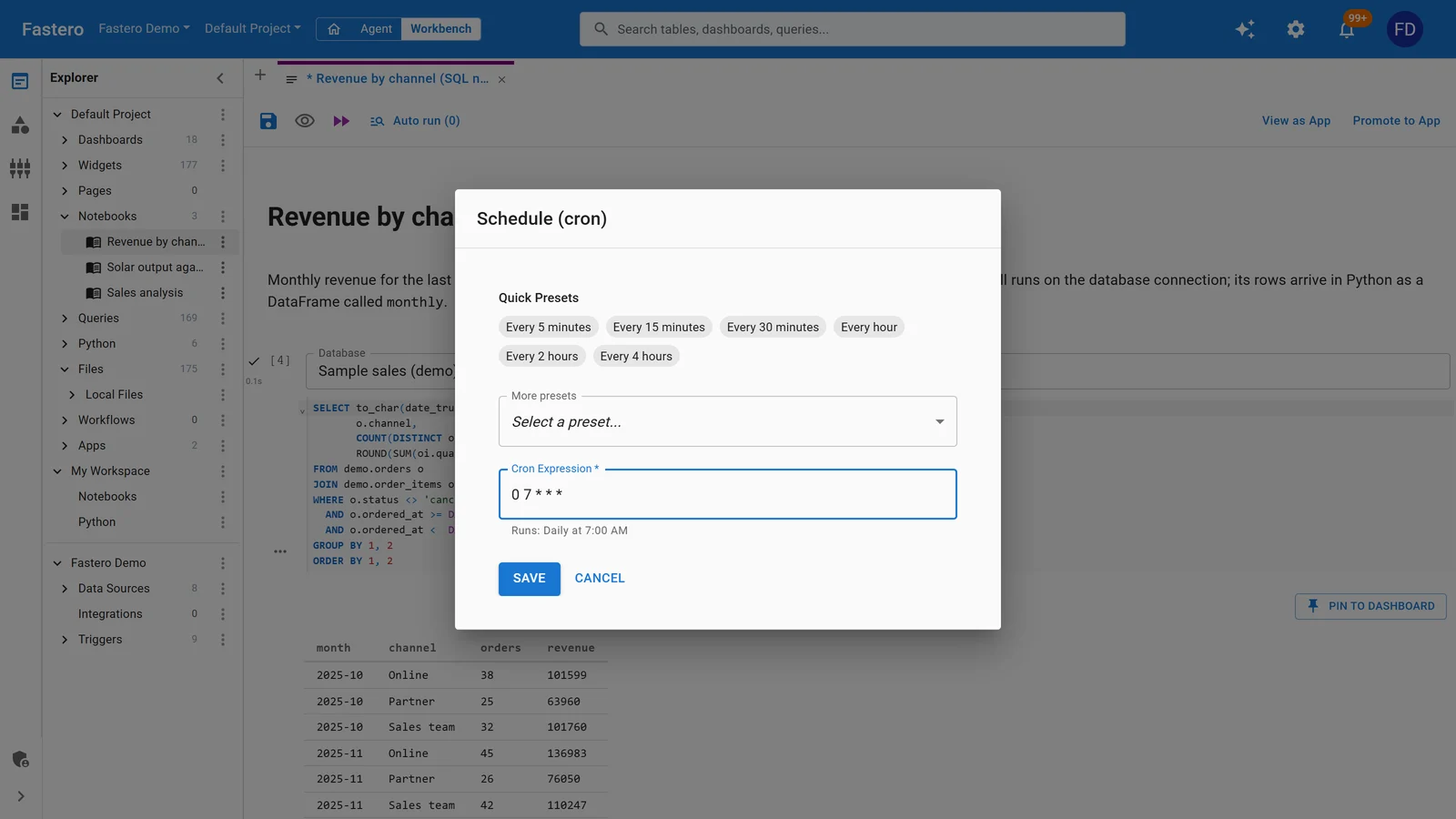
Scheduling a notebook in Fastero: presets or any cron expression. Sample data.
Fastero's Free plan has no end date, and Pro is $20 per editor a month. More on scheduling a Jupyter notebook and sharing one with your team.
FAQ
Is JetBrains Datalore discontinued?
No. As of 12 November 2026 JetBrains sells the Cloud plan, offers Cloud Free and a 14-day trial, and shipped Datalore 2026.4.1. The product JetBrains retired is DataSpell, its desktop IDE, which stopped being sold on 28 May 2026.
Is Datalore free?
Cloud Free is: 120 machine hours a month on a 2 vCPU, 4 GB machine, 10 GB of storage, two notebooks running at once and one interactive report. It has no scheduled runs, no GPUs and no Datalore AI.
How much does Datalore cost?
The Cloud plan is $35 per user a month, or $29.17 a month billed yearly, as of 12 November 2026, before tax. On-Premises is priced on request.
Does Datalore have GPUs?
On the Cloud plan, yes, paid with Datalore credits: 6 come with each user's plan every month, and more can be bought. GPU machines start at 1.07 credits an hour on spot machines. Cloud Free users can't buy credits.
Can I schedule notebooks in Datalore?
On the Cloud plan, hourly, daily, weekly, monthly or with a cron expression. Cloud Free has no scheduling, and the trial allows two schedules at least 24 hours apart.
What's the difference between Datalore and DataSpell?
Datalore is an online notebook platform, hosted by JetBrains or installed on your servers. DataSpell was a desktop IDE for data science; its final release is 2026.1, and eligible subscriptions became PyCharm Pro on 1 September 2026.
Can I self-host Datalore?
Yes. Datalore On-Premises runs on Kubernetes with Helm or in Docker, or as a dedicated instance JetBrains manages, with SSO, audit logs and free viewers. Pricing is on request.
Sources
Read on 12 November 2026:
- JetBrains Datalore: Pricing, Datalore plans, Cloud plan, Sign up for Cloud trial, Licensing considerations, What's new, Query data with SQL cells, Supported databases, Schedule notebook runs, Deliver results, Choose CPU and GPU machines, Computation modes, Use Datalore credits, Overview of features, Datalore blog
- JetBrains: The upcoming sunset of DataSpell
- Other tools: CoCalc pricing, Kaggle efficient GPU usage, Lightning AI pricing