 Fastero Dev Team
Claude Dashboards, the feature that turns a question about your warehouse into a dashboard, was renamed Claude Data on 10 November 2026 and is no longer in beta. Dashboards you already made keep working. The new name covers more than dashboards: data stories, short narrated videos and written summaries come from the same template.
The short answer: Claude Data writes one SQL query per chart and runs it against a connected data source: a warehouse such as Amazon Redshift, BigQuery, ClickHouse, Databricks or Snowflake, or another app you've connected, such as Salesforce. Each chart shows its query and when its data was last refreshed. It's on Pro, Max, Ultra, Team and Enterprise, not Free, and counts toward your plan's usage limits. It "doesn't refresh on a schedule": a dashboard re-queries when someone opens it and its data is due for a refresh. Dashboards start private and are shared like any artifact, with each viewer using their own connections unless live sharing (beta) is on. For a dashboard on your own Postgres or MySQL database that refreshes on a timer and arrives by email, use a tool built for that job.
Fastero
Connect your database. Ask questions. Get dashboards.
Postgres, BigQuery, Snowflake, and 10+ sources — live-connected, AI-powered, no dashboard builder learning curve.
Try free →What changed when Claude Dashboards became Claude Data
| Claude Dashboards (8 October 2026) | Claude Data (10 November 2026) | |
|---|---|---|
| Status | Beta on paid plans | Generally available; certified queries and live sharing in beta |
| What it makes | Dashboards | Dashboards, scrolling data stories, narrated short videos and written summaries |
| Loading | "every dashboard would reload on every load" | Cached, with a refresh cadence set per dashboard |
| Trust | Each chart shows its query | Plus certified queries with a badge |
| Sharing | Viewers use their own connections | Plus live sharing from the owner's connection, inside the organization |
| History | Tracked changes and version history, with restore | |
| Enterprise default | Off until an admin turned it on | On by default from 19 November 2026, unless an owner already saved a setting |
Anthropic's reason for the rename: "the way companies use their data is broader than dashboards". Design systems now work in Claude Data too.
What Claude Data builds, and how you ask for it
Ask in any chat, or open the Artifacts tab, choose Data and describe what you want. Anthropic's own examples:
Build a dashboard of this quarter's revenue by region.
Show weekly signups for the last six months, split by plan.
Turn this quarter's revenue numbers into a data story.
Its advice is to "Say what you want to know, not just what to chart", and to name the table or app when you know where the data lives. Besides dashboards, Claude Data offers three formats: a Scrollyteller ("Scrolling stories built from your numbers"), a Visual short (a short video that walks through the numbers) and a Visual analysis (a written summary).
You refine the result by asking Claude ("Add a filter for region"), by editing a title, caption or chart yourself, or by opening a chart's query. Version history keeps every version, and Restore brings one back for everyone. Everything is saved in the Artifacts tab.
Anthropic positions it narrowly: dashboards "are made for quick, exploratory questions, like how this week's signups compare with last month's." For deeper analysis you send the dashboard to a partner tool such as Amplitude, Mixpanel, Omni, PostHog, Sigma or ThoughtSpot.
Which plans include Claude Data
Checked 12 November 2026. US prices before tax.
| Plan | Claude Data | Price | Notes |
|---|---|---|---|
| Free | No | $0 | Ordinary artifacts only |
| Pro | Yes | $17 a month billed annually, $20 monthly | |
| Max | Yes | $100 a month | |
| Ultra | Yes | $200 a month | |
| Team | Yes | $20 a seat annually, $25 monthly (Standard) | On by default, both betas on |
| Enterprise | Yes | $20 a seat a month annually, plus usage at API rates | On by default from 19 November 2026; betas off by default; owners can limit it to groups with custom roles |
There's no separate charge: "Claude Data counts toward your plan's usage limits, like the rest of your work with Claude." Owners manage it under Organization settings > Artifacts. Seats are compared in Claude Team plan.
Which data sources Claude Data can query
Claude Data "needs a data connector, such as a warehouse or CRM". Anthropic's help names two kinds:
- A data warehouse: "such as Amazon Redshift, BigQuery, ClickHouse, Databricks, or Snowflake".
- Other apps you've connected to Claude: the example is a dashboard of your Salesforce opportunities.
Those are examples, not a closed list, but none of Anthropic's Claude Data pages mention Postgres, MySQL or SQL Server, or say whether a connector to one works with the template. For a spreadsheet, an ordinary artifact from the uploaded file is the route, as a snapshot.
Certified queries can also come from definitions your team already keeps "in dbt, Looker, or Cube (via existing MCP connectors)".
How a chart's SQL is written and shown
"Claude writes a SQL query for each chart and runs it against your data source." Every chart shows that query and when its data was last refreshed. Click a number to see the query behind it, or ask Claude to explain it. If the query isn't counting what you meant, tell Claude what to change.
Certified queries (beta) are "the official queries your data team has approved". Claude reuses them when it builds new dashboards, and charts built on them carry a badge. To certify one, open a chart's query, turn on Certify query, add any instructions for Claude, click Test, then Publish. Three rules worth knowing:
- "Anyone with write access to a Data artifact can certify."
- "Editing a certified query removes its certification."
- An organization can keep certified queries in a Git-backed plugin and review changes as pull requests in GitHub. The admin picks "the marketplace and plugin that store your certified queries", which is the same plugin system covered in how Claude's marketplaces work.
Does Claude Data refresh automatically?
Only when someone looks. Anthropic's help: "Claude refreshes a dashboard's data when someone opens it and the data is due for a refresh. It doesn't refresh on a schedule". The launch post adds that dashboards now cache results, and "refresh cadences can be set on a per-dashboard basis."
Read together, a dashboard re-runs its queries when it's opened and its cached results are older than that dashboard's cadence. If nobody opens it, nothing runs.
| What happens | Claude Data |
|---|---|
| Someone opens it and the data is due | Re-queries the source |
| Someone opens it within the cadence | Shows cached results |
| Nobody opens it | Nothing runs |
| The data changes in the warehouse | Not described in Anthropic's help |
| Sent by email or Slack on a schedule | Not described in Anthropic's help |
The wording has shifted. The October launch post said Claude "keeps it current as the data changes"; the current help page is more specific and says it doesn't refresh on a schedule. Go by the help page. To put Claude itself on a timer, a separate feature, see Claude scheduled tasks.
Who can open a Claude Data dashboard
"Everything you make in Claude Data starts private to you." To share, open it and click Share.
| Plan | Who you can share with |
|---|---|
| Pro, Max, Ultra | "Only you" or "Anyone with the link"; specific people by email invitation (beta) |
| Team, Enterprise | People you invite, everyone in your organization, or anyone with the link if an Owner has turned on external sharing |
Access levels are Can view, Commenter and Can edit. "People with view-only access can't edit a dashboard or restore a version."
What a viewer sees depends on whose connection runs the queries:
- Without live sharing, "a shared dashboard loads its data with each person's own connections". Someone without access to that warehouse sees an error in place of your data.
- With live sharing (beta), people in your organization see results from your connection, limited to "the exact queries the dashboard needs", which can't change without an editor's approval. Anthropic's warning: "Anyone you share the dashboard with sees those results, even if they don't have access to that source."
- Outside your organization, Anthropic's sharing help says people who open a link from outside, or without signing in, see an artifact "but the parts that use connected apps or Claude don't work for them". Live sharing covers only your organization, so check what an outside viewer sees before you send a link.
More on links, invitations and owners' controls in how sharing a Claude artifact works.
Connect any database. Ask in plain English.
Start free →Limits worth knowing
Checked 12 November 2026.
- Usage: every dashboard draws on your plan's usage limits; on usage-based Enterprise plans, tokens are billed at API rates.
- Invitations: up to 50 people from outside your organization per artifact; pending invitations expire after 30 days.
- Phones: you can't change sharing settings in the iOS or Android app.
- Regulated data: on HIPAA-ready plans, Dashboards "aren't covered under your Business Associate Agreement (BAA)".
- Audit: the Compliance API records when Data artifacts are created, viewed, edited or deleted, but not their content.
Claude Data vs artifacts vs the other Claude dashboards
| Data comes from | Refresh | Who sees what | |
|---|---|---|---|
| Artifact from an uploaded file | The file | Never: a snapshot | Everyone sees the same snapshot |
| Artifact on connected apps | Each viewer's connectors | When it loads, or on an interval | Each viewer sees their own data |
| Claude Data | A warehouse or connected app, one SQL query per chart | On open, when the cached data is due | Viewer's own connection, or the owner's with live sharing |
Claude Data is the one that shows its SQL and lets a data team certify the numbers. All the routes, Claude Code included, are compared in Claude dashboard: 5 ways to build one, and the older Cowork version in Claude live artifacts.
When the dashboard is for a team that opens it every Monday
Claude Data suits a quick question from someone who uses Claude. A weekly dashboard on your production database, read by people who don't, needs a refresh that runs when nobody is looking and a way to reach them. That's what Fastero, an AI and data platform where people and AI agents work together on a team's data, does.
- Your own database: Postgres (Supabase and Neon connect as Postgres), MySQL, SQL Server, Redshift, Snowflake, Oracle and BigQuery.
- A refresh that doesn't wait for a viewer: a dashboard refreshes on a timer, every 1, 5, 15 or 60 minutes, or, for Postgres and BigQuery data only, when the data changes.
- A scheduled email: daily, weekly or monthly, with the numbers, charts and tables plus a PDF. People in the workspace also get a button that opens it in Fastero; an address outside the workspace confirms first. The same dialog posts to Slack once Slack is connected.
- Readers who don't need a seat: viewers are free on every plan. The Free plan is $0 with no end date, and Pro is $20 per editor a month.
- One dashboard for one person: Just this person sends it to an email address, and that person sees only that dashboard, after a code sent to their inbox.
- Claude can still build it: Fastero is in Claude's connector directory, so Claude writes and saves the queries in your workspace.
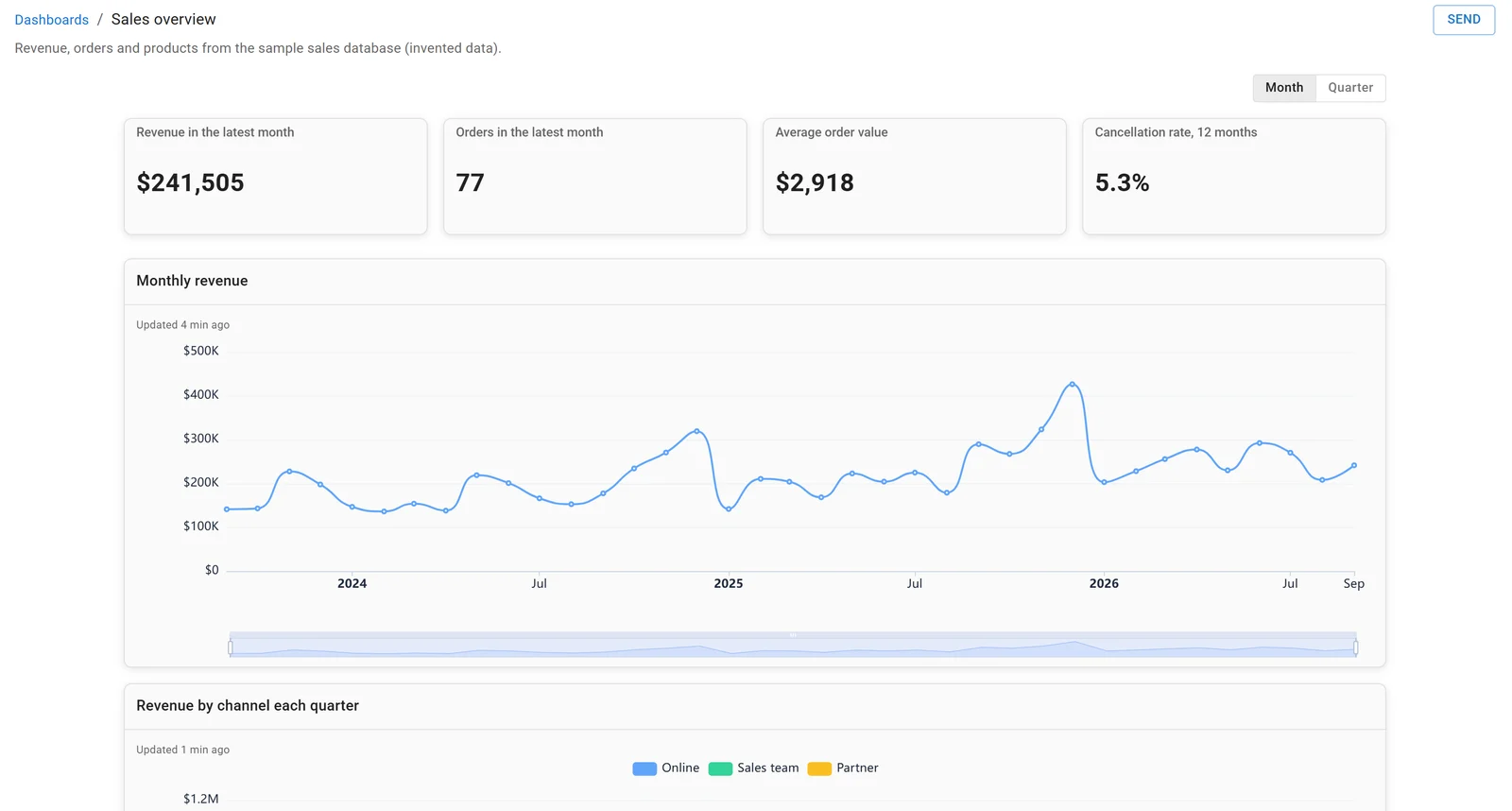
A dashboard in Fastero, built on the sample sales database. Invented data.
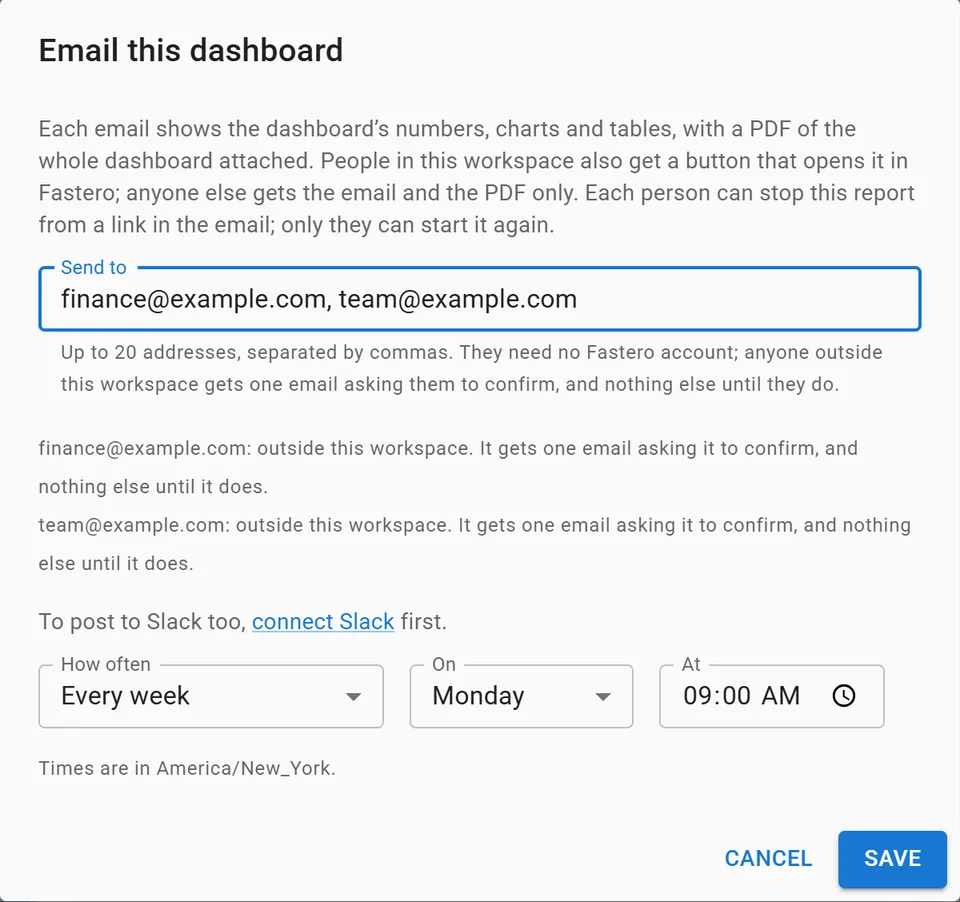
Setting up a weekly email of a dashboard, with invented addresses.
FAQ
What is Claude Data?
Anthropic's template for asking questions of your company's data in plain language. Claude writes a SQL query for each chart, runs it against a connected warehouse or app, and builds a dashboard, data story, short video or written summary that shows each query.
Is Claude Dashboards the same as Claude Data?
Yes. Claude Dashboards launched in beta on 8 October 2026 and became generally available as Claude Data on 10 November 2026. Dashboards made before the rename keep working.
Is Claude Data free?
No. It's on Pro, Max, Ultra, Team and Enterprise, and its work counts toward your plan's usage limits. Free accounts can make ordinary artifacts but not Data ones.
Does Claude Data refresh automatically?
It refreshes when someone opens a dashboard and its data is due for a refresh, using a cadence set per dashboard. It doesn't refresh on a schedule while nobody has it open, and Anthropic's help doesn't describe scheduled email delivery.
Can Claude Data connect to Postgres or MySQL?
Anthropic names Amazon Redshift, BigQuery, ClickHouse, Databricks, Snowflake and connected apps such as Salesforce. None of its Claude Data pages mention Postgres or MySQL, so check before you plan around one.
Can someone without access to the warehouse see my dashboard?
Inside your organization, yes, if you turn on live sharing (beta): they see results from your connection. Without it, each viewer's own connection runs the queries, and a viewer without access sees an error in that part.
Sources
Checked 12 November 2026:
- Anthropic help: Get started with Claude Data, Share artifacts, Artifacts admin guide for Team and Enterprise plans, What are artifacts and how do I use them?, Release notes, Artifacts in Claude Code
- Anthropic announcements: Introducing Claude Whiteboards, Claude Sheets, and Claude Data (10 November 2026), Build live dashboards and animate explainers with Claude (8 October 2026)
- Prices: Claude pricing
- Fastero: Pricing, MCP server