 Fastero Dev Team
How much Claude can hold in one conversation depends on the model, on where you use it, and for two older models on your plan: Anthropic gives the same model different windows on different surfaces. We read its pages on 18 November 2026 and measured a data file against them.
The short answer: on the API, Claude Fable 5.2, Opus 5.5, Sonnet 5.5 and Haiku 5.5 all have a 1M-token context window at their normal per-token price, except that Haiku 5.5 prompts over 100,000 tokens cost $0.50 and $2.50 per million tokens instead of $0.10 and $0.50. In claude.ai chats on paid plans the newest models get 1M, Fable 5, Opus 4.6 to 4.8 and Sonnet 4.6 get 500K, and other models 200K; Anthropic publishes no figure for the Free plan. Claude Code runs every current model at 1M and compacts the conversation at about 967K tokens. When a claude.ai chat fills, Claude summarises older messages on paid plans with code execution on, and Projects switch to searching their files.
Fastero
Connect your database. Ask questions. Get dashboards.
Postgres, BigQuery, Snowflake, and 10+ sources — live-connected, AI-powered, no dashboard builder learning curve.
Try free →Context window by model and by surface
Checked 18 November 2026, from Anthropic's model overview and its help article on paid plans:
| Model | API | claude.ai chat (paid plans) | Claude Code | Claude Cowork |
|---|---|---|---|---|
| Fable 5.2 | 1M | 1M | 1M | 1M |
| Opus 5.5 | 1M | 1M | 1M | 1M |
| Sonnet 5.5 | 1M | 1M | 1M | 1M |
| Haiku 5.5 | 1M | 1M | 1M | 500K |
| Opus 5 | 1M | 1M | 1M | 1M |
| Sonnet 5 | 1M | 1M | 1M | 1M, compacts at 500K |
| Fable 5 | 1M | 500K | 1M | 1M |
| Opus 4.8, Opus 4.7 | 1M | 500K | 1M | 1M |
| Opus 4.6 | 1M | 500K | 1M with [1m] |
200K |
| Sonnet 4.6 | 1M | 500K | 1M with [1m], usage credits |
200K |
| Haiku 4.5 | 200K | 200K | Not listed | 200K |
What the table doesn't show:
- Output shares the window. Current models write up to 128K tokens a request, and "A portion of the context window is always reserved for Claude's response".
- Free plan: no figure. Anthropic says only that Claude will tell you "if your prompt exceeds the available context window."
- Newer models count more tokens. The tokenizer of Claude 4.7 and later "produces approximately 30% more tokens for the same text".
- On Amazon Bedrock and Google Cloud's Agent Platform, Claude Code's
sonnetalias means Sonnet 4.5, a 200K model; name a newer model in full. - The plan matters for two models. In Claude Code, Opus 4.6 at 1M is included on Max, Ultra, Team and Enterprise and needs usage credits on Pro; Sonnet 4.6 at 1M needs them on every subscription. Anthropic's help article exempts usage-based Enterprise plans; the Claude Code docs don't.
What a data file costs in tokens
Anthropic's rule of thumb: "1M tokens is roughly 555k words or 2.5M Unicode characters on the current tokenizer". We applied it to the invented sales file that ships with Fastero:
$ python -I measure.py sample-sales.csv   (run 2026-11-18, Python 3.14.3)
file: sample-sales.csv (invented orders bundled with Fastero)
bytes: 382923
unicode characters: 382923
lines incl. header: 4735
data rows: 4734
columns: 10 ['order_id', 'order_date', 'region', 'channel', 'segment', 'category', 'product', 'quantity', 'unit_price', 'revenue']
characters per row (avg): 80.9
estimated tokens at 2.5 characters per token: 153169
copies of this file in 1,000,000 tokens (estimate): 6.5
copies in 200,000 tokens (estimate): 1.3
rows that fit in 1,000,000 tokens (estimate): 30907
By that ratio, a 383 KB CSV of 4,734 rows is about 153,000 tokens: nearly a whole 200K window, and a 1M window holds about 31,000 such rows. The ratio is for text in general; for an exact count, Anthropic's token counting API is "free to use". It's also why a claude.ai chat can take a 500 MB upload: Claude opens it with code rather than reading it into context, as our Claude file upload limits test showed.
What the 1M context costs
Checked 18 November 2026: on the API, for Claude 4.6 and later models except Haiku 5.5, "A 900k-token request is billed at the same per-token rate as a 9k-token request." Prices per million tokens, and our arithmetic for one 900,000-token prompt:
| Model | Input | Output | Cache read | Input cost of a 900K prompt | Same prompt from the cache |
|---|---|---|---|---|---|
| Fable 5.2 | $8 | $40 | $0.20 | $7.20 | $0.18 |
| Opus 5.5 | $4 | $20 | $0.20 | $3.60 | $0.18 |
| Sonnet 5.5 | $2 | $10 | $0.10 | $1.80 | $0.09 |
| Haiku 5.5, prompt over 100K | $0.50 | $2.50 | $0.05 | $0.45 | $0.045 |
On Haiku 5.5 the 100K threshold counts cache reads and writes too. Caching cuts the price, not the space: "Cached prompt prefixes still occupy the context window". On a subscription there's no per-token bill, but "Longer conversations that trigger automatic context management use more of your usage limit." Every model's price: Claude API pricing.
What happens when the window fills
| Where | What happens | What you can do |
|---|---|---|
| claude.ai chat | On paid plans with code execution on, Claude summarises earlier messages and keeps going; you may see it "organizing its thoughts". The full history is kept for Claude to refer back to | Start a new chat for a new task. Very large first messages can still hit the limit |
| claude.ai Project | When project knowledge nears the window, Claude switches to searching it (RAG), on paid plans, for "up to 10x" the capacity | Trim files you no longer use. More in our Claude Projects guide |
| Claude Code | Compacts automatically, at about 967K tokens on models with a native 1M window | /compact with a focus, /clear, or /autocompact 500k to compact earlier |
| API | Input over the window returns a 400, "prompt is too long". Output that reaches it stops with model_context_window_exceeded |
Compaction (beta), on demand or at a threshold (150,000 input tokens by default). Context editing clears old tool results |
After compacting, Claude Code reloads the project-root CLAUDE.md and auto memory, re-reads up to five recently changed files, and re-injects invoked skills, at most 5,000 tokens each and 25,000 in all. Path-scoped rules and nested CLAUDE.md files are summarised away until needed again. Compacting is itself a large request; /clear costs nothing.
We checked what our own install offers:
$ claude --version   (run 2026-11-18)
2.1.284 (Claude Code)

$ claude --help   (excerpt)
  --autocompact <auto|tokens>           Auto-compact window size (auto, or
                                        100k–1M tokens)
  -c, --continue                        Continue the most recent conversation in
                                        the current directory
  --fork-session                        When resuming, create a new session ID
                                        instead of reusing the original (use
                                        with --resume or --continue)
  --model <model>                       Model for the current session. Provide
                                        an alias for the latest model (e.g.
                                        'fable', 'opus', or 'sonnet') or a
                                        model's full name.
Our 2.1.284 has --autocompact, but two compaction features in the docs need newer builds: skill descriptions rebuilt after compaction (v2.1.304) and switching off idle compaction (v2.1.290).
Connect any database. Ask in plain English.
Start free →What counts toward the window
- API: everything in the request: the system prompt, messages with their tool results, images and documents, tool definitions, and the output, thinking included. Files API content is billed as input tokens.
- claude.ai: Project files and Google Drive files are read as text and must fit; chat uploads Claude opens with code don't. "Tools and connectors are token-intensive".
- Claude Code: before you type, the system prompt, CLAUDE.md, auto memory, MCP tool names and skill descriptions load: 7,850 tokens in Anthropic's illustrative session. Tool search, on by default, loads an MCP tool's definition only when Claude needs it. MCP output over 10,000 tokens triggers a warning, 25,000 is the default ceiling (
MAX_MCP_OUTPUT_TOKENS), and text results over 50,000 characters go to a file.
How to fit more into Claude's context
- Clear between tasks. A new chat or
/clear: old conversation crowds out what you need next. - Compact at a break, with a focus:
/compact focus on the auth bug fix. A "Compact instructions" section in CLAUDE.md applies to every compaction. - Give paths, not pastes. "the @ prefix injects the entire file plus its CLAUDE.md tree into context"; a bare path lets Claude read only what it needs.
- Send big reads to a subagent, which reads in its own window and returns a summary.
- Trim what loads every time: a long CLAUDE.md, project instructions, and connectors or MCP servers the task doesn't use. Lower the effort level for routine work.
- Don't aim to fill it. "As token count grows, accuracy and recall degrade". Aggregate a table before handing it over.
When the data is in a database
The cheapest data in a context window is the answer, not the table. Fastero is an AI and data platform where people and AI agents work together on a team's data.
- Claude queries, the data stays put. Through Fastero's connector, Claude runs one read-only SQL statement per call on a connected database such as Postgres, and gets back at most 500 rows, about 100 KB, per query.
- Add it once. In claude.ai, Fastero is in Claude's connector directory (Community); Claude Code adds the remote MCP server at
https://api.fastero.com/api/v1/mcpand signs in through the browser. Keys for scripts start at read and SQL only. - The result outlives the chat. A chart Claude makes can go onto a dashboard colleagues open with their own login; viewers are free. It refreshes on a timer (1, 5, 15 or 60 minutes) or, for Postgres and BigQuery data only, when the data changes.
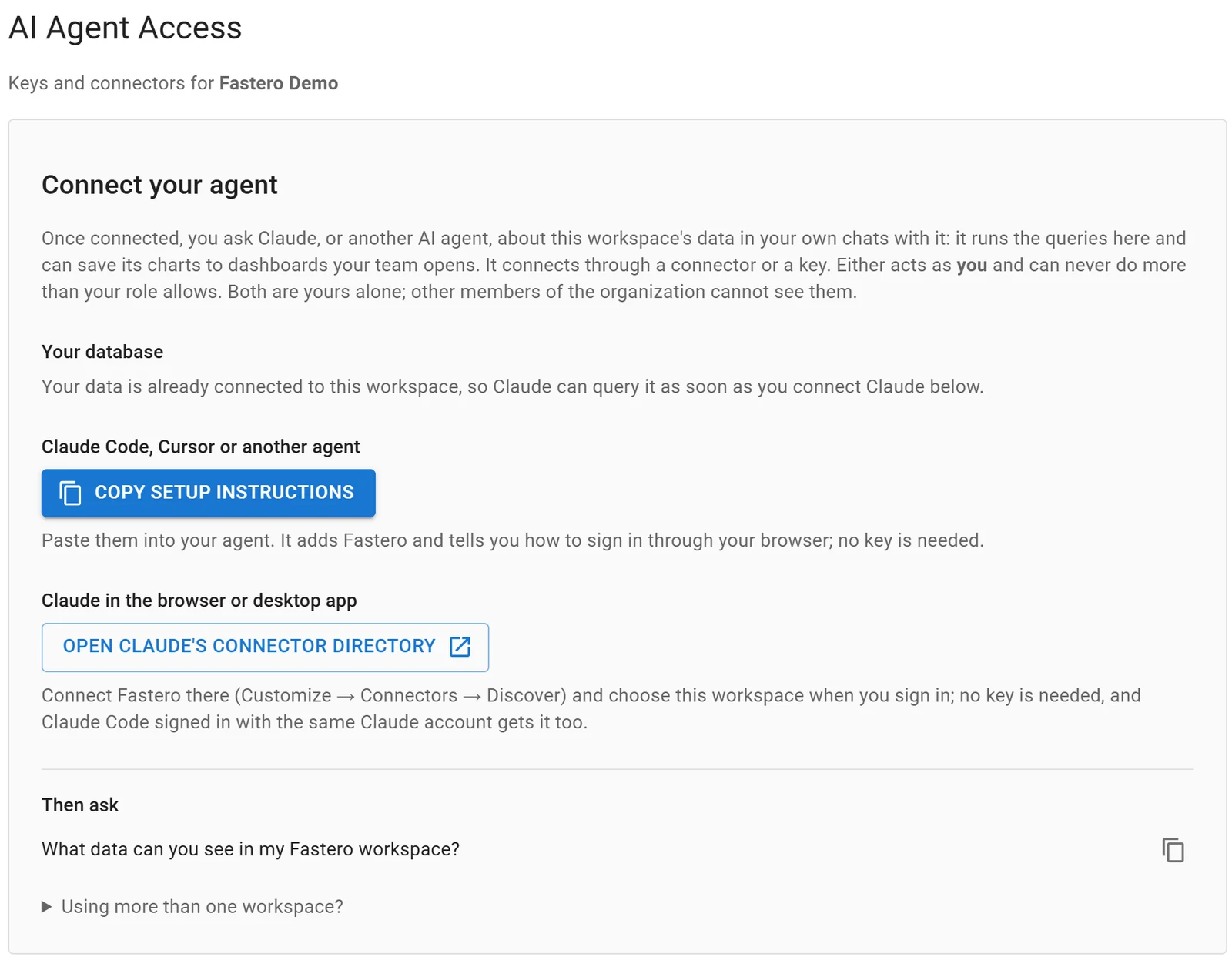
Settings, AI Agent Access: an agent signs in through the browser, so there is no key to copy.
FAQ
What is Claude's context window?
1M tokens on the API for every current model: Fable 5.2, Opus 5.5, Sonnet 5.5 and Haiku 5.5. In claude.ai chats on paid plans, the newest models also get 1M, and older ones 500K or 200K.
Does Claude Pro get the 1M context window?
Yes, on the newest models: Opus 5.5, Sonnet 5.5, Haiku 5.5 and Fable 5.2 get 1M in chats and in Claude Code on every paid plan. In Claude Code, Opus 4.6 and Sonnet 4.6 reach 1M only through [1m] variants, which need usage credits on Pro.
How much does the 1M context cost on the API?
Nothing extra on Claude 4.6 and later models, except Haiku 5.5: $0.50 input and $2.50 output per million tokens once a prompt passes 100,000 tokens, five times its usual rate.
What happens when a Claude chat gets too long?
On paid plans with code execution on, Claude summarises earlier messages and carries on, using more of your usage limit. Otherwise, start a new chat. Claude Code compacts automatically near the limit.
How do I see how much context is left in Claude Code?
Run /context for a coloured grid of what is using the window, with suggestions. Claude Code also shows a live indicator of how full it is.
Do files and connectors count toward Claude's context window?
Project files and Google Drive files are read as text and count in full. Connectors count too, and Anthropic calls them token-intensive. A file Claude analyses with code in a chat doesn't have to fit.
Sources
Read on 18 November 2026:
- Claude platform docs: Models overview, Context windows, Pricing, Compaction, Compaction at a token threshold, Context editing, Token counting, Files API
- Claude Code docs: Model configuration, Explore the context window, Commands, Manage costs, Prompt caching, MCP
- Claude Help Center: Context window on paid plans, Usage and length limits, RAG for Projects, Upload files, Google Workspace connectors, Getting started, Models, usage and limits in Claude Code
- Our own run of Claude Code 2.1.284 and a measurement of Fastero's invented sample sales file, 18 November 2026
Try Fastero free: let Claude query your team's database through Fastero and bring back the answer, not the table. No credit card required.