 Fastero Dev Team
Claude Managed Agents is Anthropic's hosted agent service. You describe an agent once; Anthropic runs the agent loop, the tools and a cloud sandbox for every task, and your app sends messages and streams back what the agent does.
The short answer: Claude Managed Agents is a beta API on the Claude Platform, launched on 8 April 2026, that is "enabled by default for all API accounts". You create an agent (model, system prompt, tools, MCP servers and skills), an environment (an Anthropic-managed cloud sandbox or one you host), then start sessions and exchange events with them. You pay standard token rates plus $0.08 per session-hour, counted only while a session is running. Pick it for long-running or scheduled agent work you don't want to host. Pick the Agent SDK to run a similar loop in your own process, the Messages API to write the loop yourself, and Claude Code to do the work interactively.
Fastero
Point Claude at your database.
Add Fastero to claude.ai or Claude Code. Claude builds the dashboard, deploys the app or publishes a live page, and your team opens it in Fastero.
Try free →What Claude Managed Agents is
Anthropic calls it a "Pre-built, configurable agent harness that runs in managed infrastructure", best for "Long-running tasks and asynchronous work". It is built from four parts:
| Concept | What it is (Anthropic's definition) |
|---|---|
| Agent | "The model, system prompt, tools, MCP servers, and skills" |
| Environment | Where sessions run: "an Anthropic-managed cloud sandbox, or a self-hosted sandbox on your own infrastructure" |
| Session | "A running agent instance within an environment, performing a specific task and generating outputs" |
| Events | "Messages exchanged between your application and the agent (user turns, tool results, status updates)" |
Agents are versioned and reused across sessions. A session keeps its history and sandbox on Anthropic's side, and when it finishes it goes idle, not terminated, so you can send it another message later.
Checked 12 November 2026, it is in beta on the Claude API, Claude Platform on AWS and Claude Models on Google Cloud (Anthropic managed), on every model, behind the managed-agents-2026-04-01 header that the SDKs set for you. Because sessions are stored, it is "not currently eligible for Zero Data Retention or HIPAA Business Associate Agreement (BAA) coverage".
Managed Agents vs the Agent SDK, the Messages API and Claude Code
| Messages API with tool use | Claude Agent SDK | Claude Managed Agents | Claude Code | |
|---|---|---|---|---|
| What it is | One model call at a time | Claude Code's agent as a Python or TypeScript library | A hosted agent harness, configured through the API | Anthropic's coding tool, in a terminal, IDE, desktop app or browser |
| Who runs the loop | You: "You write the tool loop yourself" | The library, "in a process you operate" | Anthropic | Claude Code, while you watch and steer |
| Where tools run | Wherever your code runs them | Your machine or server | A cloud sandbox, or a self-hosted one | Your machine, or a cloud session |
| Conversation state | You keep the history array | Sessions you can resume or fork, kept by your process | Stored server-side | Your session |
| How you pay | Tokens | Tokens | Tokens plus $0.08 per running session-hour | Your Claude plan, or an API key |
With the Messages API, "You maintain the conversation history array and pass it back on every turn"; with Managed Agents, "Pre-built tools run inside the sandbox automatically." Against the Agent SDK, "The difference is where they run: the SDK runs in a process you operate, whereas Managed Agents runs in Anthropic's infrastructure." Plan mode, slash commands and turn limits move to your client. Our Claude Agent SDK guide covers the library.
Claude Code is the tool you use yourself, and Anthropic's branding rules forbid partners from calling a Managed Agents product "Claude Code". To run Claude Code itself on a timer, see Claude Code routines.
How it works: agent, environment, session
Condensed from Anthropic's Python quickstart (pip install anthropic), it comes down to four calls:
from anthropic import Anthropic

client = Anthropic()

agent = client.beta.agents.create(
    name="Coding Assistant",
    model="claude-opus-5-5",
    system="You are a helpful coding assistant. Write clean, well-documented code.",
    tools=[{"type": "agent_toolset_20260401"}],
)

environment = client.beta.environments.create(
    name="quickstart-env",
    config={"type": "cloud", "networking": {"type": "limited", "allow_package_managers": True}},
)

session = client.beta.sessions.create(agent=agent.id, environment_id=environment.id)

with client.beta.sessions.events.stream(session.id) as stream:
    client.beta.sessions.events.send(session.id, events=[{
        "type": "user.message",
        "content": [{"type": "text", "text": "Create a script that writes the first 20 Fibonacci numbers to fibonacci.txt"}],
    }])
    for event in stream:
        if event.type == "session.status_idle":
            break
The service provisions a sandbox, runs the loop and its tools, streams events back, and emits session.status_idle when it's done. We installed the SDK into a fresh environment to see what it exposes:
$ pip install anthropic        # anthropic 2.8.0, Python 3.14.3, 12 November 2026
$ python check_sdk.py
client.beta.agents: yes  archive, create, list, retrieve, update
client.beta.environments: yes  archive, create, delete, list, retrieve, update
client.beta.sessions: yes  archive, create, delete, list, retrieve, update
client.beta.vaults: yes  archive, create, delete, list, retrieve, update
client.beta.deployments: yes  archive, create, list, pause, retrieve, run, unpause, update
agents.list() with a fake key -> 401 authentication_error
Claude Managed Agents pricing
Managed Agents "is billed on two dimensions: tokens and session runtime". Checked 12 November 2026:
| What you pay for | Rate |
|---|---|
| Tokens | Standard model prices: Opus 5.5 $4 / $20 per million input / output tokens, Sonnet 5.5 $2 / $10, Haiku 5.5 $0.10 / $0.50 for prompts up to 100,000 tokens |
| Session runtime | $0.08 per session-hour, measured to the millisecond, only while the session is running |
| Web search inside a session | $10 per 1,000 searches |
US-only inference (inference_geo: "us") |
Tokens at 1.1x |
Time spent idle, "waiting for your next message or a tool confirmation", doesn't count, and there is no separate container charge. The Batch API discount doesn't apply: "There is no batch mode."
Anthropic's worked example: a one-hour Opus 5.5 session with 50,000 input and 15,000 output tokens costs $0.20 + $0.30 + $0.08 = $0.58, or $0.428 if 40,000 input tokens are cache reads. The model is most of the bill.
To cap spend, set a budget when you create a session, in "a whole number of US cents written as a string" ("125" is $1.25). At the cap the session pauses with budget_reached; its history and sandbox stay.
Tools, MCP servers and vault credentials
Built-in tools. The agent_toolset_20260401 toolset includes bash, read, write, edit, glob, grep, web_fetch and web_search, all on by default. You can switch any off, limit web tools to listed domains, and add custom tools that your own code runs.
Permission policies. Each tool runs under always_allow, always_ask or auto. In Anthropic's words, "the agent toolset defaults to always_allow, and MCP toolsets default to always_ask", so an MCP call waits for your app's user.tool_confirmation until you change the policy.
MCP servers. You declare them on the agent with a name and URL, plus a matching mcp_toolset entry. They must be remote servers "that expose an HTTP endpoint", or private ones reached through MCP tunnels, which are in a more limited research preview.
Vaults. A vault is "the collection of credentials associated with an end user", attached when a session starts, so one agent can serve many users with their own logins. Three credential types:
| Type | Use it for |
|---|---|
mcp_oauth |
An MCP server that uses OAuth 2.0; Anthropic refreshes the token if you supply the refresh details |
static_bearer |
An MCP server that takes "a fixed bearer token (API key, personal access token, or similar)" |
environment_variable |
A CLI or SDK that reads a key from the environment; "The agent never sees the secret value" because a placeholder is swapped for it at egress |
Secret values are "write-only fields and never returned in API responses", and credentials are re-resolved during a session, so a rotated key takes effect without a restart.
The sandbox. Ubuntu 24.04 with up to 8 GB of memory and 10 GB of disk, and Python 3.10 to 3.13 with pandas, NumPy and Matplotlib. One trap: environments created through the API default to unrestricted networking. With limited, list the hosts the agent may reach; an MCP server on a host that isn't allowed makes session creation fail with a 400 error unless allow_mcp_servers is on.
Point Claude at your database.
Start free →Scheduled deployments
Since 9 June 2026, a scheduled deployment starts a new session on a cron schedule, "with no scheduler for you to build or host". Anthropic's examples are "a nightly data sync, a weekly compliance scan, or a daily digest".
deployment = client.beta.deployments.create(
    name="Weekly compliance scan",
    agent=agent.id,
    environment_id=environment.id,
    initial_events=[{"type": "user.message",
                     "content": [{"type": "text", "text": "Run the weekly compliance scan."}]}],
    schedule={"type": "cron", "expression": "0 20 * * 5", "timezone": "America/New_York"},
)
What to know, checked 12 November 2026:
- Down to the minute, in a five-field cron expression and an IANA time zone.
- Jitter "of up to 15 percent of the interval between runs, with a minimum of 5 seconds and a maximum of 9 minutes".
- 1,000 deployments per organisation.
- Failures are recorded, not retried. A rate-limited run waits for the next occurrence, an archived environment or vault pauses the deployment, and "Missed triggers are not backfilled."
- A budget per run. A
"2000"cap "can spend up to about $20 USD on every run".
When to use Claude Managed Agents
Use it when a task runs for minutes or hours, when your product gives each customer an agent with their own credentials, when the agent needs a sandbox you'd rather not build, or when it should run on a schedule without a server of yours.
Use something else when the agent must work on your own files and network (the Agent SDK, or a self-hosted sandbox), when you need Zero Data Retention or a HIPAA BAA, when the job is one model call (the Messages API, with its Batch discount), or when you're doing the work yourself (Claude Code or Cowork).
Giving a managed agent your team's data
An agent in Anthropic's sandbox can't see your database unless you give it a way in. A remote MCP server with a key in a vault is the cleanest: the agent gets tools, and the credential never appears in a prompt.
Fastero is an AI and data platform where people and AI agents work together on a team's data, with a remote MCP server at https://api.fastero.com/api/v1/mcp. People sign in through the browser; anything that can't sign in uses a key. We haven't run it inside a managed agent: the setup below follows Anthropic's vault docs and the Authorization: Bearer <key> header Fastero documents.
import os
from anthropic import Anthropic

client = Anthropic()

environment = client.beta.environments.create(
    name="data-env",
    config={"type": "cloud", "networking": {"type": "limited", "allowed_hosts": ["api.fastero.com"]}},
)

agent = client.beta.agents.create(
    name="Data analyst",
    model="claude-opus-5-5",
    mcp_servers=[{"type": "url", "name": "fastero", "url": "https://api.fastero.com/api/v1/mcp"}],
    tools=[{"type": "agent_toolset_20260401"},
           {"type": "mcp_toolset", "mcp_server_name": "fastero"}],
)

vault = client.beta.vaults.create(display_name="Analytics team")
client.beta.vaults.credentials.create(
    vault_id=vault.id,
    display_name="Fastero key",
    auth={"type": "static_bearer",
          "mcp_server_url": "https://api.fastero.com/api/v1/mcp",
          "token": os.environ["FASTERO_AGENT_KEY"]},
)

session = client.beta.sessions.create(agent=agent.id, environment_id=environment.id,
                                      vault_ids=[vault.id])
MCP tools still ask for approval until you set the toolset's policy. What the key gives the agent:
- Read and query by default. A key from Settings → AI Agent Access starts with read and SQL scopes. The SQL tool runs one
SELECT,WITH,EXPLAINorSHOWstatement, refuses writes, and returns at most 500 rows. - Your role, never more. A key acts as the person who made it, in one workspace; revoking it ends access at once.
- A key that expires. At most 90 days, with warnings 14 and 3 days before. Replace the vault credential and running sessions pick up the new one.
- The team's definitions. The agent reads the metric definitions your team has saved, so its revenue matches the dashboard's.
- Somewhere to put the result. With the Build dashboards preset, it can save charts to dashboards colleagues open with their own Fastero login. Viewers are free.
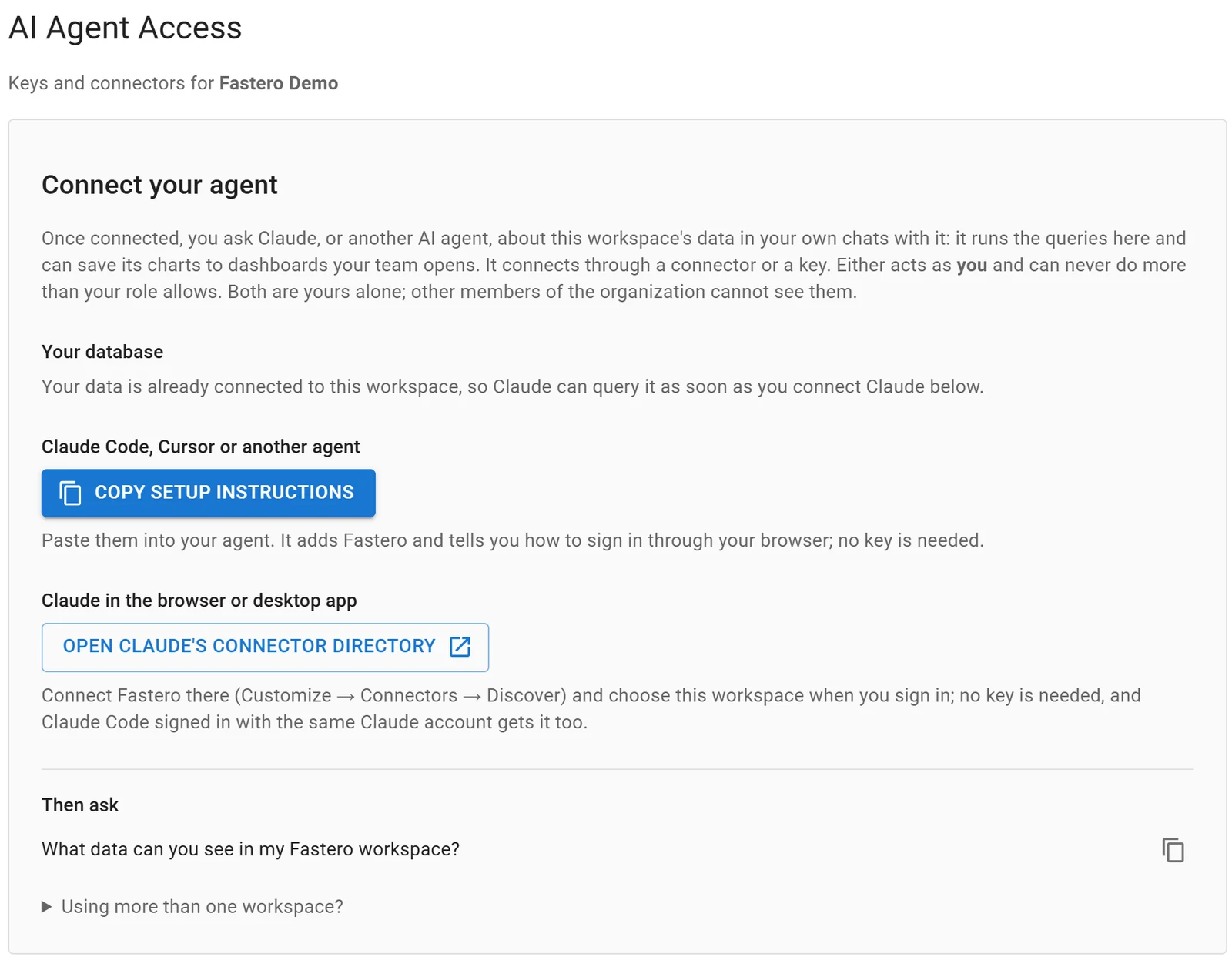
Settings, AI Agent Access: an agent signs in through the browser, so there is no key to copy.
More in what an MCP server is and MCP security.
FAQ
What is Claude Managed Agents?
A beta Claude API service that runs Claude as an autonomous agent on Anthropic's infrastructure. You define an agent and an environment and start sessions; Anthropic runs the loop, the tools and a sandbox for each.
How much does Claude Managed Agents cost?
Standard token prices plus $0.08 per session-hour while a session is running. Idle time doesn't count, web searches cost $10 per 1,000, and there's no batch discount. Anthropic's one-hour Opus 5.5 example costs $0.58.
Is Claude Managed Agents the same as the Claude Agent SDK?
No. The Agent SDK runs the loop in a process you operate, on your files. Managed Agents runs it in Anthropic's infrastructure, with state stored there.
Can a managed agent use MCP servers?
Yes, remote ones over HTTP, with credentials from a vault. MCP tools ask for approval by default, and private servers need an MCP tunnel, which is in research preview.
Can Claude Managed Agents run on a schedule?
Yes. A scheduled deployment starts a session on a cron expression in your time zone, down to the minute, with an optional budget per run.
Sources
Checked 12 November 2026; the SDK check ran the same day with anthropic 2.8.0 on Python 3.14.3:
- Anthropic docs: Managed Agents overview, Quickstart, Agent setup, Cloud environment setup, Cloud sandbox reference, Choose an environment, Sessions, Session operations, Tools, Permission policies, MCP connector, Vaults, Session budgets, Scheduled deployments, Migration, Reference, Pricing, Release notes, Agent SDK overview
- Anthropic blog: Claude Managed Agents, Scheduled deployments and vaults
- Fastero: AI Agent Access and the MCP server