 Fastero Dev Team
Claude Code has no price of its own. You get it with a Claude subscription, where it shares your plan's usage with chat, or you pay per token with an API key or through a cloud provider. The plans changed again at the end of October 2026, and most price guides still describe the old ones.
The short answer: Claude Code is included in every paid Claude plan, not in Free: Pro at $20 a month ($17 billed yearly), Max at $100, and Ultra at $200 (the plan called Max 20x until 30 October 2026). Team seats cost $20 or $25 for Standard and $100 or $125 for Premium, and Enterprise is $20 a seat plus all usage at API rates. Subscriptions work on a five-hour window and a weekly limit, except verified Ultra accounts, which have no five-hour limit; past the limit you wait or pay API rates through usage credits. On an API key you pay per token: Opus 5.5, Claude Code's default model, costs $4 per million input tokens and $20 per million output tokens, and Anthropic puts the average at about $13 per developer per active day.
Fastero
Point Claude at your database.
Add Fastero to claude.ai or Claude Code. Claude builds the dashboard, deploys the app or publishes a live page, and your team opens it in Fastero.
Try free →Claude Code pricing by plan
"Claude Code is included in all paid plans. It shares the same usage limits as the rest of your plan, so your work in the terminal and your chats draw from one pool."
| Plan | Price | Claude Code usage | Also included |
|---|---|---|---|
| Free | $0 | Not included | |
| Pro | $20 a month, or $17 a month billed yearly ($200 up front) | "at least 5x more usage per 5-hour session than Free" | Fable only through usage credits |
| Max | $100 a month, monthly only | "5x Pro usage every 5 hours and every week" | Fable up to half the weekly limit; $100 a month of API credits |
| Ultra | $200 a month, monthly only | "10x Pro usage every week", and "No 5-hour limit for verified accounts" | Everything in Max, with $200 a month of API credits |
| Team, Standard seat | $20 a seat a month yearly, $25 monthly; 2 to 150 people | 1.25 times Pro's usage per session, plus a weekly limit | $20 a month of API credits per seat |
| Team, Premium seat | $100 yearly, $125 monthly | 6.25 times Pro's per session | Fable up to half the weekly limit; $100 of API credits per seat |
| Enterprise | $20 a seat a month, billed yearly, 20 seats minimum | No allowance: all usage billed at API rates | |
| API key | Per token | No plan limits, only rate limits and any spend limit you set |
The plans' Claude Code usage is the same pool you use for Claude on the web, desktop and phone: "Your activity across Claude on web, desktop, mobile, and Claude Code all draws from the same pool." A Team plan's monthly API credits are pooled across seats, "capped at $500".
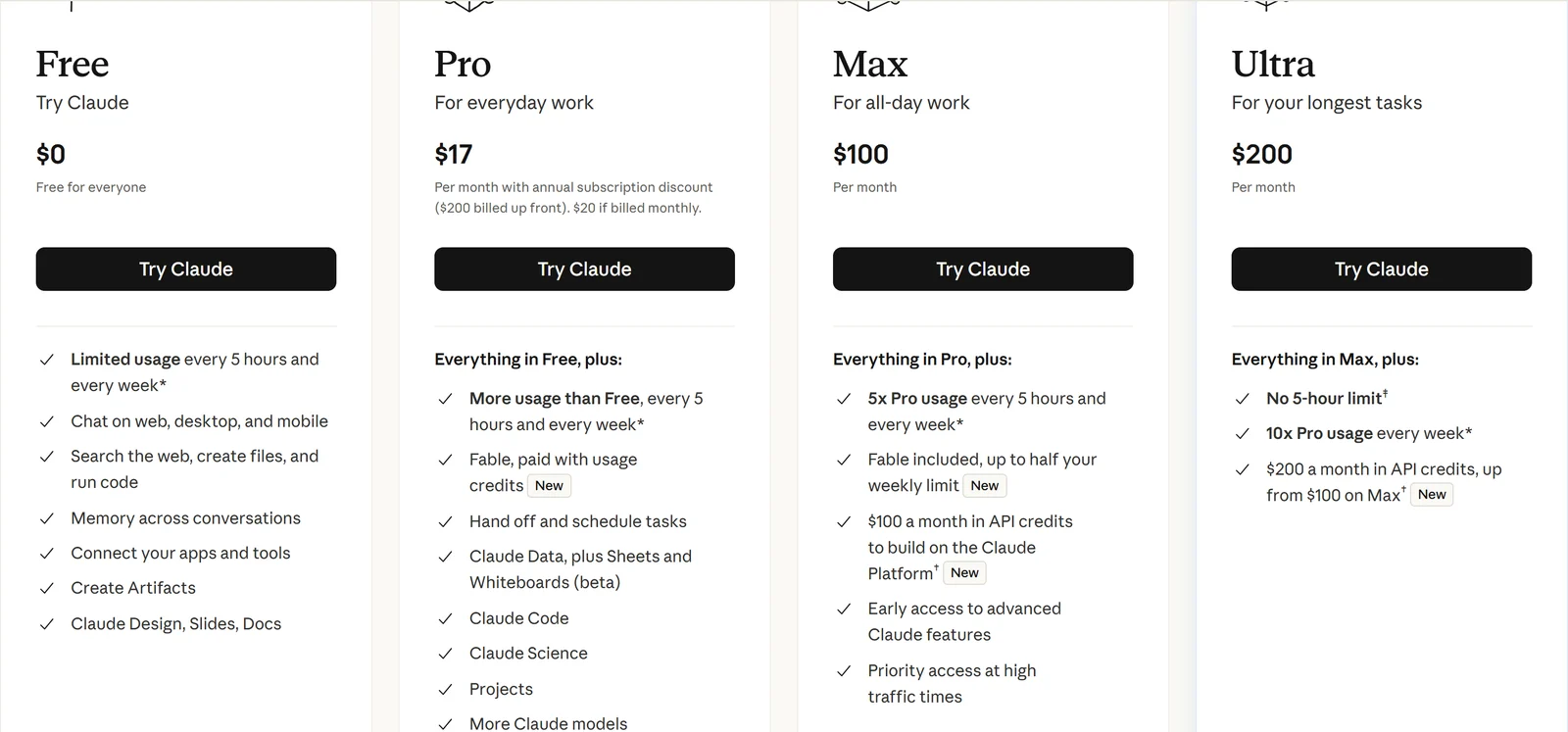
Claude's individual plans on 11 November 2026. Ultra's "No 5-hour limit" applies to verified accounts.
Max vs Ultra, and what happened to Max 20x
On 30 October 2026 Anthropic renamed its two Max tiers: Max 5x became Max, and Max 20x became Ultra. "The Max 20x plan is now called the Ultra plan. Existing Max 20x subscribers move to Ultra automatically, with no price change."
The old name overstated the weekly allowance. Explaining the change, an Anthropic product lead wrote that Max 20x's weekly limits were "10x Pro's (the 5-hour limit stayed at 20x)". Ultra keeps the 10x weekly figure and drops the five-hour limit for verified accounts instead. To check yours, open Settings › Usage: "If you don't see a Current session bar, your account is verified."
So Max suits a full working day in bursts, with five-hour resets. Ultra suits long unattended runs that would otherwise stop at a five-hour limit. Both have "a separate weekly limit for Fable", Anthropic's top model.
Team and Enterprise
"Claude Code is included with every Team plan seat", Standard seats included since January 2026. "On Claude for Teams and Enterprise plans, each member's Claude Code usage draws from a per-seat allowance that resets on a rolling five-hour window and a weekly window", shared with chat and Cowork. "Usage inside the seat allowance isn't metered in dollars", so a Team plan can't tell you what each developer costs, only what they used beyond it. Admins can set an organisation-wide monthly limit on usage credits.
Current Enterprise plans work the other way: "Enterprise seats don't come with an individual token allowance." The seat fee buys access, and every token is billed at API rates. Our Team plan guide compares Standard and Premium seats in more detail.
Claude Code on the API: prices per token
With an API key, "Claude Code charges by API token consumption." On every plan and on the API it "defaults to Opus 5.5":
| Model | Input, per million tokens | Output, per million tokens | Cache read |
|---|---|---|---|
| Fable 5.2 | $8 | $40 | $0.20 |
| Opus 5.5 (the default) | $4 | $20 | $0.20 |
| Sonnet 5.5 | $2 | $10 | $0.10 |
| Haiku 5.5 | $0.10, or $0.50 over 100K tokens | $0.50, or $2.50 over 100K tokens | $0.01, or $0.05 |
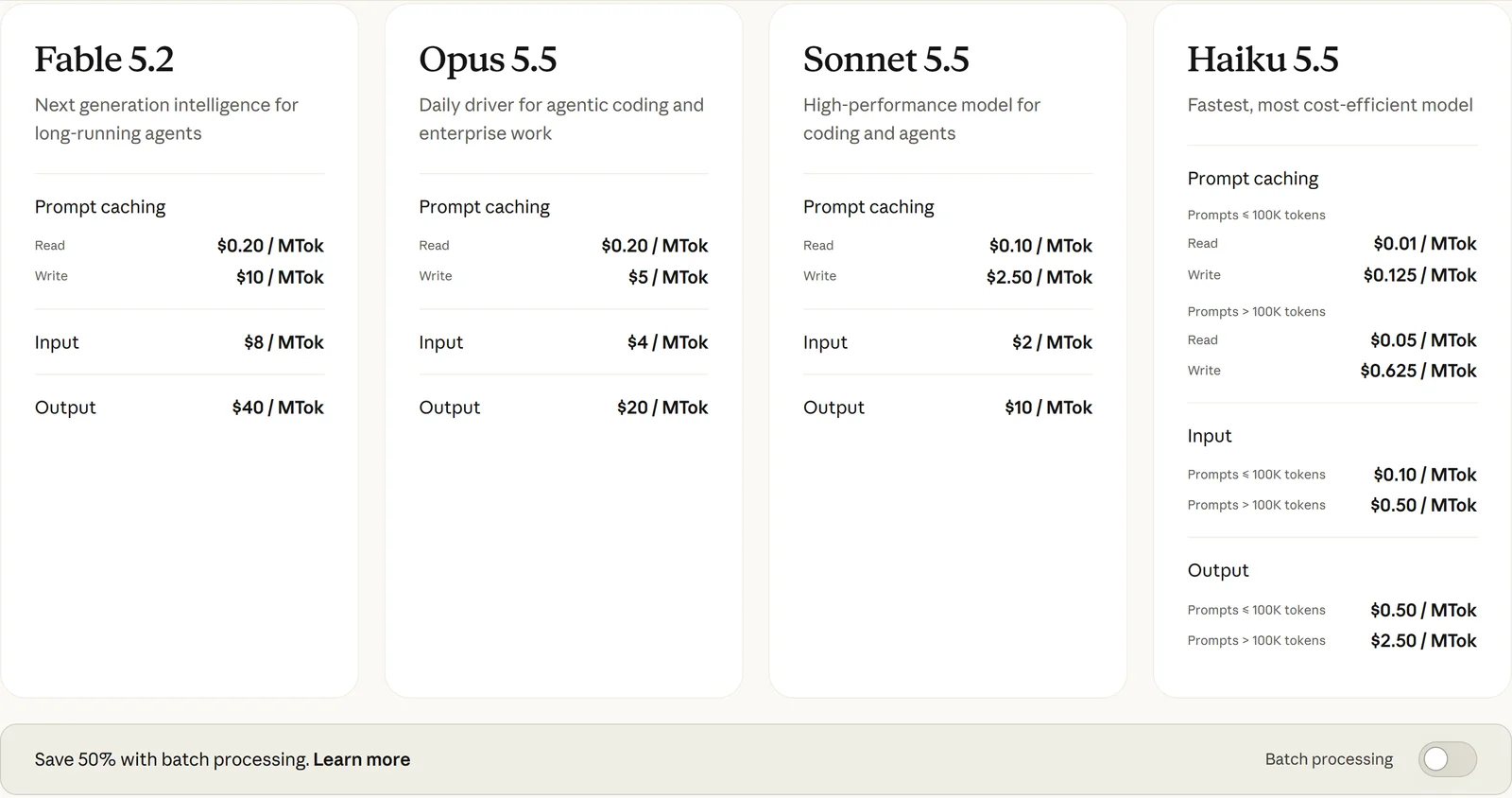
The four current models' prices on 11 November 2026. Fable 5.2 launched on 9 November.
What moves the bill beyond those rates:
- Caching does most of the work. Claude Code resends the conversation with every request, and reads from the cache cost a fraction of input: on Opus and Sonnet 5.5, cache hits are "priced at 0.05x the base input price." Writing to the cache costs 1.25 times input for five minutes, or twice input for an hour. Claude Code uses the hour-long cache for your conversation only "on a Claude subscription within your plan's included usage"; on an API key it uses five minutes, so a coffee break can mean paying for the whole conversation again.
- Thinking is output. "Thinking tokens are billed as output tokens", and "You can't turn off thinking on Opus 5.5, Sonnet 5.5, Haiku 5.5, or the Fable models". Lower
/effortinstead. - Fast mode doubles the price: "up to 2.5x faster speeds with fast mode for Opus 5.5 and Fable 5.2 at 2x standard pricing."
- The tokenizer counts more. Since the Claude 4.7 models, "This tokenizer produces approximately 30% more tokens for the same text", so older per-token estimates run low.
- US-only processing "incurs a 1.1x multiplier on all token pricing categories".
- Batch pricing doesn't apply. The Batch API's 50% discount is for API jobs, not interactive sessions.
Every model's price, including older ones, is in our Claude API pricing tracker.
What a developer costs
Anthropic publishes averages from companies using Claude Code: "the average cost is around $13 per developer per active day and $150-250 per developer per month, with costs remaining below $30 per active day for 90% of users."
At the bottom end, a run of Anthropic's Agent SDK, which runs Claude Code from a script, asked Claude to "Reply with exactly one word: pong" on 11 November 2026. It used Opus 5.5 and reported total_cost_usd: 0.0052, half a cent, most of it for writing Claude Code's instructions to the cache. A working session that reads a codebase, edits files and runs tests costs far more, because every turn resends the growing conversation.
Two cautions on any dollar figure Claude Code shows you. "Claude Code computes the dollar figure locally from token counts at list price", so it's an estimate, not a bill. And "Claude Pro, Max, and Ultra subscribers have usage included in their subscription, so the session cost figure isn't relevant for billing purposes." Run /usage to see it, with your plan's bars; /cost and /stats are the same command. Our guide to Claude Code usage covers checking it, and seeing a whole team's.
Subscription or API: which is cheaper?
For anyone who codes with it most days, a subscription. At Anthropic's average of $13 per active day, twenty working days on the API come to about $260 a month, against $100 for Max or $200 for Ultra, if the plan's allowance covers your work. The API is better when use is light or irregular, when work runs unattended in CI and shouldn't stop at a five-hour limit, or when a company needs every token on one bill.
Point Claude at your database.
Start free →When you hit the limit
"When you reach a limit, you can wait for it to reset, move to a higher plan, or, on paid plans, turn on usage credits to keep working at standard API rates."
- Usage credits are "billed at standard API rates". Turn them on with
/usage-creditsin Claude Code (it was/extra-usage). From 7 December 2026, "usage credits purchased on or after December 7, 2026 expire 12 months after the purchase date." - Changing model only helps with a model limit. A session or weekly limit covers every model, "so the developer can't restore access by switching models with
/model". An Opus or Sonnet limit is per family, and "switching to a model outside that family with/modeldoes keep the developer working". - The step in progress can finish. At a five-hour limit, Claude Code may keep going briefly, showing "Usage limit reached · wrapping up".
- It can carry on by itself. Claude Code v2.1.234 and later can "wait and continue the interrupted task automatically after the reset".
Two things always bill usage credits on a subscription: fast mode, which "is available via usage credits only and not included in the subscription rate limits", and Fable requests in scripted runs (claude -p and Agent SDK apps): "When a Fable request there would bill to usage credits, Claude Code bills it without asking."
Three billing traps
- An API key in your environment. "If you have an ANTHROPIC_API_KEY environment variable set on your system, Claude Code will use this API key for authentication instead of your Claude subscription", and the API bills you per token. Check with
/status, which shows the account in use. - Monthly API credits don't cover interactive Claude Code. Max, Ultra and Team now include API credits "to build on the Claude Platform", but they don't apply to "Interactive Claude Code in the terminal, IDE, desktop, or web", nor to usage credits. They do pay for apps you build with the Agent SDK.
- An unpinned model on a cloud provider. On Amazon Bedrock, "if you don't pin a primary model, you're billed at the Opus rate". Set
ANTHROPIC_MODEL.
On Amazon Bedrock or Google Cloud
Through AWS or Google Cloud (Google's docs now call Vertex AI the Agent Platform), "Claude Code is billed per token to your cloud account, and spend controls live in your cloud provider's billing console." Regional endpoints "include a 10 percent premium over global endpoints". Anthropic's dashboards see none of it: "Claude Code does not send metrics from your cloud back to Anthropic", so per-developer numbers come from OpenTelemetry or a gateway.
How Claude Code pricing changed in 2026
- 16 January: "Claude Code access added to Team plan Standard seats".
- 12 February: self-serve Enterprise, with "a single seat type that includes access to Claude, Claude Code, and Cowork."
- 22 September: Opus 5.5 at $4 and $20, which "costs 40% less to run than Opus 5", becomes Claude Code's default.
- 7 October: "Max and Team plans now include monthly API credits for running your own apps and agents on the Claude Platform."
- 30 October: Max 5x becomes Max, Max 20x becomes Ultra, and verified Ultra accounts lose the five-hour limit.
- 9 November: Fable 5.2 at $8 and $40, cheaper than Fable 5.1's $10 and $50.
- 7 December: usage credits bought from this date expire after 12 months.
Seeing what your team spends
What Claude Code costs a team is a data question, and the answer sits in several places: Anthropic's analytics dashboard for your plan, its Analytics API, a spend report, OpenTelemetry. Fastero is an AI and data platform where people and AI agents work together on a team's data; through Fastero's connector, Claude Code can query those numbers and build a team dashboard with a weekly email and an alert on a runaway day. The walk-through is in our Claude Code usage guide.
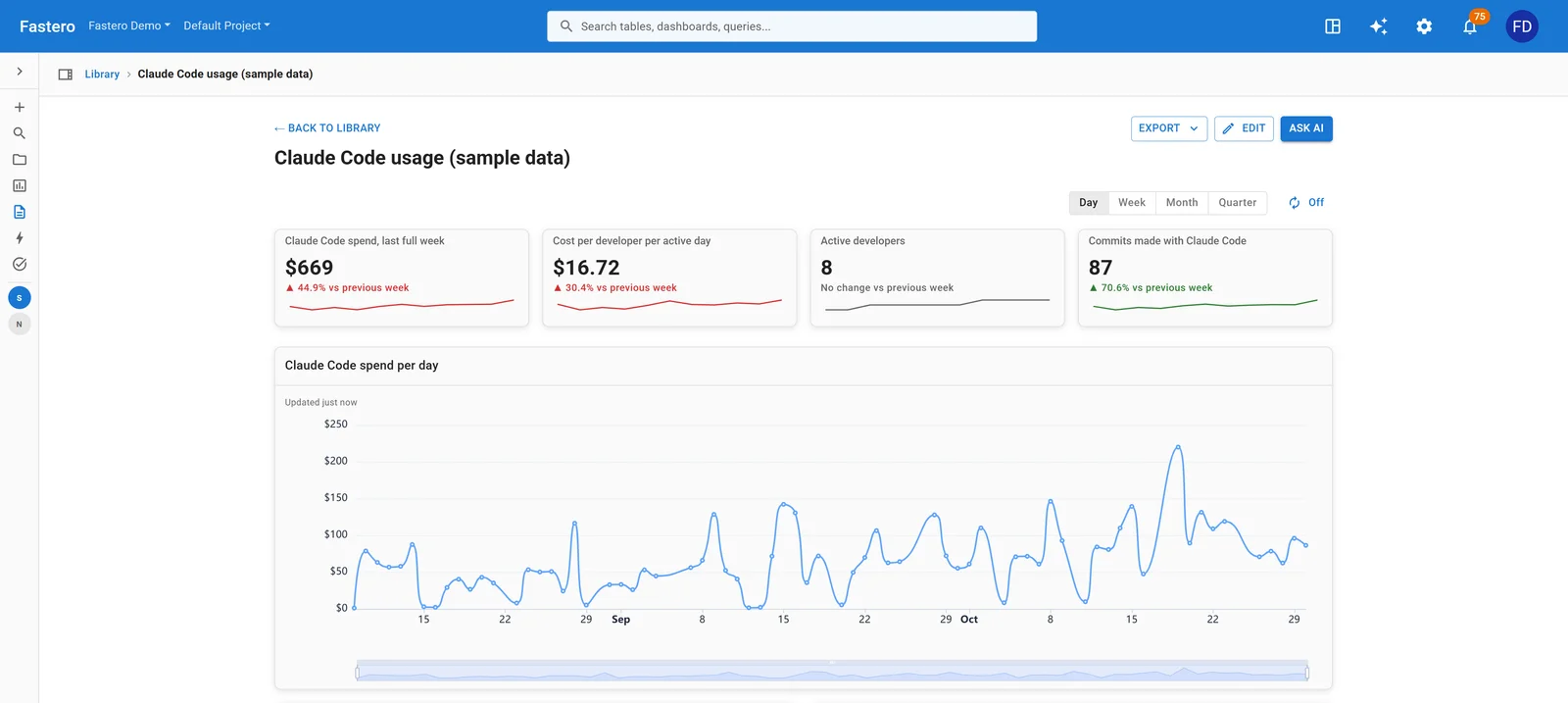
A team's Claude Code usage in Fastero. Sample data: an invented team of eight.
More on Claude Code for data analysis and connecting MCP servers to Claude Code.
FAQ
Is Claude Code free?
No. It isn't included in the Free plan. You need Pro ($20 a month, or $17 billed yearly) or a higher plan, or an API key, which bills per token.
How much is Claude Code per month?
$20 on Pro, $100 on Max, $200 on Ultra; $25 or $125 a seat on Team billed monthly ($20 or $100 billed yearly); and on Enterprise, $20 a seat plus usage at API rates.
What happened to Claude Max 20x?
It was renamed Ultra on 30 October 2026, at the same $200 a month. Ultra gives 10 times Pro's weekly usage and no five-hour limit for verified accounts. The $100 plan, once Max 5x, is now just Max.
Is Claude Code cheaper on a subscription or the API?
For daily use, a subscription. Anthropic's average of about $13 per developer per active day works out to around $260 a month on the API, against $100 for Max. The API makes sense for light use and for automated jobs.
What happens when I hit the Claude Code usage limit?
You wait for the reset, move to a higher plan, or turn on usage credits with /usage-credits and keep working at API rates. Switching model helps only with a per-model limit.
Do Max and Ultra's monthly API credits pay for Claude Code?
Not for interactive Claude Code in the terminal, IDE, desktop or web. They pay for apps and agents you build on the Claude Platform, including with the Agent SDK.
How do I see what Claude Code is costing me?
Run /usage (or its alias /cost) in Claude Code. The dollar figure is an estimate at list price, and on a subscription it isn't your bill. Teams have an analytics dashboard: claude.ai/analytics/claude-code on Team and Enterprise, platform.claude.com/claude-code on the API.
Which model does Claude Code use by default?
Opus 5.5, on every plan and on the API. Switch with /model; Sonnet 5.5 costs half as much per token.
Sources
Read on 11 November 2026, signed out; the Agent SDK run was on Windows 11 the same day.
- Anthropic: Claude pricing, API pricing, Manage costs, Model configuration, Prompt caching in Claude Code, Fast mode, Commands, Amazon Bedrock, Claude Code changelog
- Claude Help Center: What is the Max plan, What is the Ultra plan, What is the Team plan, Claude Code with Pro or Max, Claude Code on Team and Enterprise, Enterprise billing, Usage limits, Usage credits, Team usage credits, Monthly API credits, Release notes
- The Max 20x to Ultra announcement, 30 October 2026