
An MCP server gives Claude Code tools from another system: your issue tracker, a browser, a database, a design file. Claude Code already reads and edits files, runs shell commands, uses git, and fetches and searches the web, so a server is worth adding only when it reaches something those can't. Anthropic's own docs go further: CLI tools like gh, aws, gcloud and sentry-cli "are still more context-efficient than MCP servers", because they add no tool listing to the session.
The short answer: add Context7 for current library documentation, Playwright or Chrome DevTools for a browser, and the official server for each service your team works in: GitHub, Linear or Jira, Sentry, Figma, your database. Use the vendor's own server, never the old reference servers that most lists still link, and add servers with --scope user or per project as you need them.
How to add an MCP server to Claude Code
A remote server, one with a web address, is added with its URL:
claude mcp add --transport http linear https://mcp.linear.app/mcpThen run /mcp in a session, select the server and choose Authenticate to sign in through the browser. A server that takes a token instead gets it as a header, for example --header "Authorization: Bearer YOUR_TOKEN".
A local server is a program Claude Code starts on your machine. Everything after -- is the command:
claude mcp add playwright -- npx -y @playwright/mcp@latestWhere the server is saved depends on its scope:
| Scope | Loads in | Saved in | Shared with the team |
|---|---|---|---|
local (the default) |
This project only | ~/.claude.json, under the project |
No |
project |
This project | .mcp.json in the repository |
Yes, through git |
user |
Every project | ~/.claude.json |
No |
claude mcp list shows every server and its status, and /mcp in a session shows each one's tool count. If you signed in to Claude Code with a claude.ai account, the connectors you added in claude.ai appear automatically; with an API key, they don't.
16 MCP servers worth adding
| Server | Made by | What it gives Claude Code | Sign-in | Cost |
|---|---|---|---|---|
| Context7 | Upstash | Documentation for the library version you're using | API key or OAuth | 1,000 calls a month free, then $10 per seat |
| GitHub | GitHub | Issues, pull requests, code search and Actions across repositories | A personal access token | Free; some features need paid GitHub plans |
| Playwright | Microsoft | A browser it drives through the page's accessibility tree | None | Free |
| Chrome DevTools | Performance traces, network requests and the console of a live Chrome | None | Free | |
| Sentry | Sentry | Errors and stack traces from your projects | OAuth | Your Sentry plan |
| Linear | Linear | Issues and projects, with a read-only address | OAuth or API key | Your Linear plan |
| Atlassian | Atlassian | Jira issues and Confluence pages | OAuth | Some tools use Rovo credits |
| Notion | Notion | Pages and databases | OAuth | Every Notion plan; some tools need Business |
| Figma | Figma | Design files, components and variables | OAuth | Calls limited by seat |
| Supabase | Supabase | Database, auth and storage, with read-only and one-project modes | OAuth | Your Supabase plan |
| Neon | Neon | Postgres projects, branches and queries, with a read-only mode | OAuth or API key | Your Neon plan |
| BigQuery | Google Cloud | Datasets, tables and SQL, up to 3,000 rows a query | Google OAuth and IAM | BigQuery's own query charges |
| PostHog | PostHog | Product analytics, feature flags and experiments | OAuth or API key | Free to call |
| Vercel | Vercel | Deployments, logs and domains; it can deploy | OAuth | Every Vercel plan |
| Cloudflare | Cloudflare | The whole Cloudflare API in about 1,000 tokens | OAuth or API token | Free; some features need paid Workers |
| Fastero | Fastero | Read-only SQL on your connected databases, plus dashboards, Streamlit apps and schedules your team opens | claude.ai sign-in or a key | Free plan; Pro $20 per editor a month |
Every server here is maintained by the company that makes the product. The install commands below come from that company's documentation or Claude Code's, checked on 21 October 2026.
Fastero
Point Claude at your database.
Add Fastero to claude.ai or Claude Code. Claude builds the dashboard, deploys the app or publishes a live page, and your team opens it in Fastero.
Try free →Documentation and code
Context7 fetches documentation for the version of a library you actually have, so Claude writes against your version instead of the one in its training data. It has two tools, one to find a library and one to query its docs. The free plan stops after 1,000 calls a month, with 20 extra a day; Pro, at $10 a seat a month, is never blocked.
claude mcp add --scope user --header "Authorization: Bearer YOUR_API_KEY" --transport http context7 https://mcp.context7.com/mcpGitHub's official server is remote, and in Claude Code it needs a personal access token in a header: GitHub's OAuth sign-in for the remote server works in the editors GitHub lists, and Claude Code isn't one of them. Claude Code's documentation gives:
claude mcp add --transport http github https://api.githubcopilot.com/mcp/ --header "Authorization: Bearer YOUR_GITHUB_PAT"In October 2025 GitHub cut the default set from 101 tools to 52, about 30,000 tokens of definitions. The X-MCP-Toolsets header narrows it to the groups you use, and X-MCP-Readonly makes it read-only. If you only need pull requests and issues, the gh CLI does the same job with no tool listing at all.
A browser
Playwright MCP, from Microsoft, drives a browser through the page's accessibility tree rather than screenshots: claude mcp add playwright -- npx -y @playwright/mcp@latest (Node 18 or newer). Microsoft's README now suggests coding agents may do better with its Playwright CLI and skills, which keep large tool schemas out of the context.
Chrome DevTools MCP, from Google's Chrome DevTools team, inspects a live Chrome: performance traces, network requests, the console, the DOM. --slim cuts it to three tools, and usage statistics are sent by default unless you pass --no-usage-statistics.
claude mcp add chrome-devtools --scope user npx chrome-devtools-mcp@latestClaude Code also has a browser of its own: start it with claude --chrome on a paid Anthropic plan, and Claude works in your Chrome with your logged-in sessions.
Errors, issues and documents
Sentry's hosted server signs in with OAuth. Put your organization and project in the address and it hides the discovery tools you don't need:
claude mcp add --transport http sentry https://mcp.sentry.dev/mcp/your-org/your-projectLinear: claude mcp add --transport http linear-server https://mcp.linear.app/mcp. The address https://mcp.linear.app/mcp/readonly only ever exposes read tools.
Atlassian's Rovo server covers Jira and Confluence at its v2 address, which replaced v1: claude mcp add --transport http atlassian https://mcp.atlassian.com/v2/mcp. Some tools spend Rovo credits, up to 10 per call for search.
Notion: claude mcp add --transport http notion https://mcp.notion.com/mcp. Use the hosted server; Notion's local open-source server is no longer maintained.
Design
Figma recommends its remote server, claude mcp add --transport http figma https://mcp.figma.com/mcp, or its plugin, which also installs Figma's skills: claude plugin install figma@claude-plugins-official. Reads are rate-limited by seat: 200 calls a day on a Professional plan's Full or Dev seat, and 20 a month on a View or Collab seat.
Your data
Supabase's server signs in with OAuth and takes options in its address: read_only=true runs queries as a read-only Postgres user, and project_ref limits it to one project. Supabase's own guidance names prompt injection as "the primary attack vector unique to LLMs" and suggests connecting to production only when the task needs it. Its published command, with read_only=true added:
claude mcp add --scope project --transport http supabase "https://mcp.supabase.com/mcp?read_only=true"Neon adds ?readonly=true for read-only access and recommends its server "for development and testing only, not production environments". Its SSE address was due to stop working from 1 October 2026, and its local npm package is deprecated.
BigQuery has an official hosted server, generally available since 20 April 2026, at https://bigquery.googleapis.com/mcp. It signs in with Google OAuth and your IAM permissions, returns at most 3,000 rows, and cancels a query after three minutes. Google documents it as a claude.ai custom connector rather than a claude mcp add command; added there, it reaches Claude Code through your claude.ai account.
PostHog: claude mcp add --transport http posthog https://mcp.posthog.com/mcp -s user. Calling it is free, and its features filter keeps a server with hundreds of tools to the parts you use.
Fastero is one connector for every database you connect to it: PostgreSQL, MySQL, SQL Server, Redshift, Oracle, BigQuery and Google Sheets. The passwords stay in Fastero. Its SQL tool runs only read-only statements (on Postgres, inside a read-only transaction) and returns at most 500 rows to Claude. It also gives Claude Code somewhere to put what it builds: dashboards colleagues open with their own login, Streamlit apps, and notebooks and Python jobs on a schedule. If you've added Fastero as a connector in claude.ai, Claude Code picks it up; otherwise create a key under Settings → Developers → AI Agent Access, which shows this command ready to paste:
claude mcp add --scope user --transport http fastero https://api.fastero.com/api/v1/mcp --header "Authorization: Bearer fst_pat_..."A new key reads and runs SQL only; building, running code and sharing are permissions you switch on.
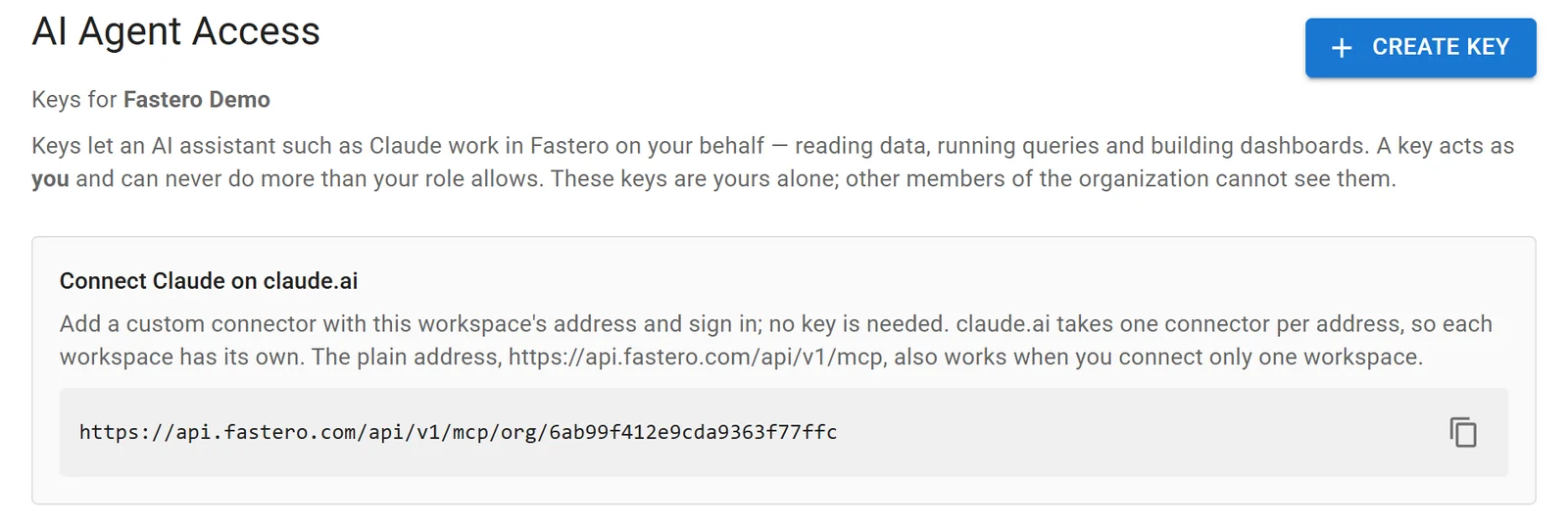
Fastero's AI Agent Access settings. Sample data.
Deploys and infrastructure
Vercel: claude mcp add --transport http vercel https://mcp.vercel.com. It accepts only clients Vercel has reviewed, Claude Code among them, and since July 2026 it can deploy as well as read.
Cloudflare's Code Mode server, https://mcp.cloudflare.com/mcp, covers the whole Cloudflare API with four tools in about 1,000 tokens, where full definitions of its 2,500 endpoints would run past a million. Most of Cloudflare's older per-product servers are deprecated.
What servers cost in context
Every connected server used to load all its tool definitions into each session. Tool search changed that: it is on by default, so only tool names and server instructions load at session start, and a tool's full definition loads when Claude needs it. Advice that tool search starts once tools fill 10% of the context describes January 2026, not today.
It still pays to look:
/context allshows how many tokens each loaded MCP tool uses, and/mcpshows each server's tool count./usageattributes recent usage to individual MCP servers on Pro, Max, Team and Enterprise plans.- Large results are capped. Claude Code warns when a tool's output passes 10,000 tokens and caps it at 25,000 by default;
MAX_MCP_OUTPUT_TOKENSchanges the cap, and a longer result is saved to a file instead. - Narrow a server where you can: GitHub's toolsets and read-only header, Supabase's
read_onlyandproject_ref, Neon'sreadonly, Linear's read-only address, Chrome DevTools'--slim, PostHog'sfeatures.
Servers to skip
- The archived reference servers. On 29 May 2025, the MCP project archived its reference servers for PostgreSQL, SQLite, Puppeteer, GitHub, GitLab, Slack, Sentry, Brave Search, Google Drive, Google Maps, Redis and others, with the warning that "no security updates or bug fixes will be provided". Many lists still link them. Use the vendor's own server instead.
- Servers for what Claude Code already does. Filesystem, Git and Fetch servers duplicate built-in tools.
- Deprecated versions of good servers: Notion's local server, Neon's local package, Atlassian's v1 address, Cloudflare's per-product servers, and Stripe with a secret key, which Stripe's server stops accepting in December 2026.
Keep servers safe
- Project servers ask first. Claude Code asks before using servers from a repository's
.mcp.jsonin an interactive session, so a repository you clone can't start programs on your machine without your consent.claude mcp reset-project-choicesresets your answers. Inclaude -p, the Agent SDK and cloud sessions, project servers load without asking. - Keep tokens out of git. Write
Bearer ${GITHUB_MCP_TOKEN}in.mcp.jsonand set the variable in your shell, rather than committing the token. Use a name of your own: Claude Code never puts its own or your cloud provider's credentials into a remote server's headers, even when.mcp.jsonasks. - Give database servers a read-only login, and treat anything a server returns as data, not instructions: a page, an issue or a table can contain text written to steer the model.
FAQ
How do I add an MCP server to Claude Code?
Run claude mcp add --transport http <name> <url> for a remote server, or claude mcp add <name> -- <command> for a local one, then /mcp to sign in if the server uses OAuth. Add --scope user to make it available in every project.
Where does Claude Code store MCP servers?
In ~/.claude.json for the local and user scopes, and in .mcp.json at the repository root for project scope. Claude Code doesn't read Claude Desktop's config file; claude mcp add-from-claude-desktop imports from it on macOS and WSL.
Do MCP servers use up Claude Code's context?
Much less than they did. Tool search, on by default, loads only tool names at the start of a session and fetches full definitions when Claude needs them. /context all shows what each tool costs.
Can Claude Code use my claude.ai connectors?
Yes, when you sign in to Claude Code with your claude.ai account: connectors you added in claude.ai appear automatically. With an API key, Amazon Bedrock or another provider, they don't load.
What's the best MCP server for a database in Claude Code?
Your database provider's own server if it has one: Supabase, Neon, BigQuery or MotherDuck, with read-only options switched on. For several databases at once, and for dashboards your team opens from the results, Fastero connects them all through one connector.
Are there free MCP servers for Claude Code?
Playwright and Chrome DevTools are free and open source, PostHog charges nothing to call its server, and Context7 includes 1,000 calls a month. Most other servers come with the service's own plan.
Related reading:
- Best Claude Code plugins
- Claude Code routines, now called scheduled tasks
- Postgres MCP server: connect Claude to PostgreSQL
- Best MCP servers for data analysis
- Claude Code for data analysis: 7 setups that work
- MCP registry and marketplaces compared
Sources: Connect Claude Code to tools via MCP, MCP quickstart, Manage costs, Tools reference, Claude in Chrome, GitHub MCP server and its default toolsets, Context7 and plans, Playwright MCP, Chrome DevTools MCP, Sentry MCP, Linear MCP, Atlassian Rovo MCP, Notion MCP, Figma MCP and rate limits, Supabase MCP, Neon MCP, BigQuery MCP, PostHog MCP, Vercel MCP, Cloudflare MCP, Stripe MCP, MCP reference servers and archived servers. Checked 21 October 2026.
Try Fastero free — give Claude Code read-only access to your team's databases, and somewhere to put the dashboards and apps people open. No credit card required.