 Fastero Dev Team
Databricks pricing is based on compute: you pay for DBUs, at a price set by workload, cloud, tier and sometimes region, and on classic compute you also pay your cloud provider for the machines. We read Databricks' own price data and priced three ordinary workloads with a small script.
The short answer: Databricks charges per DBU, billed by the second. On AWS's Premium tier in US East, checked 20 November 2026, a DBU costs $0.15 for classic jobs, $0.55 for a classic all-purpose (notebook) cluster, $0.35 for serverless jobs, $0.75 for serverless notebooks, and $0.22, $0.55 or $0.70 for a Classic, Pro or Serverless SQL warehouse. Classic compute runs on machines in your own cloud account, which your cloud provider bills on top; serverless prices include the machines. Free Edition costs nothing for non-commercial use, and the 14-day trial gives "Up to $400 in credits". Our calculator put three small example workloads at $699 a month on AWS, $503 of it for one dashboard's SQL warehouse.
Fastero
Jupyter notebooks for your team, with nothing to install.
Start a notebook or bring your .ipynb files. SQL cells query your databases with no password in the code, and a notebook runs now or on a schedule. Colleagues open it with their own login; viewers are free.
Try free →What a DBU is
Databricks calls it "a normalized unit of processing power on the Databricks Lakehouse Platform used for measurement and pricing purposes." How many you use depends on the compute:
- Classic clusters use a fixed number per machine per hour: 0.69 for an AWS m5.xlarge (4 vCPUs, 16 GB) in Databricks' data, 1.00 for an Azure D4ds v5 on Microsoft's page. Photon, the faster engine, multiplies that: Databricks' pages give 2X, 2.5X and 2.9X.
- SQL warehouses are sized in DBUs: 2X-Small uses 4 an hour, Small 12, Medium 24, 4X-Large 528.
- Serverless jobs and notebooks have no published rate: "The best way to estimate serverless DBUs is to run a few representative workloads on serverless and measure the resultant DBUs."
Databricks price per DBU in 2026
From the data behind Databricks' pricing pages, checked 20 November 2026, in US dollars per DBU, for US East (N. Virginia) on AWS, US East on Azure and US (Virginia) on Google Cloud:
| Workload | AWS Premium | AWS Enterprise | Azure Premium | Google Cloud Premium |
|---|---|---|---|---|
| Jobs, classic cluster | $0.15 | $0.20 | $0.30 | $0.15 |
| Jobs, serverless | $0.35 | $0.45 | $0.45 | $0.35 |
| All-purpose, classic cluster | $0.55 | $0.65 | $0.55 | $0.55 |
| Notebooks, serverless | $0.75 | $0.95 | $0.95 | $0.75 |
| SQL Classic / Pro / Serverless | $0.22 / $0.55 / $0.70 | Same | Same | Same |
| Model serving | $0.07 | $0.07 | $0.07 | $0.07 |
- Azure has no Enterprise tier. "The Premium tier on Azure Databricks corresponds to the Enterprise tier on AWS and GCP." Against AWS Enterprise, Azure charges 50% more for classic jobs and 15% less for all-purpose clusters. Microsoft sets and bills Azure's prices, and its page matches these. Google Cloud's Enterprise prices match AWS's.
- The Standard tier is gone, upgraded to Premium "effective October 1, 2025 on AWS and GCP, and October 1, 2026 on Azure."
- Region changes some prices. Classic jobs, all-purpose and SQL Classic cost the same in all 18 commercial AWS regions. Serverless SQL runs from $0.70 in US East to $1.09 in Zurich, SQL Pro from $0.55 to $0.85.
- GPU model serving is a fixed number of DBUs per GPU per hour: 10.48 for a T4, 20 for an A10G, 100 for an H100, so $0.73, $1.40 and $7.00 an hour.
Classic vs serverless: who pays for the machines
| Classic clusters, Classic and Pro SQL warehouses | Serverless | |
|---|---|---|
| Machines run in | Your AWS, Azure or Google Cloud account | Databricks' account |
| Machine bill | "Pay separately for underlying instances to the cloud provider" | "Price fully inclusive of underlying instance costs" |
| Startup | Jobs clusters "Typically 4-6 minutes"; SQL warehouses about 4 minutes | Performance Optimized jobs "Less than a minute"; SQL warehouses 2 to 6 seconds |
| Default shutdown when idle | Classic and Pro warehouses 45 minutes; clusters 10 to 10,000 minutes, as you set | Serverless warehouses 10 minutes; "billed with a one-minute minimum" |
Until it shuts down, an idle warehouse or cluster keeps billing DBUs and, on classic, machines. Serverless jobs also have a Standard mode that starts in "Typically 4-6 minutes" and is "Up to 70% cheaper for some workloads than Performance Optimized mode".
Three workloads, priced out
The workloads are examples, not measurements:
- A. A nightly job: 1 hour a night, 30 nights, on a classic jobs cluster of three m5.xlarge machines (a driver and two workers).
- B. A shared notebook cluster: the same three machines as an all-purpose cluster, 4 hours a workday for 22 workdays, shutting down after 30 idle minutes.
- C. A dashboard's SQL warehouse: serverless, 2X-Small, 8 hours a workday with the default 10-minute shutdown.
The script reads every price from files saved on 20 November 2026: Databricks' price data, AWS's EC2 prices (an m5.xlarge is $0.192 an hour on demand in US East) and Microsoft's Azure page, which lists machine prices beside DBU prices. It ran in a Python 3.14.3 venv. Real output, with the input echo and sections 2 and 3 (AWS Enterprise and Azure) left out:
1) AWS, Premium tier, US East (N. Virginia)
Workload                                                 Hours    DBUs  $/DBU  DBU cost   VM cost     Total
A. Nightly job, classic jobs cluster                      30.0    62.1   0.15     $9.31    $17.28    $26.59
B. Shared notebook cluster, all-purpose                   99.0   204.9   0.55   $112.71    $57.02   $169.74
C. Dashboard on a serverless SQL warehouse, 2X-Small     179.7   718.7   0.70   $503.07  included   $503.07
All three, per month                                                            $625.09    $74.30   $699.40

4) Workload C on each SQL warehouse type, Azure US East, 2X-Small, default Auto Stop, 22 workdays
Type         Auto Stop  DBU/h  $/h DBU  $/h VM $/h total      Month
Classic         45 min      4    0.880   1.152     2.032    $391.16
Pro             45 min      4    2.200   1.152     3.352    $645.26
Serverless      10 min      4    2.800   0.000     2.800    $503.07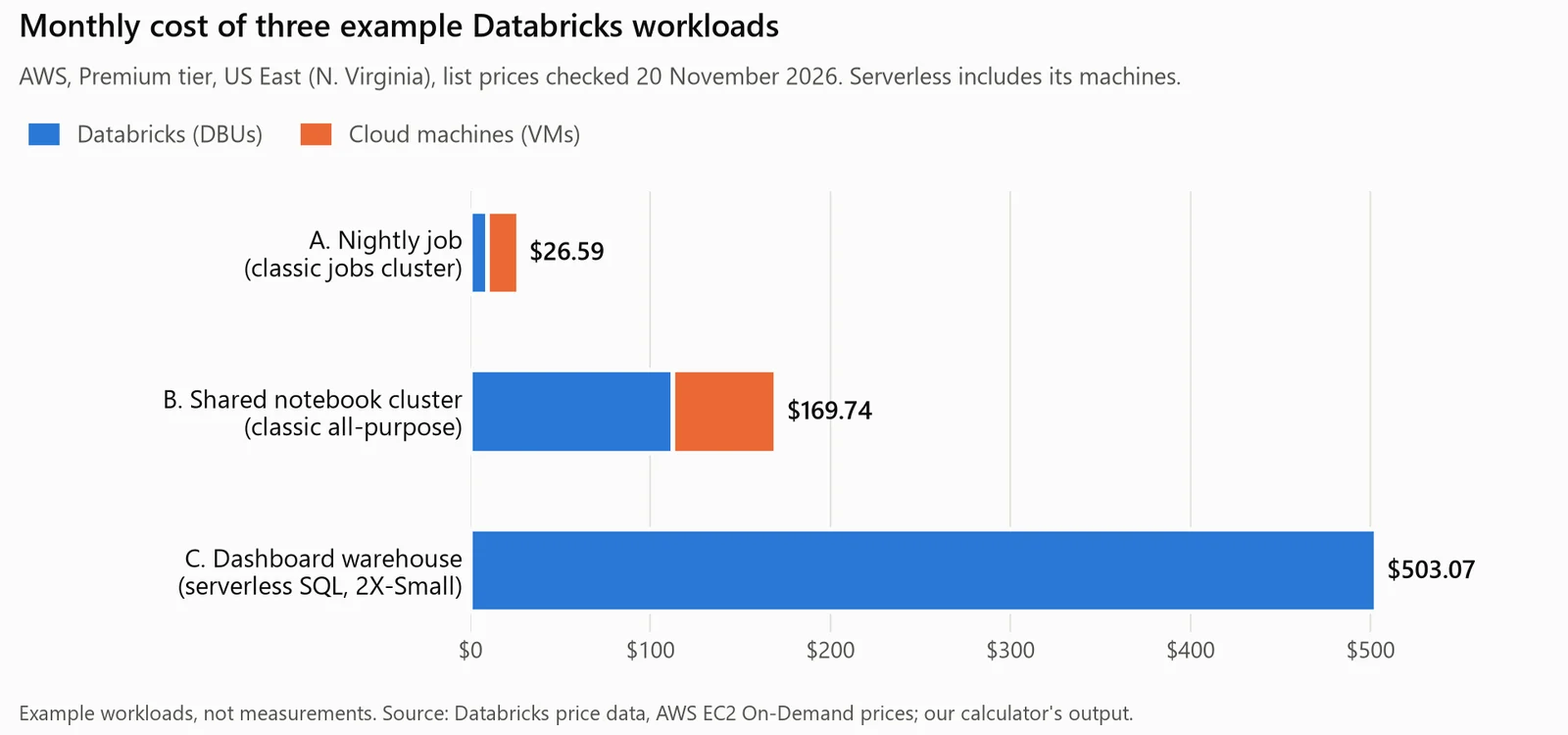
Section 1 of the calculator's output, drawn: on the two classic workloads part of the bill goes to AWS for machines, while serverless folds them into the DBU price. Example workloads, list prices checked 20 November 2026.
"Hours" includes the idle minutes before shutdown, so workload B bills 99 hours for 88 of use. What the numbers say:
- The dashboard is 72% of the AWS bill, and its price is the same on every tier.
- On a classic job, the cloud's bill is the bigger one: job A pays Databricks $9.31 and AWS $17.28.
- In the sections left out, Enterprise comes to $723.00, $23.60 more, all of it on the classic workloads, and Azure to $780.88, mostly because a D4ds v5 uses 1.00 DBU an hour to the m5.xlarge's 0.69 and classic jobs cost $0.30 a DBU there.
- Pro is the dearest warehouse once its machines are counted (section 4, on Azure, where Microsoft lists the machine price per size): $3.35 an hour against $2.80 for Serverless. Classic costs $2.03, but Databricks calls its performance "entry-level".
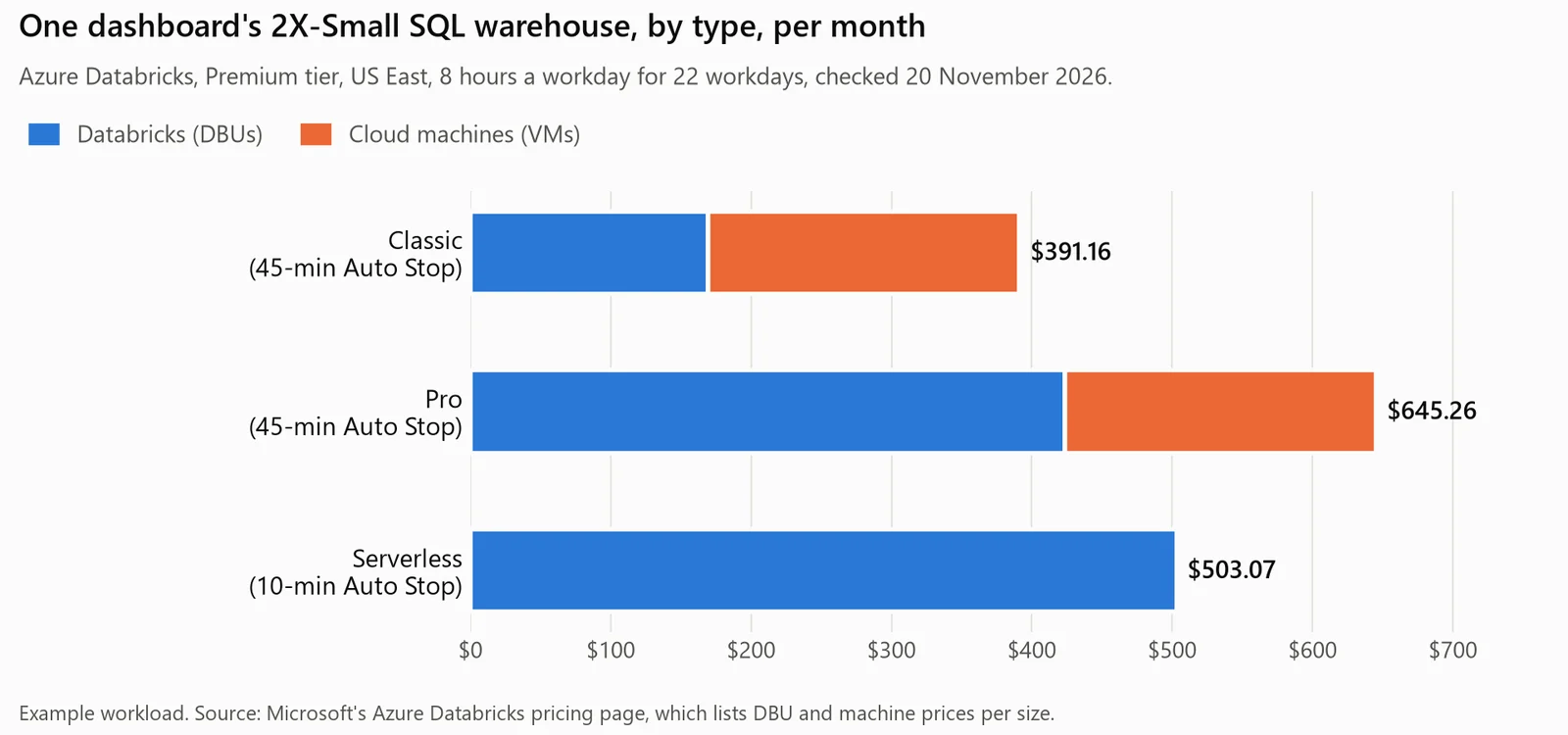
Section 4 of the output, drawn: Pro's machines and its 45-minute default Auto Stop make it the dearest of the three. Example workload, Microsoft's list prices checked 20 November 2026.
Not counted: classic startup minutes, Photon, and disks, storage and networking, which "will vary depending on the services you choose and your cloud service provider."
Jupyter notebooks for your team.
Start free →Free Edition and the free trial
As Databricks' docs describe them, checked 20 November 2026:
| Free Edition | 14-day free trial | |
|---|---|---|
| Price | "Forever free with daily limits on usage" | "Up to $400 in credits", valid for 14 days |
| For | "learning, training, and other non-commercial purposes" | "Designed for commercial use" |
| Compute | Serverless only; "One SQL warehouse, limited to a 2X-Small cluster size" | The full platform |
| Your data | "Databricks reserves the right to train on your data" | "Ability to connect proprietary data securely for POCs" |
Over Free Edition's quota, compute shuts down "for the rest of the day". In a trial on your own cloud account, "you will still be charged by your cloud provider for resources, like compute instances". More in our Free Edition guide.
Committed-use discounts
Databricks sells "Committed Use Contracts", where "The larger your usage commitments, the greater your benefits", through its sales team, with no discount table on its pricing pages. Microsoft publishes one for Azure: "up to 37% savings over pay-as-you-go DBU prices" when you pre-purchase Databricks Commit Units (DBCU) for 1 or 3 years. Worked out by our script from Microsoft's prices on 20 November 2026, a 1-year commitment saves 4% at the smallest tier (12,500 DBCU for $12,000), 11% at 100,000, 20% at 500,000 and 33% at 2,000,000; 3 years at 6,000,000 DBCU reaches the 37%.
The three example workloads use $8,321 of Azure DBUs a year at list price, less than the smallest tier, so a commitment would cost them more than paying as they go.
When Databricks is worth it
When the data doesn't fit on one machine and the work is Spark: large pipelines, streaming, shared Delta Lake tables, model training on GPUs and model serving, governed by Unity Catalog. It's a poor fit for SQL over a few gigabytes, or a notebook that reads a Postgres database each morning: workload C costs about $500 a month for one dashboard. See Databricks vs DuckDB and the best Databricks alternatives.
When the notebook is for a team, not a cluster
For everyday notebooks that query a company database, run on a schedule and get read by colleagues, Fastero is an AI and data platform where people and AI agents work together on a team's data:
- Cron schedules on the Free plan, which is $0 with no end date and includes notebooks and Python for up to 6 hours a day.
- SQL cells query a saved connection (Postgres, MySQL, SQL Server, Redshift, Oracle or BigQuery) with its stored credentials and hand the result to Python as a pandas DataFrame. Notebooks read uploaded CSV and Excel files too.
- Secrets reach cells as environment variables, so no password sits in the notebook.
- Viewers are free. Pro is $20 per editor a month, with 750 compute hours per editor.
- No Spark and no GPUs: 1 CPU and 2 GB per workspace server. For Spark-sized data or model training, use Databricks.
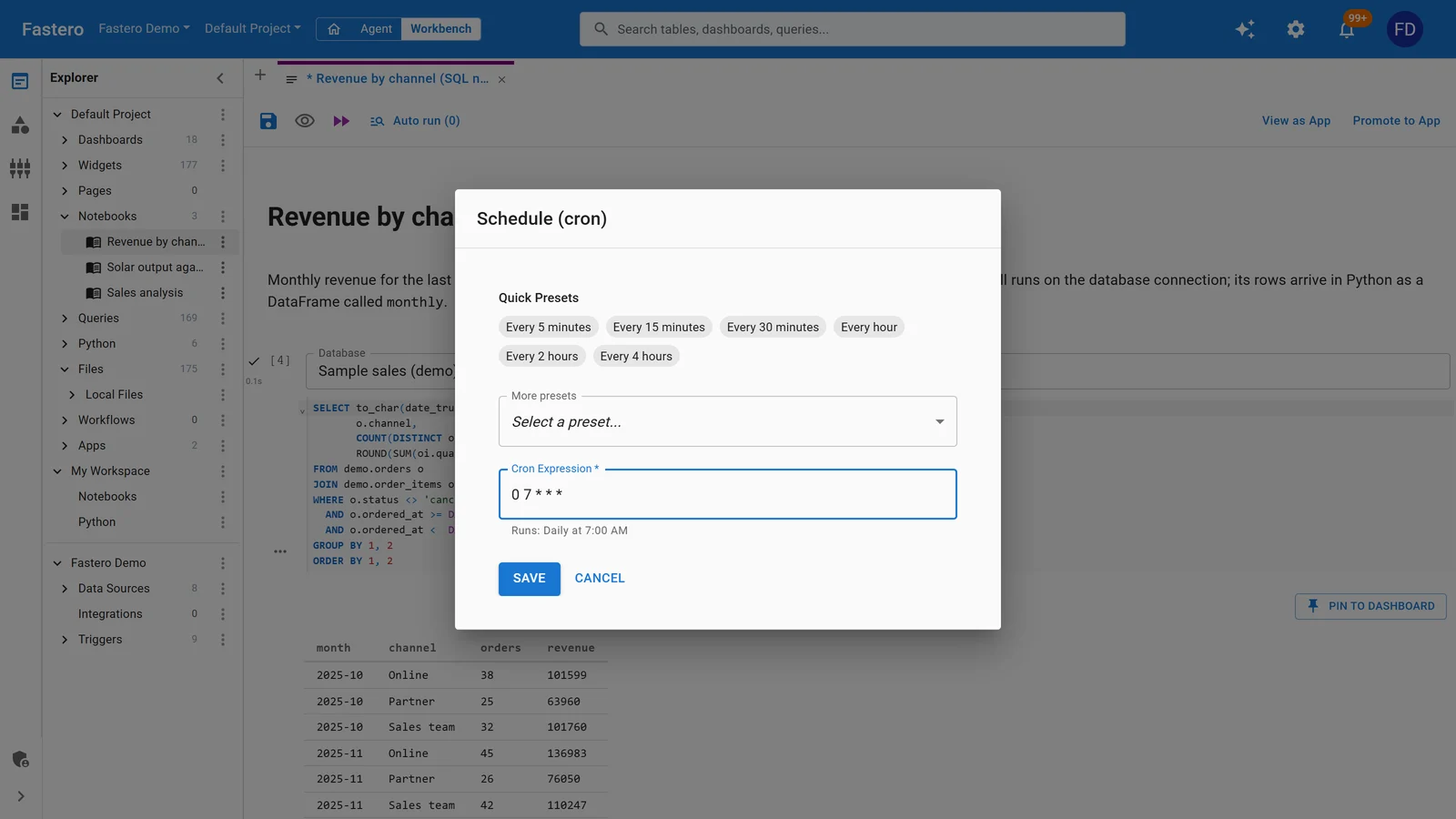
Scheduling a notebook in Fastero: presets or any cron expression. Sample data.
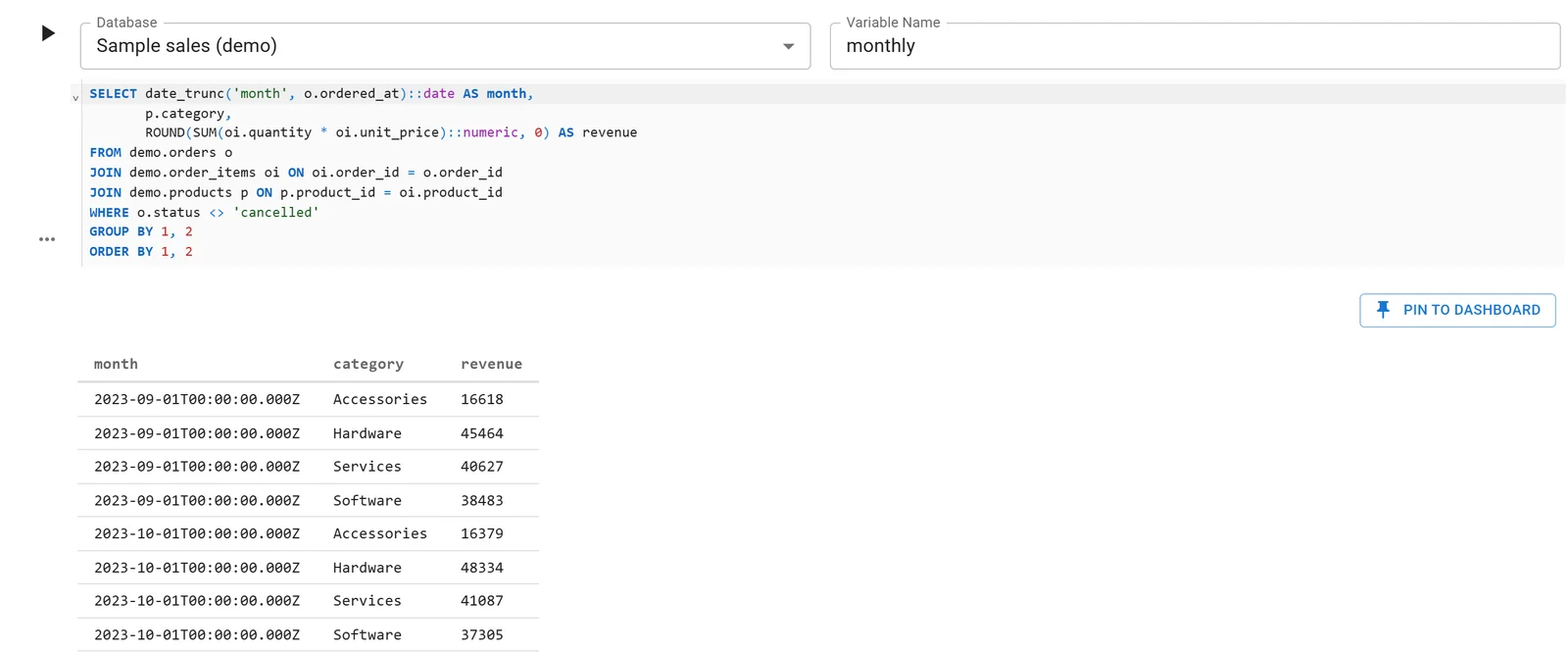
A Fastero notebook whose SQL cell reads a database connection; the rows arrive in Python as a DataFrame. Sample data.
How the notebooks themselves compare: Jupyter vs Databricks notebooks.
FAQ
How much does Databricks cost per hour?
It depends on the compute. At AWS Premium list prices in US East, checked 20 November 2026, a 2X-Small serverless SQL warehouse costs $2.80 an hour, and a classic three-node m5.xlarge jobs cluster about $0.89: $0.31 to Databricks and $0.58 to AWS.
What is a DBU in Databricks?
A Databricks Unit, "a normalized unit of processing power" billed by the second. Each classic machine uses a fixed number of DBUs an hour, and each workload type has its own price per DBU.
Is Databricks free?
Free Edition is, for non-commercial use, under a daily quota Databricks doesn't publish. For work there's a 14-day trial with up to $400 of credits, then pay as you go.
Does Databricks pricing include AWS or Azure costs?
Serverless prices include the machines. Classic clusters and Classic or Pro SQL warehouses run in your cloud account, and the provider bills the machines separately; on Azure, Microsoft bills both.
What's the difference between Databricks Premium and Enterprise?
Enterprise costs more for jobs and notebooks ($0.20 against $0.15 a DBU for classic jobs on AWS) and the same for SQL warehouses, and adds "Advanced compliance and security for mission-critical data". Azure's Premium tier corresponds to Enterprise elsewhere.
Sources
Read on 20 November 2026. Databricks' pricing pages load their prices from a data file, which we read directly; the numbers are the ones the pages display.
- Databricks: Pricing and FAQ, Lakeflow Jobs, SQL warehouses, Interactive workloads, Model Serving, Tiers, price data (cards.json, AWS.json)
- Databricks docs: Free Edition limitations, Free trial, Free trial vs Free Edition, SQL warehouse types, Create a SQL warehouse, Manage compute
- Azure Databricks pricing (Microsoft), AWS EC2 On-Demand pricing