 Fastero Dev Team
Every guide to "getting serious about data" draws the same picture: a tool that copies data out of your apps, a warehouse to store it, a tool to clean it, and a BI tool to chart it. It's a good architecture. It's also four vendors, four contracts, four logins and someone who has to wire them together and notice when a step breaks. For a company of 10 or 50 people, that's often why the project never starts.
The short answer: the modern data stack is a set of cloud tools, one per layer: a loader such as Fivetran or Airbyte, a warehouse such as Snowflake or BigQuery, a transformation tool such as dbt, and a BI tool such as Power BI, Tableau, Looker or Metabase. At today's list prices, a five-person team on common choices pays roughly $1,200 a month before storage and overages, plus the time to run it. It's the right choice when you have many SaaS sources at high volume and someone whose job is data. If your data is mostly in a database and a few apps, a single workspace that connects them, holds the definitions, runs the code and shares the dashboards does the same job with one bill.
Fastero
Connect your database. Ask questions. Get dashboards.
Postgres, BigQuery, Snowflake, and 10+ sources — live-connected, AI-powered, no dashboard builder learning curve.
Try free →What's in a modern data stack
IBM defines it as "integrated, cloud-based tools and technologies that enable the collection, ingestion, storage, cleaning, transformation, analysis and governance of data." In practice:
| Layer | Job | Common tools |
|---|---|---|
| Loader (ELT) | Copies data out of Stripe, HubSpot, ad accounts and databases on a schedule | Fivetran, Airbyte |
| Warehouse | Stores it all in one place and runs the queries | Snowflake, BigQuery, Redshift, Postgres |
| Transformation | Turns raw tables into clean ones and defines metrics | dbt |
| BI | Dashboards, reports and sharing | Power BI, Tableau, Looker, Metabase |
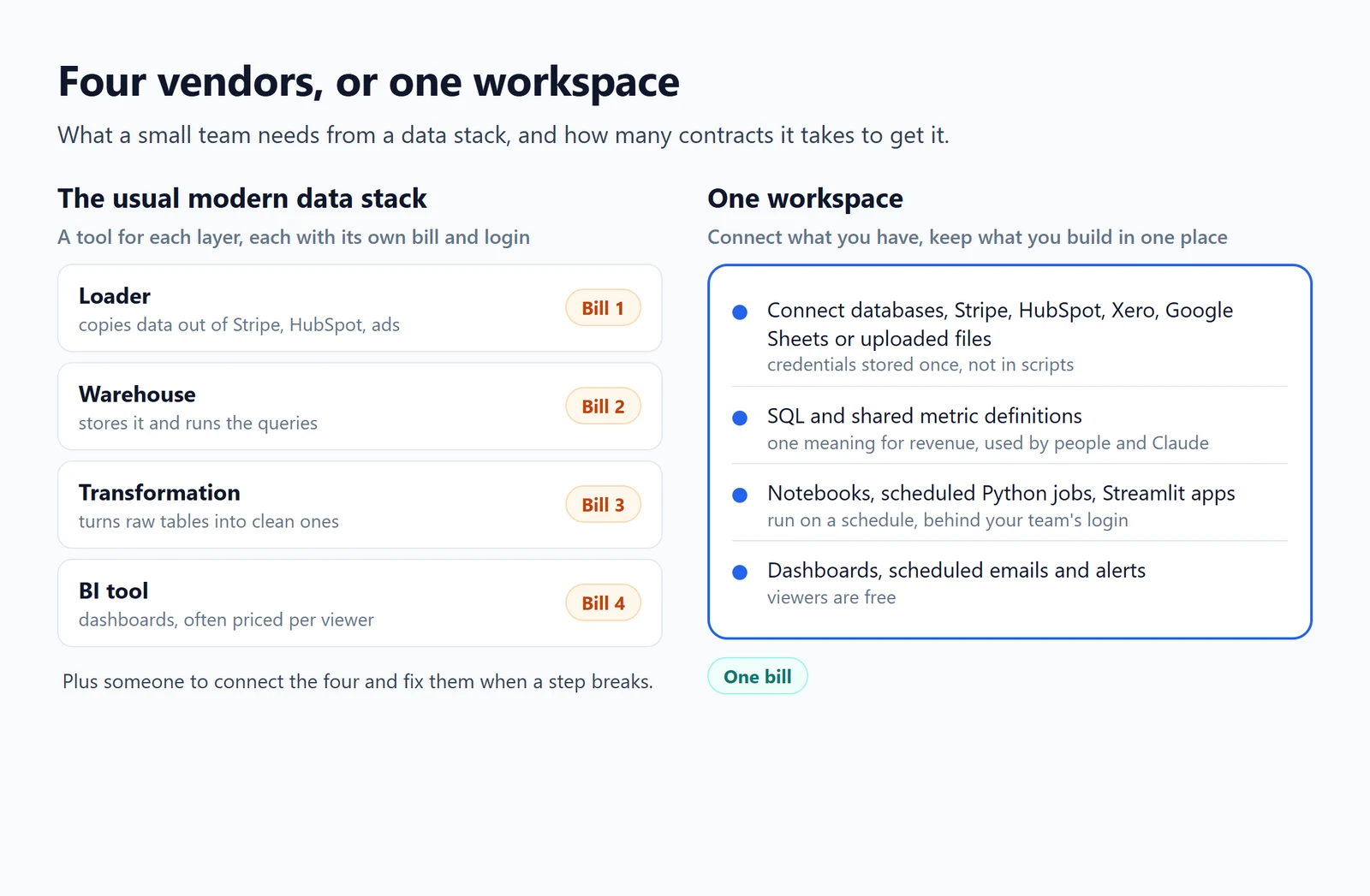
The four layers of the usual stack, each with its own bill, against one workspace.
What each layer costs in 2026
List prices from each vendor's own pricing page, checked 5 November 2026:
| Layer | Vendor and plan | List price | Free tier or catch |
|---|---|---|---|
| Loader | Fivetran Free | Free | Up to 500,000 monthly active rows |
| Loader | Fivetran Standard | Usage-based; Fivetran's own example for four connectors totals $511.15 a month | From 1 January 2026, a $5 base charge per connection, and deleted rows count as paid rows |
| Loader | Airbyte Cloud Standard | From $20 a month, 5 credits included | Airbyte Core is free to host yourself |
| Warehouse | Snowflake Standard | $2.00 per credit (AWS US East); the smallest warehouse uses 1 credit an hour | Storage $23.00 per TB a month; 60-second minimum each time a warehouse starts |
| Warehouse | BigQuery on-demand | $6.25 per TiB of data queried | The first 1 TiB of queries and 10 GiB of storage each month are free |
| Transformation | dbt Developer | Free | One developer seat |
| Transformation | dbt Starter | $100 per user a month | Includes the dbt Semantic Layer |
| BI | Power BI Pro | $14.00 per user a month, paid yearly | Up from April 2025; sharing reports needs Pro or Premium |
| BI | Tableau | From $15 per user a month (Standard), billed annually | Every deployment needs at least one Creator licence; Tableau no longer lists Creator prices |
| BI | Looker | "Call sales" | Standard edition is for teams under 50 users |
| BI | Metabase Cloud Starter | $100 a month, first 5 users included, then $6 per user | Open-source version is free to host yourself |
Three changes in 2026 worth knowing: Fivetran's $5 minimum per connection; the merger of Fivetran and dbt Labs on 1 June 2026, so the loader and the transformation tool are now one company; and Tableau showing only a "Starting at" price on its site.
A worked example: five people, four bills
An illustration at list prices, for a five-person team that wants dashboards on Stripe, HubSpot, ads and its product database:
| Bill | Assumption | Monthly cost |
|---|---|---|
| Fivetran Standard | Fivetran's own four-connector example | $511.15 |
| Snowflake Standard | Smallest warehouse, running 2 hours a day | $120 plus storage |
| dbt Starter | 5 seats | $500 |
| Power BI Pro | 5 users | $70 |
| Total | about $1,200 a month before storage and overages |
You could cut it: BigQuery's free tier instead of Snowflake, dbt's free seat for one person, Metabase hosted yourself. Each cut moves cost from the bill to someone's time.
The cost that isn't on any bill
Four tools means four things that can break, and they break between each other. A loader's API token expires, a column is renamed upstream, a dbt model fails, and the dashboard quietly shows last week's numbers. Somebody needs to know how all four fit together, watch them and fix them. In a big company that's a data team. In a small one it's usually the founder or an engineer doing it on the side, which is exactly the person who doesn't have time.
When the full stack is the right choice
Be honest about when the four-vendor version is worth it:
- Many SaaS sources at volume. Dozens of apps whose data you need joined, where a maintained loader saves real engineering time.
- Heavy transformations. Complex modelling, slowly changing dimensions and tests that benefit from dbt's tooling.
- A data team. People whose job is the pipeline and who'll own it.
- Scale. Data volumes or query loads that need a warehouse's separation of storage and compute.
If that's you, the stack earns its cost. If not, you're paying for layers you don't use.
Connect any database. Ask in plain English.
Connect database →The small-team version: one workspace
Most small companies have their important data in a few places: a production database, Stripe, a CRM, a spreadsheet or two. What they need is to query those in one place, agree what the numbers mean, run the odd script, and share dashboards without paying for every viewer. That's what a single workspace does.
In Fastero:
- Connect what you have, once. Postgres, MySQL, SQL Server, Redshift, BigQuery and Athena, plus Stripe, HubSpot, Xero and Google Sheets, or upload a CSV or Excel file. Credentials are stored in the workspace, not in scripts. Apps Fastero doesn't connect yet can be requested from the same page.
- Agree the numbers. Save metric definitions as SQL expressions, so revenue means one thing on every dashboard and in every AI answer.
- Run code where the team can see it. Notebooks with SQL cells, Python jobs on a schedule, and Streamlit apps behind your team's login.
- Share without per-viewer pricing. Dashboards refresh on a schedule, go out by email, and can raise an alert when a number crosses a line. Viewers are free.
- Let AI work on it safely. Claude connects through Fastero's connector with each person's own permissions and read-only SQL.
The bill is one line: Fastero is free to start, with no card. Pro is $20 per editor a month, with $10 of AI usage, always-on apps and 750 compute hours per editor included, and viewers are free.
How to decide in an afternoon
- List your sources. If it's fewer than about ten and most data is in one database, start with one workspace.
- List who builds and who reads. Count editors and viewers separately: per-viewer BI pricing is where small teams overspend.
- List what breaks today. If it's the glue between tools, fewer tools is the fix.
- Start small and keep the exit open. Write definitions in SQL and keep code in notebooks and Git, so moving to a bigger stack later is a migration, not a rewrite.
FAQ
What is a modern data stack?
A set of cloud tools, one per job: a loader that copies data from your apps, a warehouse that stores it, a transformation tool that cleans it, and a BI tool that charts and shares it. Fivetran, Snowflake, dbt and Power BI are a common combination.
How much does a modern data stack cost a small company?
At list prices, around $1,200 a month for five people on Fivetran, Snowflake, dbt Starter and Power BI Pro, before storage and overages. Free tiers can bring it down, at the cost of more hands-on work.
Is there a free modern data stack?
You can assemble one from free tiers: Fivetran's free plan (500,000 monthly active rows), BigQuery's first 1 TiB of queries and 10 GiB of storage a month, a free dbt developer seat and a self-hosted Metabase. It works for small volumes and needs someone to run it.
Why did my Fivetran bill go up in 2026?
From 1 January 2026 Fivetran applies a $5 base charge to each connection with between 1 and 1 million monthly active rows, and deleted rows now count toward paid usage.
Do small companies need a data warehouse?
Often not at first. If most of your data already sits in a Postgres or MySQL database, you can query it directly, read-only, and add a warehouse when volumes or the number of sources demand one.
Related reading:
- What is a semantic layer?
- Automated reporting
- Run a Python script online, on a schedule
- Connect multiple databases to one dashboard without a warehouse
- Best free dashboard tools
Sources: IBM: modern data stack, Fivetran pricing, Fivetran usage-based pricing, Airbyte pricing, Snowflake pricing, BigQuery pricing, dbt pricing, Power BI pricing, Power BI price update, Tableau pricing, Looker pricing, Metabase pricing, TechTarget on the Fivetran and dbt Labs merger. Prices checked 5 November 2026; list prices only, before discounts and taxes.
Try Fastero free — connect your database and apps, agree the numbers, and share dashboards with free viewers, on one bill. No credit card required.