

I keep seeing the same question on every data team Slack, Reddit thread, and Hacker News post: "We need open-source BI -- should we use Superset, Metabase, or Redash?" The answers always turn into a flame war between people who picked different tools three years ago and are now emotionally invested.
Here's the thing: all three tools connect to databases, run queries, and produce charts. But they were designed for different people, and picking the wrong one for your team means you'll fight the tool for the next two years instead of using it. I've deployed all three in production, and the differences are not subtle once you live with them daily.
Quick decision matrix
If you want the short answer before the details:
- Your team is mostly non-technical users who need dashboards -- pick Metabase
- Your team is SQL-fluent and needs serious visualization and scale -- pick Superset
- You already run Redash and it works -- keep it, but plan your migration
- You're starting from scratch in 2026 -- do not pick Redash
The rest of this post explains why.
Architecture: three different animals
All three tools connect to external databases and let you query them. That's where the similarity ends.
Apache Superset is a Python/Flask application that grew out of Airbnb's data team around 2015. A production deployment involves Gunicorn (the app server), PostgreSQL or MySQL (for Superset's own metadata), Redis (for caching and session management), and Celery workers (for async query execution). The standard Docker Compose file spins up five to seven containers. Superset graduated to a top-level Apache Software Foundation project, and the managed version is Preset, built by Superset's original creator Maxime Beauchemin.
Metabase is built in Clojure and runs on the JVM. The simplest deployment is literally java -jar metabase.jar -- one process, one file, running in under a minute. It ships with an embedded H2 database for its own state (swap this for Postgres in production). Docker deployment is one container with one environment variable. The company behind it (Metabase, Inc.) offers Metabase Cloud starting at $85/month for a starter plan, plus Pro and Enterprise tiers.
Redash is Python/Flask, structurally similar to Superset but much lighter. A Docker Compose deployment runs four to five containers: the web server, a Celery worker, a scheduler, Redis, and PostgreSQL. Founded in 2013 by Arik Fraimovich, acquired by Databricks in 2020. The hosted service (Redash.io) shut down in 2023. The last major release was v10 in late 2021.
The architecture difference matters most at setup time and at scale. Metabase is the simplest to get running. Redash is moderate. Superset requires the most infrastructure knowledge but scales the furthest. For a detailed breakdown of what self-hosting each one actually entails, see our best self-hosted BI tools guide.
Fastero
Connect your database. Ask questions. Get dashboards.
Postgres, BigQuery, Snowflake, and 10+ sources — live-connected, AI-powered, no dashboard builder learning curve.
Try free →The visual query builder spectrum
This is the single biggest differentiator between the three tools, and it determines which teams will actually use them.
Metabase has the best visual query builder in open-source BI, and it's not close. The "notebook editor" lets users pick a table, add filters, choose groupings, select aggregation functions, and sort results -- all through dropdown menus. It handles JOINs (through their "Models" semantic layer), multi-step aggregations, and basic expressions. An account manager with zero SQL knowledge can answer "show me revenue by region for Q2" in three clicks. Metabase also has a SQL editor for power users, but the visual builder is the headline feature and the reason most teams choose it.
Superset has a chart exploration interface ("Explore" view) that lets you build visualizations from pre-defined datasets without writing SQL. You can pick metrics, add filters, choose dimensions, and configure chart options. It works, but it assumes you understand what a metric definition is and how datasets are structured. It's usable by someone who's data-literate but not SQL-fluent -- think a product manager who understands what "COUNT DISTINCT users WHERE signup_date > X" means conceptually, even if they wouldn't write that query. SQL Lab, Superset's dedicated SQL IDE, is where the tool really shines for hands-on analysts.
Redash has no visual query builder at all. You open Redash, you write SQL, you pick a chart type for the results. That's the entire workflow. If you don't write SQL, Redash offers you nothing. This is a feature, not a bug -- Redash was designed for engineering-adjacent teams who think in SQL and want the shortest path from query to dashboard. But it means the tool is useless for anyone who can't write a SELECT statement.
In my experience, this is the axis that matters most. If even 30% of your dashboard consumers are non-technical, Metabase's visual builder saves you from becoming a full-time dashboard-building service for your team.
Data source support
All three tools connect to the databases you'd expect, but the coverage varies.
Superset supports 30+ databases through SQLAlchemy. PostgreSQL, MySQL, ClickHouse, BigQuery, Snowflake, Redshift, Presto/Trino, Apache Druid, DuckDB, SQLite, and more. Adding a new database means installing a Python DB-API driver. Because Superset targets analytical workloads, the integrations with columnar and OLAP databases (ClickHouse, Druid, Presto) are well-tested and performant.
Metabase supports around 20 databases natively, including PostgreSQL, MySQL, MongoDB, BigQuery, Snowflake, Redshift, Spark SQL, SQLite, and H2. Community drivers extend coverage to ClickHouse, DuckDB, and others. Metabase's driver system is Java-based, so adding a new driver requires more effort than Superset's Python approach.
Redash historically had the widest connector list -- 40+ data sources, including non-database sources like Google Sheets, Google Analytics, Jira, Salesforce, and REST APIs. This was a genuine advantage: you could query a Google Sheet alongside your Postgres database. The catch in 2026 is that many of these connectors haven't been updated to match API changes in the external services. The Google Analytics connector, for example, still targets Universal Analytics, not GA4. Several community members maintain updated drivers, but you need to check individually whether the connector you need actually works with current API versions.
The three-way comparison table
| Apache Superset | Metabase | Redash | |
|---|---|---|---|
| Language | Python (Flask) | Clojure (JVM) | Python (Flask) |
| GitHub stars | ~64k | ~40k | ~26k |
| Last major release | 4.1 (2026) | 0.52 (2026) | v10 (late 2021) |
| Release cadence | Monthly | Monthly | Stalled |
| License | Apache 2.0 | AGPL v3 | BSD-2-Clause |
| Visual query builder | Basic (Explore view) | Excellent (notebook editor) | None |
| SQL editor | Excellent (SQL Lab) | Functional | Good, with parameterization |
| Chart types | 40+ | ~20 | ~15 |
| Semantic layer | Datasets + calculated metrics | Models (lightweight) | None |
| Access control | Full RBAC, row-level security | Basic groups + permissions | Basic groups, data source perms |
| Embedding | Improving (guest tokens, iframe) | Mature, well-documented (JWT iframe) | Basic iframe |
| Database support | 30+ (SQLAlchemy) | ~20 native + community drivers | 40+ (but many outdated) |
| Self-host complexity | High (5-7 containers) | Low (1 container) | Moderate (4-5 containers) |
| RAM for comfortable use | 4-8 GB | 2-4 GB (JVM) | 2-4 GB |
| Managed option | Preset (free tier, $20/user/mo Pro) | Metabase Cloud ($85/mo starter) | None (hosted shut down) |
| Parameterized queries | Jinja templates | Dashboard filters | {{param}} syntax (best-in-class) |
| Community health (2026) | Active (Apache project, Preset-funded) | Active (company-backed) | Minimal (community forks) |
| Custom viz plugins | Yes (plugin system) | Limited | No |
| API | Full REST API | Full REST API | Full REST API |
Community health in 2026: the real differentiator
Here's where sentiment and reality diverge. People who picked Redash in 2018 still recommend it based on their experience -- but the project's trajectory has changed fundamentally.
Superset is the most actively developed of the three. As a top-level Apache project, it has a large contributor base, regular releases, and corporate backing from Preset. The GitHub repo sees hundreds of commits per month. New chart types, performance improvements, and security fixes land consistently. The community Slack is active. If you file a bug, someone will look at it.
Metabase has a well-funded company behind it. Monthly releases, responsive GitHub issue tracking, active Discourse forum. The codebase is mature and stable. Metabase, Inc. has been around since 2015 and has a sustainable business model through their cloud and enterprise offerings. You're betting on a real company, not just a community project.
Redash is in a fundamentally different position. Databricks acquired it in 2020 and effectively deprioritized the open-source version. The last major release (v10) shipped in late 2021. The GitHub repo is not archived -- issues still get discussed, and occasional security patches land -- but there are no roadmap updates, no major features in development, and no full-time maintainers. Community forks exist (notably some maintained by former contributors), but none has reached critical mass as a successor project. Some teams pin to a specific Docker image and run it indefinitely. That works until a database driver breaks or a CVE drops without a timely patch.
I want to be fair: Redash still runs. Thousands of teams use it in production right now and it doesn't spontaneously fall over. But "it still works" and "it's the right choice for a new deployment" are different statements.
Self-hosting: what it actually takes
Metabase: pull the Docker image, set MB_DB_CONNECTION_URI to a Postgres connection string, run the container. You can be querying your data in 10 minutes. The JVM wants 1-2 GB of RAM minimum, 4 GB for comfortable use with a medium-sized team. Upgrades are straightforward -- pull the new image, restart. A product manager can set this up on a Friday afternoon.
Redash: clone the repo, use the provided Docker Compose file (web server, worker, scheduler, Redis, Postgres). First boot takes 5-10 minutes. The Python dependencies are pinned in the repo, so builds are reproducible. Upgrades mean pulling a new image, running migrations, restarting. Someone with basic Docker knowledge can manage it. The gotcha in 2026 is that the Docker images on Docker Hub may lag behind community patches -- some teams build from source to include security fixes.
Superset: the official Docker Compose orchestrates Superset web, Celery workers, a Celery beat scheduler, Redis, and Postgres. Configuration happens through superset_config.py, a Python file where you set everything from secret keys to feature flags to database connection limits. This is powerful (you can configure anything) but it means you need someone who can read Python config files. First deployment realistically takes 30-60 minutes for someone experienced, longer if you're tuning things like async query timeouts, result caching, or RBAC policies. Production-grade Superset wants 4-8 GB of RAM and benefits from multiple workers.
The operational burden scales differently too. Metabase is one process -- monitoring it means watching one container. Superset has multiple processes that can fail independently -- a Celery worker crashing doesn't kill the web UI but silently breaks async queries. Redash sits in between.
Embedded analytics
If you're building a SaaS product and want to ship dashboards to your customers, embedding matters.
Metabase leads here. Signed JWT embedding lets you embed individual questions or full dashboards, controlling which filters are locked vs. user-facing. The Pro/Enterprise tier adds full-app embedding with white-labeling. The documentation is thorough, the API is stable, and plenty of production SaaS products run Metabase embeds.
Superset has a guest token API and iframe embedding that has improved significantly over the past two years. White-labeling requires custom CSS work and is less turnkey than Metabase's approach. The embedded experience is usable but rougher around the edges, and the documentation is thinner.
Redash supports basic iframe embedding. No signed tokens, no white-labeling, no fine-grained filter control. If embedding is a requirement, Redash is not a serious option.
The honest answer about Redash in 2026
I ran Redash for two years and genuinely liked it. The SQL-first philosophy, the parameterized queries, the fork-and-edit workflow -- these are well-designed features built by someone who understood how data engineers actually work.
But I would not start a new Redash deployment today. The reasons are practical, not philosophical:
- No new features. Superset and Metabase have shipped major improvements in semantic layers, visualization, and access control since 2022. Redash has not.
- Driver rot. Database connectors need maintenance as APIs and protocols evolve. Unmaintained connectors accumulate silent incompatibilities.
- Security risk. Dependencies go stale. Vulnerabilities in Python packages, Redis, or Postgres client libraries need timely patches. A project with no active maintainers cannot guarantee timely security responses.
- Hiring friction. New analysts joining your team will not have Redash experience. They'll have Metabase or Superset experience, or nothing. Training on a tool with no future is a hard sell.
If you already run Redash and it genuinely works for your team, there is no emergency. Keep running it. But start planning the migration -- not because it will break tomorrow, but because the forcing function (a driver update, a security issue, a team that outgrows the permission model) will eventually arrive.
Where all three share the same limitation
Superset, Metabase, and Redash all follow the same model: connect to a database, query it, visualize the results. That model works perfectly when your data is already consolidated in a warehouse.
But a lot of real-world analysis involves joining data that lives in different places -- Stripe transactions with CRM contacts, a warehouse table with a CSV from the finance team, database records with a spreadsheet someone emailed you. None of these three tools can do that without an ETL pipeline in between. If cross-source, ad-hoc analysis is your primary need rather than dashboarding against a single warehouse, tools like Fastero that combine database connections with file uploads and cross-source queries solve a different problem entirely.
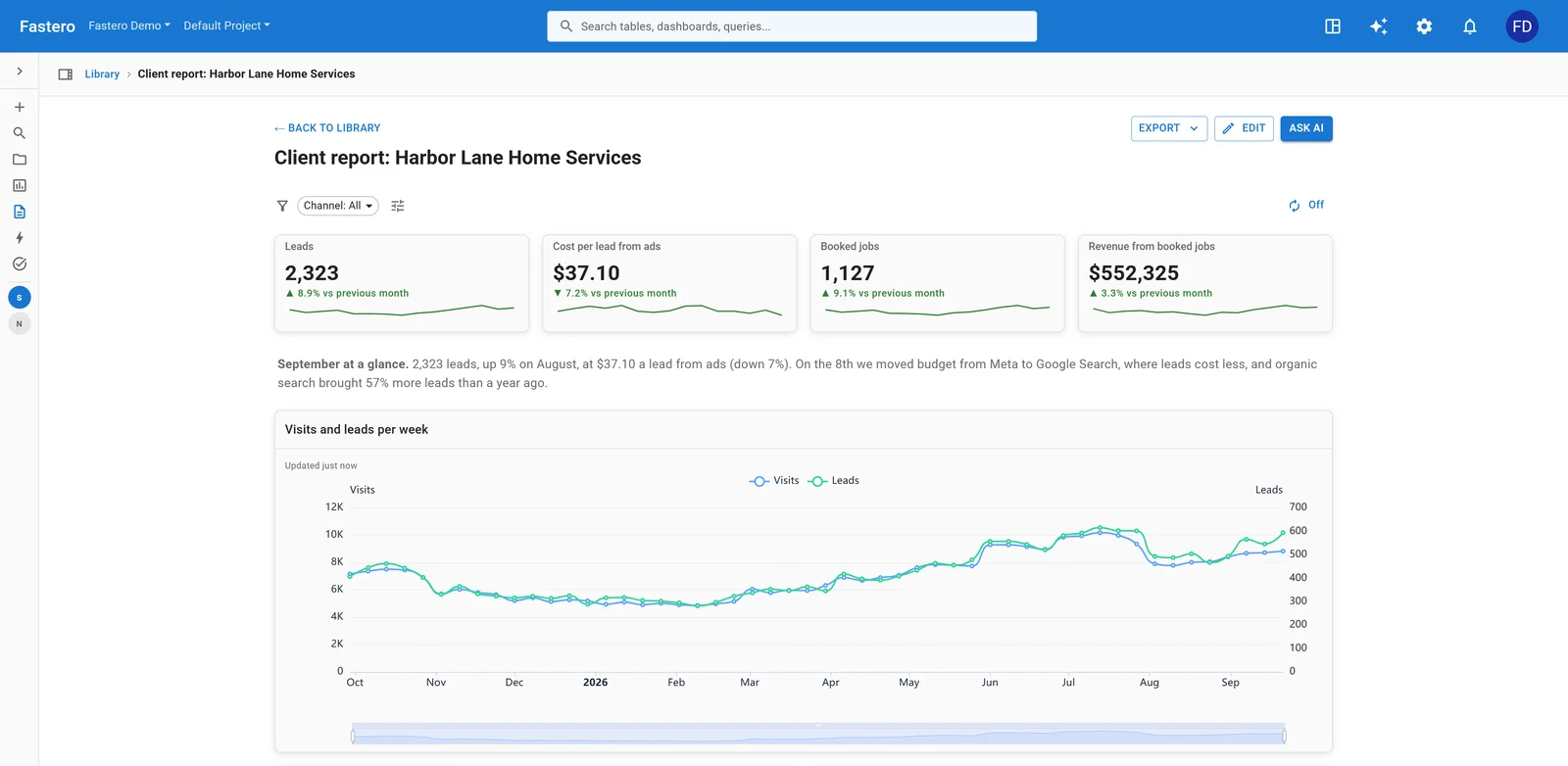
A dashboard in Fastero. Sample data.
My concrete recommendations
If your team is a mix of technical and non-technical people -- Metabase. The visual query builder means your ops team, account managers, and product managers can build their own dashboards. Your SQL-fluent analysts can still use the SQL editor. One tool serves both audiences. Start with Docker, point it at your database, hand it to your team.
If everyone writes SQL and you need serious visualization -- Superset. SQL Lab is a genuine productivity tool. The 40+ chart types, deck.gl maps, and plugin system cover edge cases that Metabase can't reach. Budget half a day for setup and expect to spend time on configuration, but the investment pays off quickly for data-heavy teams.
If you need embedded analytics in your product -- Metabase. The embedding support is more mature, better documented, and easier to white-label. Superset is catching up, but Metabase has a two-year head start in this area.
If you're scaling to hundreds of users on a large warehouse -- Superset. The stateless architecture with Celery workers scales horizontally. Metabase's JVM can become a bottleneck before the database does.
If you already run Redash -- keep it running, but start evaluating Superset (if your team is SQL-first) or Metabase (if you're growing to include non-SQL users). The migration is manual -- reconnect data sources, recreate queries, rebuild dashboards. Most teams prune 30-50% of their queries during the move because half of them were abandoned anyway.
If you're starting fresh in 2026 -- Metabase or Superset. Full stop. Redash had its moment, and it was a good tool. But adopting a project with no development trajectory in 2026 is a choice you'll have to explain to your team in 2027. If you also need to weigh these against enterprise options like Looker, see our Looker vs Metabase vs Superset comparison.
Related comparisons
If you're evaluating these tools, these head-to-head comparisons go deeper on each pair:
- Metabase vs Superset -- the most common two-way choice
- Metabase vs Redash -- visual builder vs SQL-only
- Superset vs Redash -- two SQL-first tools, different trajectories
- Grafana vs Metabase -- if monitoring dashboards are also in the picture
Try Fastero free — connect your database, ask questions in plain English, and get dashboards that update themselves — no BI tool learning curve. No credit card required.
Last updated: July 2026.