 Fastero Dev Team
Lovable turns a description into a working web app, and it is very good at it: it says its annualized revenue passed $600 million in September 2026. Pro costs $25 a month for 100 credits ($21 a month billed yearly), and since June 2026 building, hosting and the app's own AI all draw on that one balance. People look for alternatives when the credits run out faster than the app gets finished, when they want the code somewhere they control, or when the app is meant for colleagues and company data rather than the public.
The short answer: for the same kind of tool on different terms, try Bolt, v0 or Replit, but expect the same credit arithmetic, because their users complain about it too. If you can read code, Claude Code or Cursor builds in your own repository and you host the result wherever you like. If the app is an internal tool on company data, use a tool built for that: Retool for forms and admin panels, Databricks Apps or Streamlit in Snowflake if your data lives there, or Fastero for Python data apps your team signs in to. Skip Firebase Studio and GitHub Spark, which some lists still include: both have stopped taking new users.
Fastero
Connect your database. Ask questions. Get dashboards.
Postgres, BigQuery, Snowflake, and 10+ sources — live-connected, AI-powered, no dashboard builder learning curve.
Try free →Why people leave Lovable
- Credits that run out first. The most common complaint in Lovable's recent Trustpilot reviews is credits running out before the work is done, and Lovable's 2026 changelog reads like an answer to it: 10 free fixes, each back a day after use, pauses on long tasks, usage limits and warnings. Credit-billed rivals get the same complaint, often about credits spent on the AI fixing its own mistakes: Bolt has 1.6 out of 5 on Trustpilot, and Base44 and Replit 2.8 each.
- Lock-in. Lovable's GitHub sync always creates a new repository and can't attach to an existing one, downloading the code needs a paid plan, and moving from Lovable Cloud to your own Supabase means exporting the data and rebuilding the schema.
- Security that stays with you. In 2025 a researcher who scanned 1,645 Lovable-built projects found inadequate database access rules in 170 of them (CVE-2025-48757, which Lovable disputes). In April 2026, Lovable said that from February until 20 April, the chat history and code of public projects could be read by any Lovable user who had the project's link. Lovable's documentation is clear that "you are responsible for ensuring that your app meets the security requirements appropriate for its use case", and the same holds for every tool here.
- The app is for work. Lovable now connects to Snowflake, BigQuery, Databricks and Redshift, but its Snowflake connection is one shared login for everyone. Free and Pro apps are public or shared with up to 10 invited people; opening an app to your whole workspace needs the Business plan.
14 Lovable alternatives, compared
| Tool | Best for | Free | Paid from | Billed by | Code you can take |
|---|---|---|---|---|---|
| Bolt.new | Web apps and Expo mobile apps | 1M tokens a month | $25 a month ($18 yearly) | Tokens | Zip, two-way GitHub sync |
| v0 | Next.js apps on Vercel | 7 messages a day | $30 per user a month | Credits per model | Two-way GitHub sync |
| Replit | Full-stack apps and internal tools | Not on its pricing page | $20 a month ($18 yearly), with $20 of credits | Effort per request | Git and GitHub |
| Base44 | Business apps with a built-in backend | 25 message credits a month | $16 a month, billed yearly | Message and integration credits | GitHub sync from Builder; runs on Base44 |
| Google AI Studio | Web apps that call Gemini | Free, with a modest daily quota | Pay for Gemini and Cloud Run | API and cloud usage | Zip, GitHub sync |
| Figma Make | Prototypes and sites from a design | 150 credits a day, up to 500 a month | $16 a month for a Full seat, billed yearly | Credits per seat | Zip, push to GitHub |
| Claude Code | Building in your own repository | Not on the Free plan | Claude Pro, $20 a month | Your plan's usage | It's your repository |
| Cursor | Building in your own repository | Limited free use | Plus, $8 a month (Grok and Cursor's own models only) | Usage pool; other models at API price | It's your repository |
| Retool | Internal tools on any database or API | Up to 5 users | Per builder and user | Seats, AI credits, workflow runs | React and TypeScript, run on Retool |
| Softr | Portals and business apps | 3 builders, 5 users | $19 a month ($25 monthly) | Users and AI credits | No code export |
| Glide | Internal apps, AI-built in GlideOS | 2 members, no published apps | $25 a month | Credits and members | None documented |
| Databricks Apps | Apps on Databricks data | 3 apps on Free Edition, non-commercial | Pay per DBU-hour while running | Compute | Your Streamlit, Dash or Node.js code |
| Streamlit in Snowflake | Python apps on Snowflake data | None for apps | Snowflake credits | Warehouse or container time | Your Python code |
| Fastero | Python data apps your team signs in to | Free plan with $20 of AI | $20 per editor a month | Editors; viewers free | Streamlit code, in your GitHub repository if you import one |
Prices are each vendor's own, checked on 20 and 21 October 2026. Many lead with the yearly price, so the monthly figure is shown where the vendor publishes it.
Connect any database. Ask in plain English.
Connect database →The same kind of tool, different terms
Bolt.new, from StackBlitz, is the closest match: describe an app and get a running one, with a built-in database, sign-in and hosting since Bolt v2 in October 2025, and mobile apps through Expo. The free plan gives 1 million tokens a month with a 300,000-a-day cap; Pro is $25 a month, or $18 billed yearly, from 10 million tokens. Billing is by tokens, and because most of them go on sending your project's files to the AI, a bigger project costs more per message.
v0, from Vercel, builds Next.js apps that deploy to Vercel, with Neon, Drizzle and Better Auth as the defaults for new apps that need a database and sign-in. Free is 7 messages a day; Plus is $30 per user a month with $30 of credits. It syncs both ways with GitHub through branches and pull requests, and never pushes straight to main.
Replit builds full-stack apps, internal tools and iOS apps, with separate development and production databases since its agent deleted a user's live database in July 2025. Core is $20 a month ($18 yearly) and includes $20 of credits; requests are priced by how much work they took, so costs vary by task. Its pricing page no longer shows a free plan. Our Replit alternatives guide covers why people leave it and where they go.
Base44, owned by Wix since June 2025, suits business apps with its own database, sign-in and automations. Starter is $16 a month billed yearly. It counts two kinds of credit: message credits for building, and integration credits that the live app spends on email, AI calls and backend functions. When those run out, the app's actions fail. GitHub sync starts on the Builder plan, but the app still runs on Base44's backend.
Rocket, Anything (formerly Create.xyz) and Emergent work the same way, on credits. Anything has no free building at all.
Google's and Figma's builders
Google AI Studio's Build mode makes React web apps that call Gemini, sets up Firestore and Google sign-in with your approval, and deploys to Cloud Run. Building is free within a daily quota; the published app uses your API key for every user's Gemini calls, so you pay Google's usage rates once real people arrive. It syncs both ways with GitHub.
Figma Make turns designs and prompts into prototypes and web apps. It is free on Figma's Starter plan up to 500 credits a month; a Professional Full seat is $16 a month billed yearly ($20 monthly) with 3,000 credits. You can download the code or push it to GitHub, one way.
Don't start on Firebase Studio or GitHub Spark. Firebase Studio stopped taking sign-ups on 22 June 2026 and deletes remaining data on 22 March 2027; GitHub Spark has taken no new users since 4 August 2026.
Build in your own repository
If you can read the code an AI writes, a coding agent removes the lock-in question: the app lives in your repository and you deploy it where you choose.
Claude Code works in the terminal, VS Code, JetBrains IDEs, the desktop app and the browser, and is included in every paid Claude plan from Pro at $20 a month. It brings no backend or hosting of its own, so you choose a database and a host.
Cursor is an AI code editor, part of SpaceX since August 2026. New customers buy it through the X Subscription: Plus at $8 a month is limited to xAI's Grok models and Cursor's own, and Claude or GPT come from Premium at $30, billed at API prices on top. Cognition's Windsurf editor is now called Devin Desktop.
On Hacker News, the biggest theme in the discussion of Lovable's August 2026 funding was that these agents can build the same apps. Lovable's answer is that it delivers a running product, hosting included, rather than code.
Apps on company data
Most Lovable apps are built for the public. An internal tool is a different job: it reads the company's database, colleagues sign in to it, and the people who view it outnumber the people who build it.
Retool connects to any database or API on every plan, read and write, and limits tables, columns and rows by user on Postgres. Its new builder, launched in June 2026, writes React and TypeScript, and it can deploy apps built in Claude Code, Codex, Replit or Lovable. It's free for up to 5 users, then priced per builder and per user.
Softr and Glide build portals and internal apps without code. Softr's Basic plan is $19 a month billed yearly; its SQL database sources start on the Business plan and Snowflake on Enterprise. Glide's AI builder, GlideOS, launched in August 2026 from $25 a month. Neither offers code export.
Databricks Apps and Streamlit in Snowflake run your own Python next to the data, inside your company's account, and can run each viewer's queries with that viewer's own permissions. Viewers need an account on the platform, apart from Snowflake's embedded apps, and you pay while an app runs: Databricks per DBU-hour, Snowflake in warehouse or container time, where one viewer's session keeps a warehouse running for about 15 minutes after they stop.
Fastero hosts the same kind of Python data app without a Databricks or Snowflake account. Describe the app and Fastero's AI writes a Streamlit app; or import one from GitHub, or upload an app.py. It runs behind your team's login with database passwords kept as secrets, colleagues sign in with their own accounts, and viewers are free. The code is ordinary Streamlit that you can read and edit, and it stays in your own GitHub repository if you import the app from one. Apps wake when someone opens them, and on Pro, at $20 per editor a month, you can keep an app always on.
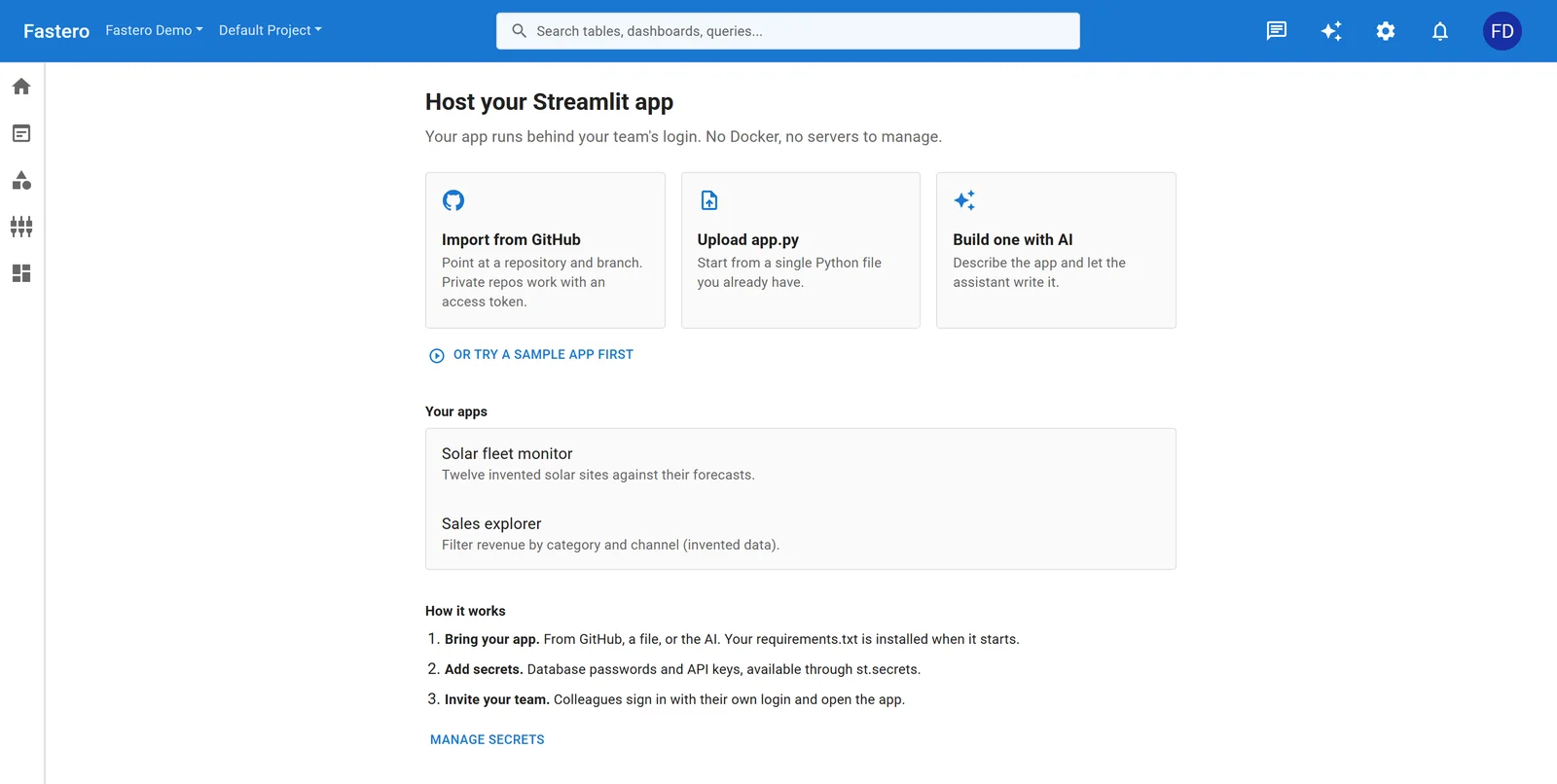
Starting a Streamlit app in Fastero. Sample data.
How to choose
- You want Lovable, cheaper or different: Bolt, v0 or Replit. Compare the same small task in each before committing, because every one bills by usage.
- You can read code, or have someone who can: Claude Code or Cursor, with a host you choose.
- It's an internal tool on company data: Retool for forms and admin screens, Databricks Apps or Streamlit in Snowflake where your data already lives, Fastero for Python data apps your team signs in to.
- It's a prototype from a design: Figma Make.
Whatever you pick, read what you'd do to leave: how the code comes out, where the database lives, and who is responsible for its security. In every tool on this list, that last one is you.
FAQ
What is the best alternative to Lovable?
For the same prompt-to-app experience, Bolt.new, v0 or Replit. For code you own, Claude Code or Cursor. For internal tools on company data, Retool, Databricks Apps, Streamlit in Snowflake or Fastero.
Is there a free Lovable alternative?
Bolt's free plan gives 1 million tokens a month, v0's 7 messages a day, Base44's 25 message credits a month, Figma Make's up to 500 credits a month, and Google AI Studio is free to build in within a daily quota. Hosting a real app usually costs money on all of them.
Why is Lovable so expensive?
Every message, the app's hosting and its AI features draw on the same credits, and fixes to the AI's own mistakes cost credits once the 10 free fixes are used; each comes back a day later. Lovable publishes example costs: around 1.2 credits to add sign-in, 1.7 to 2 for a landing page.
Can I export my code from Lovable?
Yes. GitHub sync works on every plan, though it always creates a new repository, and downloading the code needs a paid plan. A Lovable Cloud database moves out by export, not one click.
Is Lovable safe for company data?
Lovable connects to Snowflake, BigQuery, Databricks and Redshift, but its Snowflake connection is one shared login, and security of the app stays with you, as Lovable's own documentation says. For apps where each colleague should see only their own data, look at tools that can run queries with each viewer's permissions, such as Databricks Apps or Streamlit in Snowflake.
Related reading:
Sources: Lovable plans, Lovable credits, one balance for building and running apps, Lovable changelog, Lovable GitHub sync, Lovable Cloud, Lovable Snowflake connector, Lovable security, CVE-2025-48757 (NVD), researcher's statement, Lovable on the April 2026 incident, TechCrunch on Lovable's revenue (24 September 2026), Lovable on Trustpilot, Bolt pricing and tokens, v0 pricing, Replit pricing, Base44 pricing and credits, Google AI Studio Build, Figma pricing, Firebase Studio migration, GitHub Spark deprecation, Claude pricing, Cursor pricing, Devin Desktop, Retool pricing and its React builder, Softr plans, Glide pricing, Databricks Apps, Streamlit in Snowflake billing. Checked 20 and 21 October 2026.
Try Fastero free — describe a data app and get a Streamlit app your team signs in to, on your own data. No credit card required.