
You can describe an app in plain English and get working code in under a minute. That's not a differentiator anymore — it's a baseline. Lovable hit $500M ARR and a $13.3B valuation proving it. The field that matters now isn't "can AI build my app?" but "what happens after it's built?" Can it connect to your production database? Does it survive you closing your laptop? Does it notice when the data it depends on changes? Those are the questions this list is organized around.
Quick comparison
| Tool | Live data connectivity | Hosting model | Pricing | Target user | Best for |
|---|---|---|---|---|---|
| Lovable | Limited (Supabase, API calls) | Managed hosting | Credits ($20-100/mo) | Non-technical founders | MVP web apps, landing pages |
| Replit | Via code (any DB library) | Managed VMs | Core $25/mo, Teams $40/seat | Developers, students | Full-stack prototyping |
| Base44 | Built-in DB + integrations | Managed | Free tier, Pro ~$30/mo | Non-technical prosumers | Business process apps |
| Vercel v0 | None (generates code only) | You deploy via Vercel | v0 free, Vercel Pro $20/mo | Frontend developers | React/Next.js components |
| Bolt.new | Via generated code | Export or StackBlitz hosting | Free tier, Pro $20-50/mo | Web developers | Browser-based full-stack |
| Cursor | N/A (IDE, not a builder) | Local | Pro $20/mo, Business $40/mo | Professional developers | AI-assisted code editing |
| Claude Artifacts | None | Ephemeral (in-conversation) | Part of Claude subscription | Anyone | Single-page tools, analysis |
| Retool | Native (30+ connectors) | Managed cloud or self-hosted | $10-50/user/mo | Ops teams with SQL skills | Internal CRUD tools on prod data |
| Databricks Genie/Apps | Native (Unity Catalog) | Databricks-managed | Bundled with Databricks | Data engineers, analysts | Enterprise AI/BI on lakehouse |
| Fastero | Native (databases + SaaS) | Managed, always-on | Free tier, paid from $20/mo | Data teams, RevOps | Data apps with event-driven triggers |
The AI app builder spectrum
Not all of these tools are doing the same thing. Here's where each one sits:
Code assistant ◄──────────────────────────────────────────► Full platform

  Cursor          v0        Bolt.new     Lovable      Base44      Retool
    │              │           │            │            │           │
    ▼              ▼           ▼            ▼            ▼           ▼
 You write     Generates   Generates    Generates    Generates   Generates
 code, AI      components  full apps    full apps    full apps   apps on
 assists       you deploy  in browser   + deploys    + deploys   prod data

              Claude                    Replit       Databricks   Fastero
             Artifacts                    │          Genie/Apps     │
                │                         ▼              ▼         ▼
            Ephemeral               Full apps +     AI/BI on     Data apps +
            single-page             managed VMs     lakehouse    event triggers
The left side gives you more control and assumes you know what you're doing. The right side handles more for you but constrains what you can build. The interesting question is which tools connect to your existing data — not a demo database, your actual production schema. That's where most of the left-side tools silently drop out.
Fastero
Connect your database. Ask questions. Get dashboards.
Postgres, BigQuery, Snowflake, and 10+ sources — live-connected, AI-powered, no dashboard builder learning curve.
Try free →What does Lovable actually do at $500M ARR?
Lovable is the market leader for a reason: it takes a natural-language description and produces a deployed, working web application. The output is real React code (TypeScript, Tailwind, shadcn/ui). You get a hosted URL you can share immediately. For someone who needs a landing page, an internal form, or an MVP to show investors, Lovable genuinely delivers in minutes.
The Supabase integration gives you a backend — auth, a Postgres database, row-level security. That's meaningful. But it's Supabase's database, not yours. If your business data lives in your company's Postgres, MySQL, or a SaaS tool like HubSpot or Stripe, Lovable doesn't connect to it at runtime. You'd need to export, copy, or build an API layer yourself.
Pricing: Credit-based. Plans range from roughly $20/month to $100/month depending on generation credits. Heavy iteration burns through credits fast.
The gap: Lovable builds excellent prototypes and simple production apps. It doesn't solve the problem of connecting those apps to live business data, and the apps don't react to changes in that data on their own.
Is Replit Agent actually autonomous?
Replit's Agent (versions 3 and 4) is the strongest autonomous builder in the group. You describe what you want, and it writes code, installs packages, creates files, runs the dev server, debugs errors, and iterates — all without you touching the editor. Agent 4 in particular handles multi-file full-stack apps impressively well.
Because Replit gives you a real VM, you can install any npm package or Python library. That means you can connect to any database — write the connection code, store credentials in Replit Secrets, and your app talks to Postgres, MongoDB, whatever. But Agent doesn't do this for you automatically. You need to know what you're asking for. "Connect to my company's Postgres and show a table of recent orders" requires you to provide the connection string and trust the generated SQL.
Pricing: Core plan is $25/month with Agent access. Teams plan is $40/seat/month. Compute is metered on top — your app runs on Replit's infrastructure, and heavy usage costs extra.
The gap: Replit gives you the power to connect to anything, but the responsibility to wire it up and keep it running is still yours. There are no built-in data connectors, no scheduled refreshes, no triggers that fire when data changes.
Who is Base44 for?
Wix acquired Base44 in early 2026 for exactly the audience you'd expect: non-technical business users who want to build apps without learning to code. Think small-business owners, operations managers, and team leads who currently solve problems with spreadsheets.
Base44 generates full applications with a built-in database, forms, workflows, and user management. The Wix integration means you get hosting, custom domains, and a path to production without touching infrastructure. For its target audience, it works well — you describe a client portal or an inventory tracker, and you get something usable.
Pricing: Free tier with limits, Pro around $30/month.
The gap: Base44's built-in database is separate from your existing systems. If your data lives in Salesforce, a warehouse, or a production database, Base44 doesn't pull from it natively. It's building new apps with new data, not surfacing or acting on the data you already have.
Does Vercel v0 compete here?
Only partially. v0 generates React and Next.js components from natural-language prompts. The output is high-quality code — clean TypeScript, Tailwind CSS, proper component structure. For a frontend developer who needs a starting point for a UI, it's excellent.
But v0 doesn't build full applications. It generates components and pages that you then integrate into your own project, deploy to Vercel yourself, and connect to your own backend. There's no database layer, no hosting, no runtime data connectivity. It's a generation tool, not a platform.
Pricing: v0 itself has a generous free tier. Deployment on Vercel Pro costs $20/month.
Best for: Developers who want AI-generated React components as a starting point, not a finished product.
Where does Bolt.new fit?
Bolt.new (by StackBlitz) runs entirely in the browser using WebContainers — a full Node.js environment in a browser tab. You describe an app, it generates and runs it live. No local setup, no terminal, no deployment pipeline. The iteration loop is fast: describe a change, see it instantly.
For web developers who want to prototype quickly, it's great. The constraint is the same as v0: Bolt generates code that you then need to deploy and maintain. StackBlitz offers hosting, but production deployment, database connections, and ongoing operations are your responsibility.
Pricing: Free tier available, Pro plans run $20-50/month.
The gap: Like most code-generation tools, Bolt solves the "build" step. The "connect to real data" and "keep running in production" steps are on you. See our comparison of data app deployment platforms for what that actually involves.
Is Cursor an AI app builder?
No. I'm including it because it shows up in every "AI app builder" list, and the distinction matters.
Cursor is an AI-enhanced code editor — a fork of VS Code with deep AI integration. It's phenomenal at what it does: autocomplete that understands your codebase, inline generation from comments, refactoring entire files from a prompt. Professional developers who use Cursor write code faster. Significantly faster.
But Cursor doesn't build apps. It helps you build apps. You still need to know what you're building, how to structure it, and how to deploy it. There's no "describe an app and get a working URL" workflow. If you're evaluating tools to generate applications from prompts without writing code, Cursor is in a different category entirely.
Pricing: Pro $20/month, Business $40/month.
Best for: Professional developers who want AI assistance in their existing workflow, not a replacement for it.
What about Claude Artifacts?
Anthropic's Claude produces "Artifacts" — self-contained HTML/CSS/JavaScript applications generated inline during a conversation. They're often beautiful. A skilled prompt can produce a working calculator, data visualizer, or interactive tool in seconds.
But Claude Artifacts are deliberately not an app platform. They run in the conversation context. There's no persistent hosting, no database connectivity, no authentication, no way to share them as standalone apps with your team. Anthropic has been clear that Artifacts are a conversation feature, not a deployment target.
Pricing: Part of the Claude Pro ($20/month) or Team subscription.
Best for: Quick, single-page interactive tools during a work session. Not for anything that needs to persist, connect to data, or serve multiple users.
How does Retool's AI generation (AppGen) compare?
Retool occupies a unique position here because it's not primarily an AI builder — it's an established internal tool platform that added AI generation on top. AppGen lets you describe an app in natural language, and it generates a Retool application connected to your actual data sources.
This is significant. When you tell AppGen "build me an admin panel for our users table," it generates components wired to your production Postgres. The app reads and writes real data from day one. No demo database, no Supabase sidecar — your schema, your data.
Pricing: $10/user/month (Team), $50/user/month (Business). Per-seat pricing means costs scale linearly with viewers, which gets expensive fast for widely shared tools. We've written about this trade-off before.
The gap: Retool is still a developer tool. The AI generation accelerates setup, but maintaining and modifying Retool apps requires someone comfortable with SQL, JavaScript, and Retool's component model. It also doesn't do event-driven automation — the apps are interactive dashboards, not autonomous systems that react to data changes.
What's Databricks doing with Genie and Apps?
Databricks Genie is a natural-language interface over your lakehouse data. You ask questions in English, Genie writes SQL against your Unity Catalog tables, and returns answers as tables or charts. Databricks Apps lets you deploy Streamlit and other Python applications directly on Databricks infrastructure, with native access to your lakehouse data.
For enterprise data teams already on Databricks, this is powerful. Genie understands your schema, respects governance policies, and produces answers grounded in your actual data. Apps gives you a way to build and deploy custom interfaces without leaving the platform.
Pricing: Bundled with your Databricks contract. Genie consumes SQL warehouse compute credits. Apps pricing depends on the compute tier.
The gap: You have to be on Databricks. If your data is in standalone Postgres, MySQL, or SaaS tools, Genie and Apps don't reach it. This is an enterprise lakehouse play, not a general-purpose app builder.
Where does Fastero fit in this landscape?
Fastero started from a different premise than most tools on this list. Instead of asking "how do we generate an app from a prompt?", the question was: "how do we build apps that are actually connected to business data — and that stay alive after you stop looking at them?"
You describe what you need in natural language, and Fastero generates a data application. But the generated app connects to your existing databases (Postgres, MySQL, MongoDB, BigQuery) and SaaS tools (Stripe, HubSpot, Shopify) at runtime. It's querying your real data, not a copy or a demo.
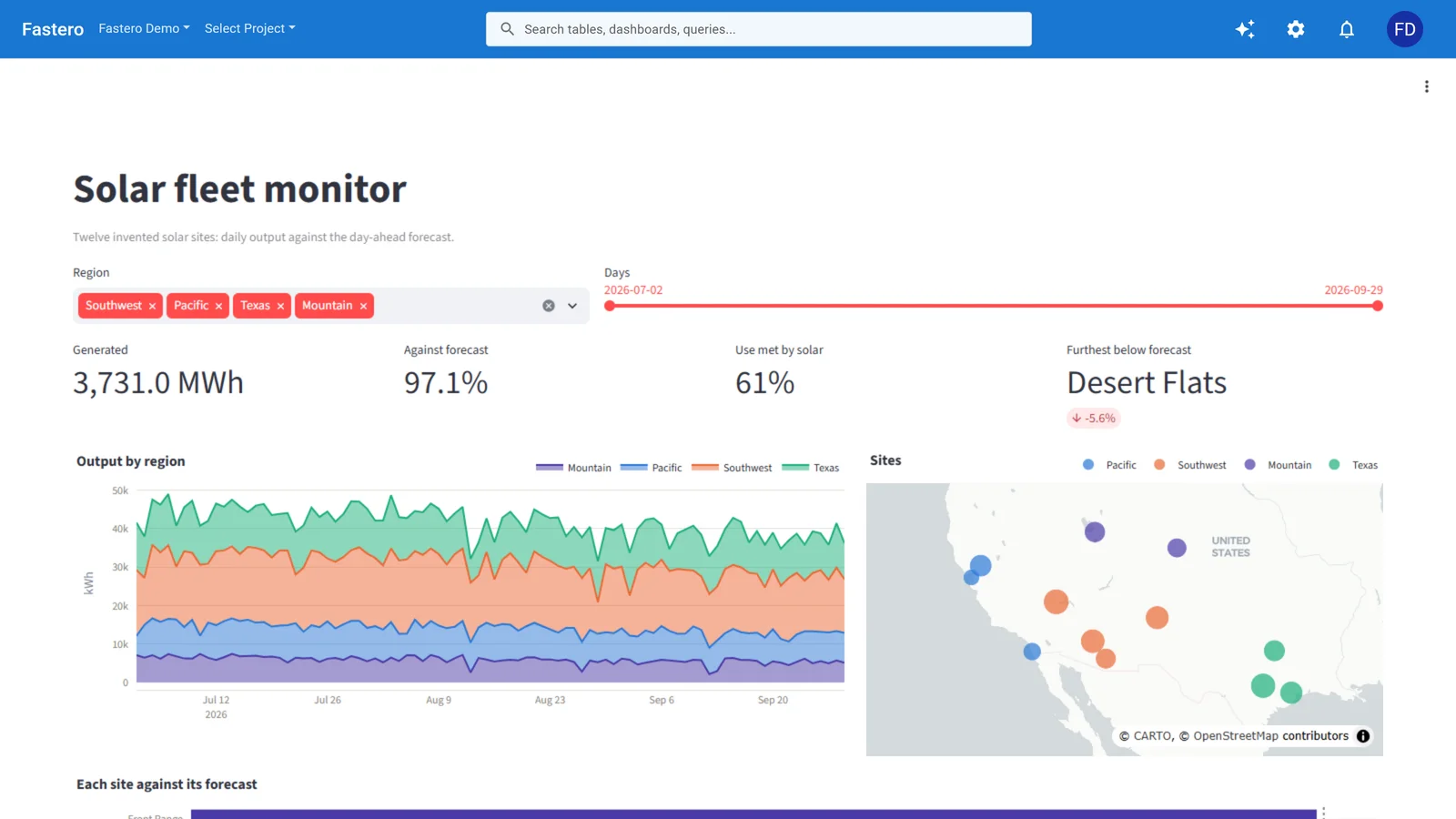
A Streamlit app running in Fastero, behind the team's login. Sample data.
The part that separates Fastero from every other tool on this list: event-driven triggers. You can set conditions — "if monthly revenue drops below X," "if a new Shopify order comes in with no matching CRM contact," "if this SQL query returns rows" — and Fastero fires actions automatically. Slack alerts, email notifications, webhook calls, or updates to other systems. The app doesn't just display data; it watches data and reacts.
This matters because most of the tools above solve a 30-minute problem (build the app) and leave you with a 30-day problem (keep it connected, keep it running, notice when something breaks). If you're coming from Streamlit or Retool and want apps that actually stay in sync with your business data, that's the gap Fastero fills.
Pricing: Free tier available. Paid plans from $20/month with always-on hosting and multiple data connections.
Best for: Data teams and RevOps who need apps connected to live business data with automation built in. Not for consumer-facing MVPs or landing pages — that's Lovable's territory.
The build-vs-connect divide
Here's the pattern I keep seeing. There are two distinct problems that get lumped under "AI app builder":
Problem 1: BUILD                          Problem 2: CONNECT + STAY ALIVE
────────────────────                      ──────────────────────────────────
"I described an app                       "My app queries production Postgres,
 and got working code"                     joins it with Stripe data, and
                                           alerts me on Slack when churn
 Lovable, Bolt, v0,                        risk spikes"
 Base44, Replit, Claude
                                           Retool, Databricks, Fastero
Most of the market — and most of the hype — is on the left side. That's where Lovable's $500M ARR comes from. It's a real, valuable product category. But if your use case involves live business data, ongoing monitoring, or automated reactions to data changes, the left side doesn't solve your problem. You'd build a beautiful app and then spend weeks wiring it to your actual systems.
The right side is smaller and less flashy, but it's where the apps that run businesses actually live. For a deeper look at how these data-connected platforms compare, see our data app platform comparison.
Frequently asked questions
Can Lovable apps connect to my company's database?
Not directly. Lovable generates React apps with optional Supabase backends. Supabase gives you a new Postgres database, not a connection to your existing one. To query your production database, you'd need to build an API layer and call it from the generated frontend. That's doable but requires development work that defeats the "no-code" promise.
Which AI app builder is best for non-technical users?
Base44 and Lovable are the most accessible. Both generate working apps from plain English descriptions without requiring any coding knowledge. Base44 (Wix-owned) has a slight edge for business-process apps with its built-in database and workflow features. Lovable is stronger for web-facing apps and MVPs.
Do AI-generated apps actually work in production?
It depends on what you mean by "production." For internal tools used by a small team, yes — the code quality from Lovable, Replit, and Bolt is good enough. For customer-facing products at scale, most teams end up rewriting significant portions. The generated code is a starting point, not a finished product. Retool and Fastero take a different approach — they're production platforms where the AI generates apps designed to run against real data from the start.
What's the cheapest option for building internal tools with AI?
Claude Artifacts (included with a $20/month subscription) costs the least for one-off tools. For persistent internal apps, Bolt.new and v0's free tiers let you generate code at no cost — but you'll pay for hosting separately. If you need data connectivity and hosting included, Fastero's free tier and Base44's free plan both include hosting.
Should I use Cursor or an AI app builder?
If you're a developer, both — they solve different problems. Use Cursor as your daily editor to write code faster. Use an AI app builder (Lovable, Bolt, Replit) when you want to generate a complete app from scratch quickly. Cursor makes you a faster developer; app builders replace the developer for simple projects.
How do event-driven triggers differ from scheduled refreshes?
Scheduled refreshes run on a fixed interval — every hour, every morning at 9 AM. They show you stale data between refreshes, and they run even when nothing has changed. Event-driven triggers fire when specific conditions are met in your data: a revenue threshold is crossed, a new record appears, a metric deviates from its baseline. They catch problems in minutes instead of hours, and they don't waste compute when nothing is happening.
Try Fastero free — build data apps connected to your databases and SaaS tools. Event-driven triggers keep them alive. No credit card required.