Airbyte is the default answer when someone asks "what open source ETL tool should I use?" And for connector breadth, that's correct. But connector breadth isn't the only dimension. Meltano gives you Singer taps plus orchestration in one CLI. dlt is a Python library you can embed in a script. Sling replicates databases with a single binary. Apache NiFi routes messages through visual DAGs. They solve overlapping problems in different ways, and the right pick depends on how much infrastructure you're willing to operate.
When does open source ETL actually make sense?
Managed pipelines like Fivetran and Stitch charge per row synced. At small volumes, that's cheap and painless. At 100M+ rows per month, the bill starts hurting. Open source flips the trade-off: you pay in engineering time instead of SaaS fees.
Three situations where self-managed ETL earns its keep:
- Data volume makes managed pricing unsustainable. If your Fivetran bill crossed $3,000/month and is climbing, self-hosting Airbyte or running dlt scripts can cut that to infrastructure costs alone. We broke down the exact math in Fivetran vs Airbyte.
- You need custom connectors. Internal APIs, legacy ERPs, proprietary file formats. Managed services don't support them. Open source tools let you build and maintain your own.
- Compliance requires data to stay in your VPC. Some regulated industries can't send production data through a third-party SaaS. Self-hosted open source is the only option.
If none of those apply, a managed service will save you headaches. Open source ETL is free in license cost, never free in operational cost.
How an ELT pipeline actually works
Before the tool list, a quick look at the architecture most of these tools implement. Modern data integration follows the ELT pattern: extract raw data, load it into a destination, then transform it there.
┌─────────────┐     ┌───────────────┐     ┌──────────────┐     ┌──────────────┐
│  Sources    │     │   Extract +   │     │ Destination  │     │  Transform   │
│             │     │     Load      │     │              │     │              │
│ Postgres    │────→│  Airbyte /    │────→│  Warehouse   │────→│  dbt / SQL   │
│ Stripe API  │     │  Meltano /    │     │  (Snowflake, │     │  models      │
│ S3 files    │     │  dlt / Sling  │     │   BigQuery)  │     │              │
│ HubSpot     │     │               │     │              │     │              │
└─────────────┘     └───────────────┘     └──────────────┘     └──────────────┘
The tools below handle the "Extract + Load" box. Transformation is a separate concern (usually dbt or SQLMesh). The critical question for each tool is: how much operational overhead does that middle box cost you?
Fastero
Connect your database. Ask questions. Get dashboards.
Postgres, BigQuery, Snowflake, and 10+ sources — live-connected, AI-powered, no dashboard builder learning curve.
Try free →The 6 tools
1. Airbyte — best for connector breadth
Airbyte is the most popular open source ELT platform, and for good reason. Over 300 connectors, CDC support for major databases, and a web UI that lets you configure and monitor syncs without writing code.
The connector catalog splits into two tiers. Certified connectors (roughly 80-100) are maintained by Airbyte's team with SLAs. Community connectors are maintained by whoever built them, and quality varies sharply. A community connector for a niche CRM might not have been updated since 2024.
Deployment reality: Self-hosted Airbyte runs 10+ Docker containers (scheduler, server, workers, webapp, temporal, database). A minimal deployment needs 8GB RAM and a dedicated host. Kubernetes is recommended for production. Budget 4-8 hours per month for upgrades, debugging failed syncs, and worker memory tuning. I've watched under-provisioned workers OOM during large initial syncs and retry silently until someone noticed.
When it works: You need 20+ connectors, a mix of databases and SaaS APIs, and you have at least one engineer who can own the deployment.
When it doesn't: You need two connectors and a cron job. Airbyte is a platform-sized solution. For small workloads, it's like driving a semi truck to the grocery store.
2. Meltano — best for Singer ecosystem + orchestration
Meltano is GitLab's open source ELT platform, built on the Singer protocol. Where Airbyte built its own connector framework, Meltano adopted Singer taps and targets as its connector layer, then wrapped them with orchestration, configuration management, and a CLI.
The pitch is a single meltano.yml that defines your entire pipeline: which taps (sources), which targets (destinations), transformation steps, and scheduling. Version it in Git. Run it with meltano run tap-postgres target-snowflake dbt:run. That's attractive for teams who want infrastructure-as-code without a UI.
Deployment reality: Lighter than Airbyte. Meltano itself is a Python CLI tool. No multi-container platform to run. The complexity lives in the Singer taps, which are individual Python packages with their own dependencies. Virtual environments can conflict. Tap quality varies widely because Singer is a community ecosystem (more on that in the Singer section below).
When it works: You already use Singer taps, you want pipelines defined as code, and you don't need a web UI.
When it doesn't: You want a visual interface for non-engineers, or you need connectors not covered by Singer taps.
3. Apache NiFi — best for complex routing and real-time flows
Apache NiFi is a different beast. Where Airbyte and Meltano are batch ELT tools, NiFi is a dataflow engine. You build processing graphs in a visual canvas: a Kafka consumer feeds into a JSON parser, which routes records by type, applies transformations, and writes to three different destinations based on content.
It handles backpressure natively, supports provenance tracking (you can trace exactly where every piece of data came from and where it went), and runs well at scale. Government agencies and large enterprises have run NiFi clusters processing billions of events.
Deployment reality: NiFi is a Java application. The single-node install is straightforward, but production clusters need ZooKeeper (or NiFi's built-in state management in newer versions) and careful JVM tuning. The learning curve is steep. Building your first flow takes hours of dragging processors onto a canvas and debugging routing rules. The visual paradigm is powerful once you learn it and impenetrable before you do.
When it works: You have complex routing requirements, multiple output destinations per record, real-time streaming needs, or compliance requirements that demand data provenance.
When it doesn't: You need a simple "sync Stripe to Snowflake" pipeline. NiFi can do it, but you'll spend a day configuring processors for something Airbyte does in 10 minutes.
4. dlt (data load tool) — best for Python-first teams
dlt takes the opposite approach from platforms like Airbyte. It's a Python library. You pip install dlt, write a Python script that yields data, and dlt handles schema inference, incremental loading, and destination management.
import dlt

@dlt.resource(write_disposition="merge", primary_key="id")
def orders():
    yield from paginated_api_call("/api/orders")

pipeline = dlt.pipeline(
    pipeline_name="shopify",
    destination="bigquery",
    dataset_name="raw_shopify"
)
pipeline.run(orders())
That's a real pipeline. No platform, no containers, no web UI. Run it in a cron job, a GitHub Action, or embed it in an existing Python application. Schema changes are handled automatically. Incremental state is stored locally or in the destination.
Deployment reality: Zero infrastructure overhead. dlt is a library, not a service. Your deployment is whatever runs Python scripts: a VM with cron, a CI/CD pipeline, a serverless function. The trade-off is you lose the monitoring, scheduling, and alerting UI that platforms provide. You build that yourself or use external tools.
When it works: You're a Python team, you need a handful of custom pipelines, and you don't want to run a platform.
When it doesn't: You need 30+ pre-built connectors out of the box. dlt has verified sources, but the catalog is smaller than Airbyte's. The value is in custom pipelines, not plug-and-play connectors.
5. Sling — best for database-to-database replication
Sling does one thing well: replicate data between databases. Postgres to BigQuery. MySQL to Snowflake. CSV files to DuckDB. It's a single Go binary with no dependencies.
sling run --src-conn POSTGRES_PROD --src-stream "public.orders" \
          --tgt-conn BIGQUERY --tgt-object "raw.orders" \
          --mode incremental --primary-key id
No YAML config file required for simple syncs. For recurring pipelines, you can define them in a sling.yml. It supports full and incremental replication, basic type mapping, and parallel extraction.
Deployment reality: Download a binary, set connection strings, run it. That's it. No containers, no Python environments, no JVM. It's the lightest option on this list by a wide margin.
When it works: You need to move data between databases and object stores. Simple replication with minimal fuss.
When it doesn't: You need SaaS API connectors (Stripe, HubSpot, Salesforce). Sling is database-centric. It won't help you ingest API data. If you're choosing between destination databases for these replications, see DuckDB vs Postgres for Analytics Workloads.
6. Singer — the protocol, not the tool
Singer isn't a tool you deploy. It's a specification for data extraction that defines how taps (extractors) and targets (loaders) communicate via a JSON-over-stdout protocol. Meltano uses Singer under the hood. Stitch (Talend) originally built Singer and used it as their connector framework.
The Singer ecosystem includes 200+ community taps and targets. Quality varies enormously. Some taps are production-grade and actively maintained. Others were written for a specific project in 2019 and haven't been touched since.
Why it matters: Singer is the de facto standard for "write an extractor once, use it with any target." If you're evaluating Meltano, you're evaluating Singer's tap ecosystem. If you're building a custom extractor, adopting the Singer protocol means it works with Meltano, Stitch, and any other Singer-compatible tool.
When to use it directly: Almost never. Use it through Meltano or another orchestrator. Running raw tap-postgres | target-bigquery in production without orchestration, state management, and error handling is asking for trouble.
How do they compare?
| Tool | Connectors | Deployment | Scaling | Best for | Community |
|---|---|---|---|---|---|
| Airbyte | 300+ (certified + community) | Docker / K8s (10+ containers) | Horizontal workers | Teams needing broad coverage | Very active, large |
| Meltano | 200+ (Singer taps) | Python CLI | Single-process | Code-first ELT | Active, GitLab-backed |
| Apache NiFi | N/A (processor-based) | Java / ZooKeeper cluster | Cluster mode | Complex routing, streaming | Mature, enterprise |
| dlt | 30+ verified sources | Python library (pip install) | Runs anywhere Python runs | Custom Python pipelines | Growing |
| Sling | Databases + file stores | Single Go binary | Single-process | Database replication | Smaller, focused |
| Singer | 200+ taps (variable quality) | Via orchestrator (Meltano) | Depends on orchestrator | Protocol standard | Mixed maintenance |
Do you actually need an ETL pipeline?
Here's the question worth asking before you commit to any of these tools: does your use case require a persistent sync pipeline, or are you just trying to query data that lives in different places?
If you're syncing 500M rows from a production database into a warehouse for a data science team, yes, you need a pipeline. Run Airbyte or Meltano. If you're an ops team that wants to query Stripe alongside Postgres alongside Google Sheets to answer business questions, a full ELT pipeline might be overkill.
Fastero takes the direct-query approach. It connects to 20+ databases and SaaS integrations, syncs data into a built-in DuckDB store on a schedule, and lets you query across sources with SQL. No warehouse to manage, no sync pipeline to monitor. For teams where the pipeline exists solely to power dashboards and reports, that's less infrastructure with the same outcome. We built event-driven triggers and workflows for the cases where you do need data to move, without the overhead of running a separate orchestration platform. More on that approach in How to Set Up Event-Driven Data Pipelines Without Airflow.
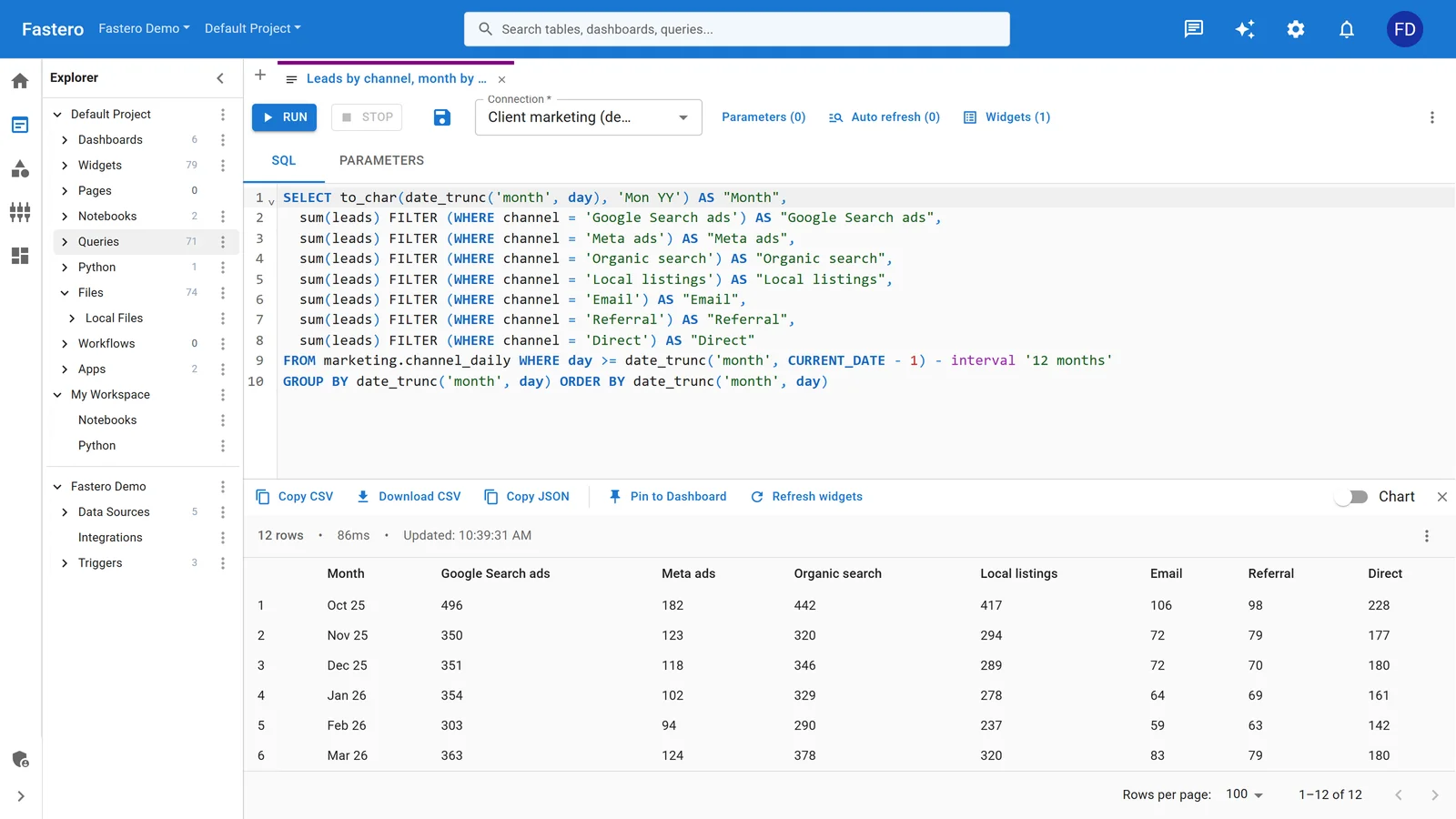
The SQL editor in Fastero. Sample data.
How to choose
         What does your pipeline look like?
         ├── 20+ SaaS + DB connectors needed
         │   └── Airbyte ✓
         ├── Singer taps + GitOps workflow
         │   └── Meltano ✓
         ├── Complex routing / real-time streams
         │   └── Apache NiFi ✓
         ├── Custom Python scripts, few sources
         │   └── dlt ✓
         ├── Database-to-database only
         │   └── Sling ✓
         └── Just need to query across sources
             └── Consider direct-query (Fastero, etc.)
One more variable: if you're evaluating Airbyte specifically against managed alternatives, read our Fivetran vs Airbyte deep dive for the full pricing and operational comparison. If ETL is part of a broader tooling decision, the best ETL tools page covers managed options too. And for a full stack perspective, see how to build a free analytics stack with open-source tools and our best tools for data engineering teams in 2026 roundup.
FAQ
Is Airbyte really free? The core platform is open source (MIT + ELv2 licensed) and free to self-host. You pay for infrastructure to run it, typically $200-400/month in cloud compute for moderate workloads. Airbyte Cloud is the managed offering with per-credit pricing. Self-hosted is free in license cost, not free in engineering time.
What's the difference between ETL and ELT? ETL transforms data before loading it into the destination. ELT loads raw data first, then transforms it in the destination (usually with dbt or SQL). Most modern open source tools follow the ELT pattern because warehouses like Snowflake and BigQuery are powerful enough to handle transformation at query time. Every tool on this list except NiFi is ELT-first.
Can dlt replace Airbyte? For custom pipelines with a small number of sources, yes. dlt is lighter, faster to set up, and doesn't require running a platform. For 20+ pre-built connectors with a monitoring UI, Airbyte is still the better fit. They're complementary rather than competing for most teams.
Is Apache NiFi overkill for simple data syncs? Yes. NiFi is designed for complex dataflow routing, not simple source-to-destination replication. If you just need to sync Postgres to BigQuery, Sling or dlt will get you there in minutes. NiFi excels when you need conditional routing, content-based splitting, or real-time stream processing.
How do Singer taps compare to Airbyte connectors? Singer taps are individual Python packages that follow a shared protocol. Airbyte connectors run as Docker containers with a standardized API. Singer's advantage is simplicity (just Python). Airbyte's advantage is isolation (each connector in its own container with managed dependencies). In practice, Airbyte's certified connectors tend to be better maintained than the average Singer tap, but the best Singer taps are excellent.
Do I need a data warehouse to use these tools? Most of these tools assume you're loading into a warehouse (Snowflake, BigQuery, Redshift) or a database (Postgres, DuckDB). If you don't have a warehouse and don't want to manage one, a direct-query tool like Fastero can connect to your sources and let you query across them without a separate destination layer.
Try Fastero free — built-in connectors for 20+ databases and SaaS tools, scheduled sync into DuckDB, cross-source SQL joins. No pipeline to manage. No credit card required.