
Trino is the best general-purpose choice for interactive, federated SQL across multiple data sources. Spark SQL wins when you need batch processing, ML pipelines, or anything beyond pure SQL. PrestoDB still works but has lost momentum to Trino. Most new deployments in 2026 pick Trino for federation or Spark SQL for heavy compute -- rarely both for the same job.
Three-way comparison table
| Trino | PrestoDB | Spark SQL | |
|---|---|---|---|
| Origin | PrestoSQL fork, renamed 2020 | Facebook (2012), now Linux Foundation | Apache Spark project |
| Led by | Original Presto creators (Starburst) | Meta + community | Databricks + Apache community |
| Architecture | MPP query engine, no storage | MPP query engine, no storage | Distributed compute engine with SQL interface |
| Primary use | Interactive federated SQL | Interactive federated SQL | Batch analytics, ETL, ML |
| Latency | Seconds (interactive) | Seconds (interactive) | Higher startup overhead (batch-oriented) |
| Federation | First-class (100+ connectors) | First-class (fewer connectors) | Reads many sources, not federation-first |
| Beyond SQL | SQL only | SQL only | ML (MLlib), streaming, graph (GraphX) |
| SQL compliance | Most ANSI-SQL compliant | Similar to Trino | HiveQL heritage, some gaps |
| Release cadence | Weekly / biweekly | Slower | Quarterly major releases |
| Cloud managed | Starburst, AWS Athena | Ahana (acquired by IBM) | Databricks, EMR, Dataproc |
| License | Apache 2.0 | Apache 2.0 | Apache 2.0 |
| GitHub stars | ~10k | ~17k (legacy count) | ~40k (full Spark) |
| Community direction | Growing, most new adopters | Shrinking outside Meta | Massive, stable |
How did we end up with three engines?
Quick history, because the naming confusion is real.
Facebook engineers created Presto in 2012 to replace Hive for interactive queries on their data lake. It was open-sourced in 2013 and grew a large community outside Facebook.
In 2018, the four original creators -- Martin Traverso, Dain Sundstrom, David Phillips, and Raghav Sethi -- left Facebook and founded Starburst. They took the community project with them under the name PrestoSQL. Facebook continued its own fork as PrestoDB under the Linux Foundation.
In December 2020, PrestoSQL renamed to Trino to end the brand confusion. Same code, same team, new name. If someone says "Presto" without clarification, ask which one -- the answer changes the conversation.
Spark SQL arrived differently. It's not a standalone engine; it's the SQL interface to Apache Spark, which started as an in-memory MapReduce replacement at UC Berkeley in 2009. Spark 1.0 shipped in 2014 with basic SQL support. By Spark 2.0 (2016), Spark SQL had become the primary way most people interact with Spark. Databricks, the company behind Spark, has driven most of the SQL optimization work since then.
Fastero
Connect your database. Ask questions. Get dashboards.
Postgres, BigQuery, Snowflake, and 10+ sources — live-connected, AI-powered, no dashboard builder learning curve.
Try free →How does each engine actually query data?
The fundamental difference is in how these engines relate to your data. Trino and PrestoDB are pure query engines -- they sit between you and your data sources, push down predicates, and return results. They store nothing. Spark SQL is a compute engine that happens to speak SQL -- it pulls data in, processes it across a cluster, and can do far more than queries.
Federation model (Trino / PrestoDB):

                                    +-- PostgreSQL
                                    |
  SQL query --> [Coordinator] ------+-- S3 / Hive
                    |               |
               [Worker nodes]       +-- Kafka
                    |               |
               Results back         +-- Elasticsearch


Compute engine model (Spark SQL):

                                    +-- S3 / HDFS
                                    |
  SQL / code --> [Driver] ----------+-- JDBC sources
                    |               |
               [Executors]          +-- Hive Metastore
                    |
              In-memory shuffle
                    |
              Results / write back
Trino sends fragments of the query to workers that each talk directly to the data sources. The coordinator stitches results together. There's no intermediate storage step -- data flows through memory. This is why interactive queries are fast: small results stream back as they're computed.
Spark SQL reads data into distributed memory (RDDs / DataFrames), shuffles across executors, and processes it. That shuffle step adds latency but enables operations that federation engines can't do efficiently: large joins across billions of rows, iterative ML algorithms, or multi-pass aggregations.
The practical difference shows up fast. A Trino query against a PostgreSQL table pushes filters down to PostgreSQL -- the database does the filtering, Trino gets back a small result set. A Spark SQL query against the same table via JDBC reads the full table into Spark executors, then filters. For selective queries, Trino is dramatically faster. For full-table scans followed by heavy computation, Spark's distributed processing wins.
What does the same query look like?
Joining data from two sources -- a PostgreSQL orders table and an S3 data lake with customer data:
Trino (federated query across catalogs):
SELECT c.name, SUM(o.amount) AS total_spend
FROM postgres.public.orders o
JOIN hive.default.customers c
  ON o.customer_id = c.id
WHERE o.created_at > DATE '2026-01-01'
GROUP BY c.name
ORDER BY total_spend DESC
LIMIT 100;
Spark SQL (after reading both sources into DataFrames):
orders = spark.read.jdbc(pg_url, "orders", properties=pg_props)
customers = spark.read.parquet("s3a://lake/customers/")

orders.createOrReplaceTempView("orders")
customers.createOrReplaceTempView("customers")

spark.sql("""
    SELECT c.name, SUM(o.amount) AS total_spend
    FROM orders o
    JOIN customers c ON o.customer_id = c.id
    WHERE o.created_at > '2026-01-01'
    GROUP BY c.name
    ORDER BY total_spend DESC
    LIMIT 100
""")
The SQL is almost identical.
The difference is what happens underneath.
Trino pushes the WHERE clause down to PostgreSQL and reads only matching rows.
Spark reads the full orders table over JDBC (you can add pushDownPredicate options, but it's not the default) and processes everything in its executors.
For this specific query, Trino probably returns in 2-5 seconds. Spark might take 20-40 seconds because of the full table read and job startup overhead. But add a complex ML scoring step after the aggregation, and Spark is the only option.
What is the actual difference between Trino and PrestoDB?
They were the same project until 2018. The original creators left Facebook and took the project with them as PrestoSQL. Facebook kept its fork as PrestoDB. In 2020 PrestoSQL renamed to Trino to end the confusion.
Since the split, Trino has pulled ahead on most dimensions:
- Connectors: Trino has 40+ maintained connectors. PrestoDB has fewer, and some lag behind.
- Release speed: Trino ships releases every one to two weeks. PrestoDB releases are less frequent.
- Community: Most third-party blog posts, Stack Overflow answers, and conference talks reference Trino. PrestoDB's community skews toward Meta's internal use cases.
- Features: Trino added polymorphic table functions, fault-tolerant execution, and improved cost-based optimization. PrestoDB added Presto on Spark (running Presto queries on Spark clusters) and Velox (a C++ execution engine).
PrestoDB is not dead -- Meta runs it at enormous scale. But if you're choosing today without an existing PrestoDB investment, Trino is the default. This is similar to how MariaDB and MySQL diverged: both work, but community gravity matters.
When should I pick Trino?
Pick Trino when you need to query data where it already lives, across multiple systems, with interactive speed.
Common scenarios: your analytics team wants to join PostgreSQL transaction data with event logs in S3 and user profiles in Elasticsearch -- all in one SQL query, returning in seconds. Or you're replacing Hive because you're tired of waiting 20 minutes for a query that should take 10 seconds. Or you need a SQL layer on top of your data lake without moving data into a warehouse.
Trino is also the engine behind AWS Athena (serverless, pay-per-query) and Starburst (enterprise Trino with RBAC, caching, and support). If you want managed Trino without running clusters, those are your options.
Where Trino falls short: it's SQL-only. No ML libraries, no streaming jobs, no custom UDFs in Python without workarounds. It also struggles with very large shuffle-heavy joins -- the kind where you're joining two billion-row tables on a non-partitioned key. That's Spark's territory.
When should I pick Spark SQL?
Pick Spark SQL when your workload goes beyond query-and-return. ETL pipelines that read from S3, transform with complex logic, and write to a warehouse. ML training pipelines where you prep features in SQL, then feed them into MLlib or scikit-learn. Streaming jobs that process Kafka topics with structured streaming.
Spark SQL is not a query engine you point at existing databases. It's a compute engine. You read data in, process it, and write results somewhere. The mental model is closer to a distributed pandas than to a database client.
The ecosystem helps: Databricks (managed Spark with a notebook UI and Unity Catalog), AWS EMR, and Google Dataproc all run Spark clusters. Delta Lake, Iceberg, and Hudi give Spark ACID transactions on object storage. If your data platform already runs on Spark, adding SQL workloads is incremental.
Where Spark SQL falls short: latency.
Starting a Spark job has overhead -- JVM startup, DAG planning, stage scheduling.
A simple SELECT COUNT(*) FROM table WHERE date = today that Trino returns in two seconds might take 15-30 seconds in Spark.
For dashboards or ad-hoc exploration, that gap matters.
Can I run Trino and Spark SQL together?
Yes, and many teams do. A common pattern: Spark handles nightly ETL, writes curated tables to S3/Iceberg, and Trino serves interactive queries on top of those tables during the day.
Iceberg is the glue here. Both Trino and Spark support Apache Iceberg natively, so Spark can write and Trino can read without format conflicts. This gives you Spark's compute power for heavy transformations and Trino's speed for analyst-facing queries. If you're evaluating cloud warehouses as an alternative, we compared the major options here.
The anti-pattern: using Spark SQL for interactive analytics because you already have a Spark cluster. Spark can do it, but the latency penalty is real and your analysts will feel it on every query.
How do they handle SQL differently?
Trino aims for full ANSI SQL compliance.
Window functions, CTEs, lateral joins, TABLESAMPLE, interval arithmetic -- they work as you'd expect from a standards-compliant engine.
Spark SQL grew out of HiveQL and carries some of that heritage.
Most standard SQL works, but you'll hit differences: LATERAL VIEW instead of LATERAL JOIN, different timestamp handling, some functions named differently (NVL vs COALESCE).
Spark 3.x closed many of these gaps, but migrating complex queries from PostgreSQL or Trino to Spark SQL still requires adjustment.
PrestoDB's SQL dialect is nearly identical to Trino's -- they diverged from the same codebase, and neither has made breaking SQL changes. If you have queries written for one, they'll likely run on the other.
For teams coming from PostgreSQL or ClickHouse, Trino's SQL will feel the most familiar.
What about concurrency and workload management?
This matters more than people realize. A query engine serving ten analysts and a batch engine processing overnight jobs have very different concurrency needs.
Trino handles many concurrent short queries well. The coordinator queues and schedules across workers, and resource groups let you reserve capacity for different workloads (dashboards get guaranteed resources, ad-hoc queries share the rest). A well-tuned Trino cluster serves 50+ concurrent analysts without issues.
Spark SQL is designed for fewer, larger jobs. Running 50 small queries concurrently on Spark is wasteful -- each one spins up executors, allocates memory, plans stages. Dynamic allocation helps (spin up executors on demand, release them when idle), but the per-query overhead is still higher. Spark excels when you have a few large jobs running in parallel, not many small ones.
PrestoDB has similar concurrency characteristics to Trino but fewer tuning knobs in the open-source version. Starburst and Athena add workload management features on top.
What about cost?
Trino and PrestoDB are free to run, but you pay for compute. A production Trino cluster is typically 5-20 nodes -- that's $2,000-$10,000/month on AWS depending on instance types. Starburst Enterprise adds licensing on top. Athena (serverless Trino) charges $5 per TB scanned -- cheaper for sporadic queries, expensive for heavy daily use.
Spark clusters are similar in raw compute cost but tend to run larger for batch workloads. Databricks pricing is on top of cloud compute -- roughly 2-3x the raw instance cost. EMR adds a smaller per-instance surcharge. For the full tooling picture, the cost comparison extends to orchestration and monitoring layers on top.
The hidden cost is operations. Trino clusters need tuning: memory limits, query queues, connector configurations. Spark clusters need sizing for shuffle partitions, executor memory, and dynamic allocation. Both need monitoring. Managed services trade money for operational burden, and for most teams that trade-off is correct.
FAQ
Can Trino replace my data warehouse?
Not directly. Trino queries data in place -- it doesn't store, index, or optimize data layout. A data warehouse like Snowflake or BigQuery stores your data in an optimized format and can serve hundreds of concurrent users. Trino works best as a query layer on top of a data lake (S3 + Iceberg/Hive) or as a federation layer across multiple sources. If your queries are mostly against one large dataset, a warehouse will outperform Trino for concurrent workloads.
Is PrestoDB dead?
No, but it's not where the momentum is. Meta still runs PrestoDB at massive scale internally, and the project has active contributors. However, most of the broader community -- connectors, tutorials, managed services, hiring -- has moved to Trino. New teams should default to Trino unless there's a specific PrestoDB feature they need (like Presto on Spark or the Velox execution engine).
Should I use Spark SQL or a dedicated query engine for my data lake?
If your data lake workload is mostly analysts running ad-hoc queries, use Trino or Athena. If it's mostly engineers running ETL pipelines that also need SQL, use Spark SQL. If it's both -- and it usually is -- run both. Spark for writes and transforms, Trino for reads and exploration. Apache Iceberg makes this dual-engine pattern straightforward.
How does Athena relate to Trino?
AWS Athena runs Trino under the hood (it switched from PrestoDB to Trino in Athena v3). You get serverless Trino with no cluster management -- just point it at S3 and query. The trade-off is less control over tuning, no custom connectors, and per-TB pricing that adds up with heavy use. For occasional queries against S3 data, Athena is the fastest path. For sustained workloads, a self-managed Trino cluster or Starburst is usually cheaper. Fastero connects to Athena, so you can query those S3 tables from its SQL editor and put the results on a dashboard without running a cluster.
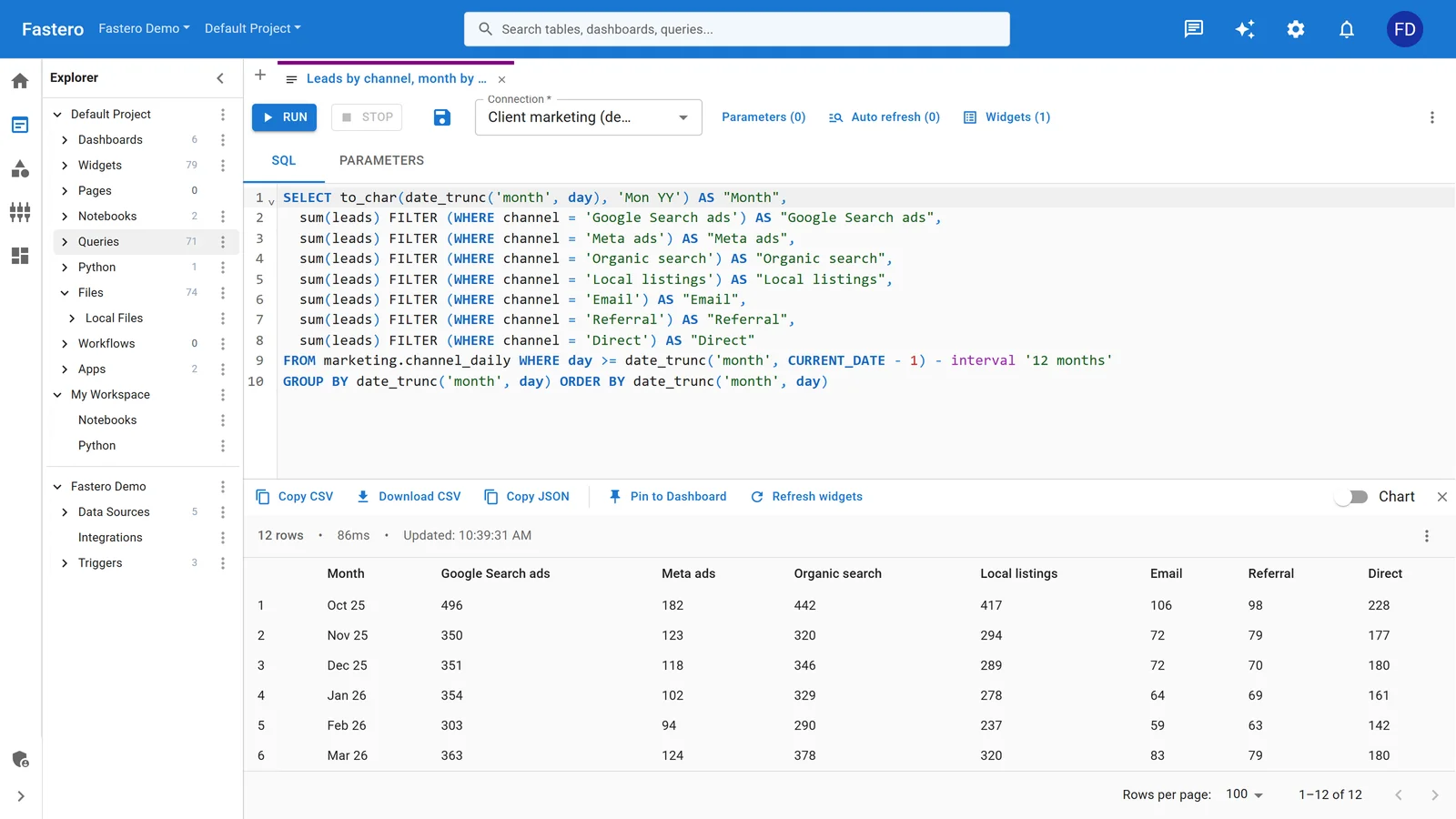
The SQL editor in Fastero. Sample data.
What about streaming? Can any of these handle real-time data?
Spark Structured Streaming processes real-time data natively -- it's part of the Spark engine. Trino and PrestoDB have Kafka connectors that let you query topics as tables, but they're not streaming engines. They run point-in-time queries against the latest state. For true stream processing, you'd pair Trino with Kafka and a stream processor (Flink, Kafka Streams), or use Spark's built-in streaming.
Try Fastero free — federated SQL across your databases without deploying Trino. Connect PostgreSQL, MySQL, MongoDB, or your warehouse. Ask in English, get dashboards. No credit card required.
Last updated: August 2026.