

PostHog, Amplitude, and Mixpanel all track user behavior, but they were built for different buyers with different budgets and different ideas about data ownership. This comparison covers the actual trade-offs — pricing math at real event volumes, feature gaps that matter, and a decision tree — so you can pick the right tool without a six-week evaluation.
Feature Comparison Table
| Feature | PostHog | Amplitude | Mixpanel |
|---|---|---|---|
| Pricing model | Per-event, usage-based | MTU-based + platform tiers | Event-based + MTU tiers |
| Free tier | 1M events/mo | 50K MTU | 20M events/mo |
| Free seats | Unlimited | Unlimited (Starter) | Unlimited |
| Self-hosting | Yes (Kubernetes) | No | No |
| Open source | Yes (MIT core) | No | No |
| Funnels & retention | Good | Excellent | Excellent |
| Session replay | Built-in (5K free/mo) | No | No |
| Feature flags | Built-in | Separate product | No |
| A/B testing | Built-in | Separate product | No |
| Surveys | Built-in | No | No |
| CDP / audience sync | Webhooks + exports | Built-in CDP | No |
| Behavioral cohorts | Basic | Advanced (behavioral graph) | Good |
| Predictive analytics | No | Yes (churn, anomaly) | No |
| B2B account analytics | Supported | Add-on | Most mature |
| SQL access | HogQL (full) | Limited | Limited |
| Data warehouse queries | Built-in (Stripe, HubSpot, Postgres) | Snowflake/BigQuery export | BigQuery-backed engine |
| Best for | Engineering-led teams | PMs + analysts | B2B product teams |
| Parent company | Independent (VC-backed) | Public (AMPL) | ServiceNow (acquired 2024) |
Who Owns Your Data?
These three tools make fundamentally different bets about where your data lives.
PostHog is open-source (MIT-licensed core). The analytics engine runs on ClickHouse — a columnar store built for fast aggregation over billions of rows. You can self-host the full stack on Kubernetes: ClickHouse, Kafka, PostgreSQL, Redis, and the app servers. Events never leave your network. For healthcare, fintech, or any company with strict GDPR requirements, that is a compliance requirement, not a preference. PostHog Cloud exists too, and most startups use it — running a production ClickHouse cluster is real operational work.
Amplitude is closed-source and cloud-only. No self-hosting option. Events go to Amplitude's infrastructure. They offer a warehouse-native mode for querying your own Snowflake or BigQuery, but the application layer still runs in their cloud. Amplitude is a public company (AMPL) with deep enterprise roots — SSO, audit logs, RBAC, SOC 2.
Mixpanel is also closed-source and cloud-only. Their query engine now runs on Google BigQuery, which made it faster and cheaper. Mixpanel was acquired by ServiceNow in late 2024 — you are betting on ServiceNow's continued investment in a product that overlaps with their own analytics capabilities.
Fastero
Connect your database. Ask questions. Get dashboards.
Postgres, BigQuery, Snowflake, and 10+ sources — live-connected, AI-powered, no dashboard builder learning curve.
Try free →Which Tool Has Better Event Tracking?
All three follow the same model: instrument your app to fire named events with properties, and the platform ingests, stores, and queries them. The SDKs are similar enough that switching is a weekend of find-and-replace.
Here is a checkout event in each:
// PostHog
posthog.capture('checkout_completed', { plan: 'pro', amount: 49.99 });

// Amplitude
amplitude.track('Checkout Completed', { plan: 'pro', amount: 49.99 });

// Mixpanel
mixpanel.track('Checkout Completed', { plan: 'pro', amount: 49.99 });
All three support JavaScript, React Native, iOS, Android, Python, and Flutter. SDK coverage is not a differentiator for web and mobile apps.
The differences show up after ingestion. PostHog stores everything in ClickHouse and exposes it via HogQL (their SQL dialect) for raw queries. Amplitude routes events through its behavioral graph — an internal data structure that pre-computes relationships between user actions, powering its advanced cohort and prediction features. Mixpanel sends events to its BigQuery-backed engine, optimized for fast segmentation and funnel queries.
Where Does Each Tool Excel?
Funnels: Mixpanel handles the most edge cases — ordered and unordered steps, per-step conversion windows, exclusion events (users who did A then B but NOT C between them). Amplitude's funnels are similarly powerful, with the added benefit of behavioral cohorts. PostHog's funnels are functional and improving but less refined at the edges.
Retention: All three offer N-day, unbounded, and custom retention. Amplitude's lifecycle analysis categorizes users into new, current, resurrected, and dormant segments automatically — giving you a clearer picture of whether growth comes from new users or briefly returning ones.
Behavioral cohorts and predictions: Amplitude leads here. The behavioral graph powers queries like "users who did X at least 3 times in 7 days but never did Y" — with drag-and-drop for PMs, no SQL needed. Amplitude also ships predictive analytics: churn likelihood, conversion probability, anomaly detection. PostHog and Mixpanel do not offer prediction out of the box.
B2B account analytics: Mixpanel's Group Analytics is the most mature. Define entities — companies, workspaces, teams — and every report type works at the group level. "How many accounts activated" instead of "how many users clicked." PostHog supports groups; Amplitude handles it through an Accounts add-on.
Session replay: Only PostHog has it built in. The killer workflow: go from a funnel drop-off directly into recordings of the users who dropped off — two clicks from "40% bail at step 3" to watching exactly what went wrong.
How Does Pricing Compare?
Pricing as of August 2026, at two realistic volumes:
At 5M events/month (typical Series A startup):
- PostHog Cloud: 1M free, 4M at ~$0.00031/event = ~$1,240/mo. Add session replay and feature flags: $1,500-2,000/mo total.
- Amplitude: Under 50K MTU, the free Starter plan covers you. Over that, Growth scales with MTU count — realistically $500-2,000/mo at this volume.
- Mixpanel: Free. The 20M events/mo free tier covers 5M with room to spare.
At 50M events/month (scaled product):
- PostHog Cloud: ~$10,000-13,000/mo. Per-event tiers decrease at volume, but the bill is still significant.
- Amplitude: Enterprise contract territory. $40K-80K/year depending on MTU count and licensed products.
- Mixpanel: 30M over free tier. Growth pricing: ~$2,000-5,000/mo.
The hidden cost equation: if you use PostHog for analytics + session replay + feature flags + experiments, you replace four vendor contracts. A stack of Mixpanel ($0) + FullStory ($10K/yr) + LaunchDarkly ($10K/yr) + Statsig ($8K/yr) costs more than PostHog's all-in-one bill, and separate tools never integrate as well as a single database.
Should You Go All-in-One or Best-of-Breed?
PostHog took the all-in-one bet further with a built-in data warehouse — query Stripe, HubSpot, and Postgres data alongside product events. Amplitude is building a platform too (Analytics + Experiment + CDP), but each product is priced separately. Mixpanel stays focused: event analytics, done well, nothing more.
The trade-off is real. PostHog's session replay is not as refined as FullStory. Its feature flags are not as battle-tested as LaunchDarkly at Fortune 500 scale. Its analytics is not as polished as Mixpanel's for pure funnel work. But the integration — watching a recording for a user in a specific experiment variant who dropped off at a specific funnel step — is better than anything you build by wiring four vendors together.
How Should You Choose?
Follow this decision tree:
START
 |
 +-- Do you need to self-host for compliance?
 |    YES --> PostHog (only option)
 |    NO  --+
 |          |
 |          +-- Is your team mostly engineers?
 |          |    YES --> PostHog (HogQL, open source, flags + replay built in)
 |          |    NO  --+
 |          |          |
 |          |          +-- Do you sell B2B and need account-level analytics?
 |          |          |    YES --> Mixpanel (Group Analytics is most mature)
 |          |          |    NO  --+
 |          |          |          |
 |          |          |          +-- Do you need predictive analytics or a CDP?
 |          |          |          |    YES --> Amplitude (behavioral graph + CDP)
 |          |          |          |    NO  --+
 |          |          |          |          |
 |          |          |          |          +-- Budget-constrained?
 |          |          |          |               YES --> Mixpanel (20M free events)
 |          |          |          |               NO  --> PostHog (most value per dollar)
Frequently Asked Questions
Is PostHog really free?
PostHog's free tier includes 1M events/month, 5K session recordings, 1M feature flag requests, and 250 survey responses. Unlimited seats. Beyond those limits, usage-based pricing kicks in — there is no jump to an opaque enterprise tier.
Can Mixpanel replace PostHog if I also need session replay?
No. Mixpanel does not offer session replay or feature flags. You would need FullStory or LogRocket alongside it. If you need analytics plus replay, PostHog is the only single-vendor option.
Does Amplitude's free plan have a catch?
Amplitude's Starter plan covers up to 50K monthly tracked users with unlimited events. The catch is not volume — it is feature gating. Behavioral cohorts, predictive analytics, and the CDP require paid plans that start at meaningful price points.
What happens to Mixpanel now that ServiceNow owns it?
ServiceNow acquired Mixpanel in late 2024. The product continues to receive updates, but you are now dependent on ServiceNow's strategic priorities. If your evaluation timeline is 3+ years, factor in the risk that investment could shift toward ServiceNow's own analytics stack.
Which tool is best for a startup with under 10K users?
Mixpanel. The 20M free events/month will last well past 10K users. The UI is fast and intuitive with no configuration overhead. If you later need session replay or feature flags, evaluate PostHog then — switching SDKs is straightforward.
Can I use PostHog, Amplitude, or Mixpanel to track revenue?
All three can track revenue-related events (purchase completed, subscription started), but none of them are built to join product behavior with billing data from Stripe, CRM pipeline from HubSpot, or ad spend from your acquisition channels. That requires connecting data across systems — a different category of tool.
The Gap All Three Share
PostHog, Amplitude, and Mixpanel tell you what users do inside your product. None of them connect that behavior to what happens outside it — revenue in Stripe, pipeline in your CRM, the ad spend that drove the signup. You can see that 500 users completed onboarding, but how many became paying customers? Did the cohort from your latest campaign retain better than organic?
Those questions require joining product events with billing and acquisition data across systems.
That is the gap Fastero fills. It connects to the places those numbers live (your product database, a warehouse such as BigQuery or Snowflake, Stripe) and puts them on one dashboard, so activation and retention sit next to revenue instead of in three different tools.
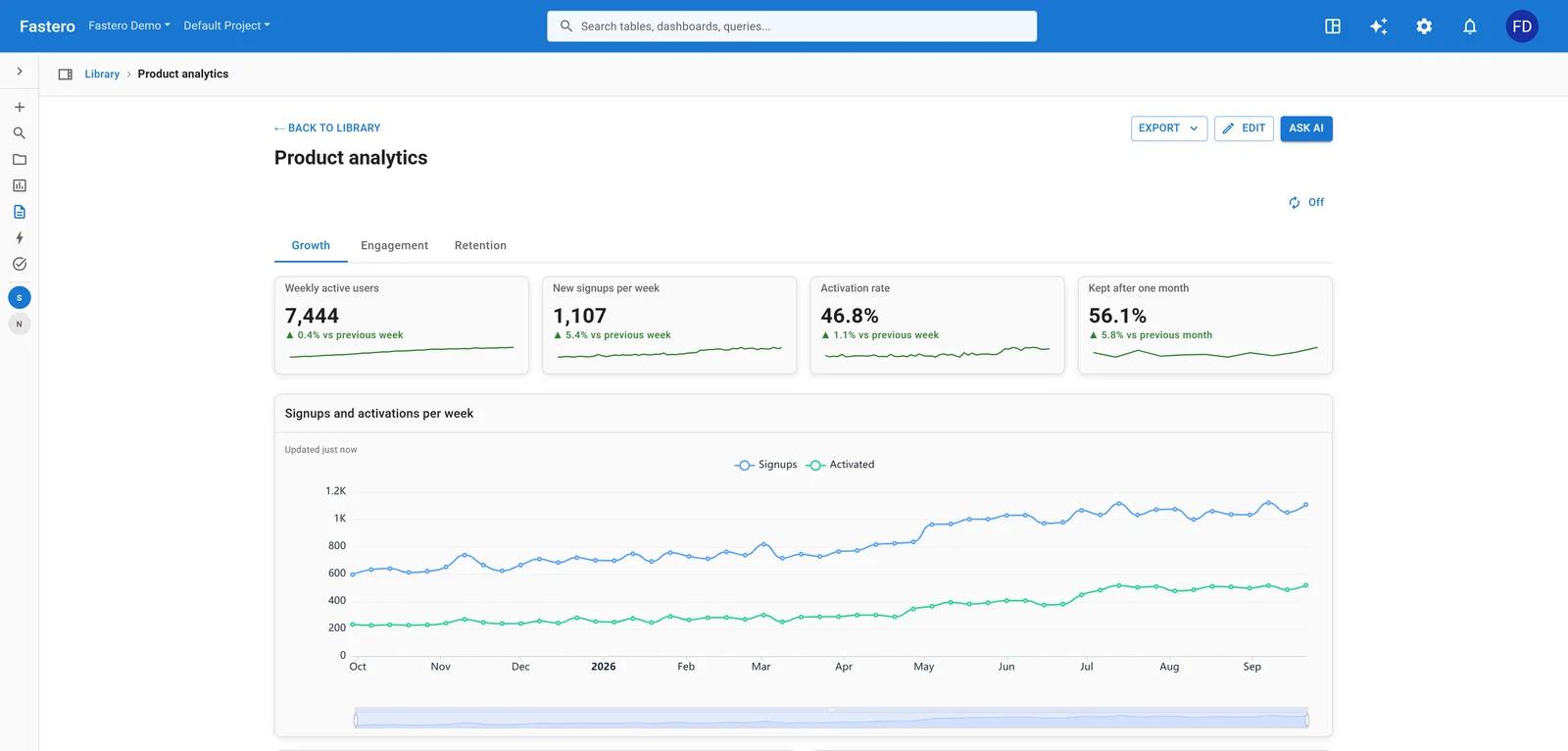
A product analytics dashboard in Fastero. Sample data.
Try Fastero free — connect your product database and ask questions in plain English — no event taxonomy required. No credit card required.
Related reading:
- PostHog vs Mixpanel: Head-to-Head Comparison
- PostHog vs Amplitude: Open-Source Analytics Compared
- Mixpanel vs Amplitude: Which Fits Your Product Team?
- Heap vs Mixpanel: Auto-Capture vs Event-Based Analytics
Last updated: August 2026.