 Fastero Dev Team
"Hex Magic", the AI that Hex launched in 2023, no longer goes by that name. Hex's AI is now one assistant, the Hex agent, which works in notebooks for analysts, in a chat called Threads for business users, in published apps, in Slack, and from Claude, ChatGPT, Cursor and Codex. And since July 2026 it is metered in credits.
The short answer: in a notebook, the Hex agent writes and fixes SQL and Python, builds charts and lays out apps, with every change waiting for your approval. Threads answers questions in plain English, from the data team's semantic models and approved tables. The agent comes with every paid plan — Professional at $36 and Team at $75 per editor a month — and each editor gets 30 or 40 credits a month, about one credit for a simple question, with more at $25 for 50. It suits data teams whose data already sits in a warehouse and is well documented. The closest alternatives are Deepnote, Databricks' Genie Code, Colab's agent, Snowflake's Cortex Code, Jupyter AI, marimo and Fastero.
Fastero
Jupyter notebooks for your team, with nothing to install.
Start a notebook or bring your .ipynb files. SQL cells query your databases with no password in the code, and a notebook runs now or on a schedule. Colleagues open it with their own login; viewers are free.
Try free →Hex AI at a glance
| Part | What it does | Who it's for | Plans |
|---|---|---|---|
| Hex agent in notebooks (formerly Magic) | Writes, edits and fixes SQL and Python cells, charts and apps; you approve each change | Analysts who can read the code | All paid plans; a 5-credit trial on Community |
| Threads | Answers plain-English questions from semantic models and endorsed tables | Business users | "Available on all plans"; the Explorer role is Team and Enterprise only |
| Chat with apps | Summarizes a published app and changes its filters and inputs | People who use the apps | Explorer role, Team and Enterprise |
| Generative apps | Builds a dashboard or data story from one prompt | Editors | Beta, all plans |
| Slack and MCP | @Hex in Slack; Hex inside Claude, ChatGPT, Cursor and Codex | Explorers and editors | Team and Enterprise |
| Semantic models and the Modeling Agent | Shared metrics and joins that the agent prefers | Admins and managers | Team and Enterprise |
What happened to Hex Magic
- 2023: Magic opened as a public beta in May, for "generating, editing, debugging, and documenting SQL and Python", running on GPT-4 for most tasks.
- 2025: the Notebook Agent arrived in August, on Claude Sonnet 4; Threads opened as a beta in October; and later that month the "Hex Agent" reached Slack and MCP.
- 2026: by September the pricing page called it the Hex agent, and Hex's docs now say its "AI features were formerly referred to as Hex Magic in product".
If you are searching for Hex Magic, the Hex agent is what you will find in the product.
In a notebook: what the Hex agent does
Inside a Hex project, the agent generates and edits cells — Python, SQL, Markdown, pivots, charts, inputs and single numbers — moves and deletes them while keeping their dependencies straight, and lays out and publishes the app on top. "Fix with agent" works through multi-step errors, and "Quick fix" repairs one cell. It can search the web, answer questions about Hex itself, take uploaded files, use other projects as context, and split a job across subagents. Typeahead completes code as you type.
Every change waits for your approval unless you turn on "Skip approvals", added in September 2026; anything that would widen access still stops and asks. Chats are kept for 30 days. Hex describes the agent as being for "technical users who can audit the SQL and code that the agent suggests", and it works in the notebook, not in published apps.
Threads: Hex's AI for business users
Threads is a chat for people outside the data team. It answers questions from the warehouse, and it "heavily prioritizes semantic models and endorsed data sources" — the metrics and tables the data team has defined and approved. For business users, it uses only endorsed data by default. It accepts CSV files and images, can query several connections, and since March 2026 it can write Python. Each Thread is backed by an unlisted Hex project that an editor can save and build on.
Threads works from Hex's home page, in Slack, through MCP clients and the command line, in ChatGPT since December 2025, and in Codex since June 2026. Only the person who started a Thread can continue it, and anyone it is shared with needs access to every connection it used. Hex's docs say Threads is "available on all plans", but the Explorer role for business users exists only on Team and Enterprise, so on Professional only editors can use it.
What Hex AI costs
| Plan | Price | Monthly credits |
|---|---|---|
| Community | Free | 5 per editor, as a trial |
| Professional | $36 per editor a month | 30 per editor |
| Team | $75 per editor a month | 40 per editor; 10 per Explorer seat |
| Enterprise | Custom | Set in the contract; bring-your-own model keys |
A credit is roughly one simple question. Hex's examples: "How many customers do we have?" is about 1 credit, a retention chart about 2, a 12-month ARR forecast about 5, and a data app with forecast inputs about 10. Monthly grants are per person and don't roll over. Extra credits come in workspace-wide packs of 50 for $25, about 50 cents each, and admins can set spending limits. When credits run out, new prompts are blocked; a run already going finishes. The agent's queries also run on your own warehouse, which bills you for them.
This is a change of course. In January 2024, Hex wrote that it was "not going to require an 'AI add-on'" and that paid plans could use as much Magic as they wanted. The credit model replaced that in July 2026, with a grace period for existing customers. Prices for Explorer and viewer seats aren't published.
Which models, and what happens to your data
Hex runs Anthropic models, including Claude Opus 5.5 and Fable 5.1; OpenAI models, including the GPT-6 family; and Kimi, an open model it hosts itself. Left on "Auto", the agent uses a single model that Hex picks for speed, cost and quality; users can choose a model for each thread, and admins set the workspace default. Enterprise customers can bring their own keys for OpenAI, Anthropic, AWS Bedrock or Google.
- Training: "Hex's LLM providers do not train on customer data."
- Retention: zero by default, except for models whose provider keeps data for safety review — Anthropic keeps Fable prompts and outputs for 30 days — which run only if an admin allows it.
- What is sent: project code, cell outputs, schemas, table and column names, prompts and responses. When Magic launched in 2023, Hex said it didn't send underlying customer data to the models.
- Hex's own use: on the self-serve plans, Hex's terms let it use AI inputs and outputs to improve its services unless you opt out in settings.
- Admin controls: turn all AI off, opt out of that use, turn off typeahead and web search, enforce endorsed data, and set credit limits.
The limits Hex states itself
Hex is direct about how to use its agent:
- Check the work. "Do not blindly trust outputs; always read the SQL or Python before relying on it!"
- Context decides quality. A lack of context "can lead to incorrect assumptions", and Hex calls curating the data "the #1 lever". Its best tools for that, semantic models and Context Studio, are on Team and Enterprise only.
- Long chats degrade. "As threads get longer, it can cause quality of responses to degrade"; the agent summarizes itself at about 70% of its context window.
- It works from samples. Hex caps how much of a notebook and its results the agent sees, and truncates large tables.
- Hiding data from the AI isn't access control. Hex points you to warehouse permissions for that.
Jupyter notebooks for your team.
Start free →Alternatives with comparable AI
| Tool | Its AI | Worth knowing |
|---|---|---|
| Deepnote | Deepnote Agent, plus generate, edit and explain | Team plan $39 per editor a month (yearly) with $39 of AI credits; the notebook went open source in 2025 |
| Databricks | Genie Code, renamed from Databricks Assistant in March 2026 | Agent mode in notebooks and the SQL editor; Genie One and Genie Agents for business users |
| Google Colab | The Data Science Agent, on Gemini | Built into Colab; a Colab MCP server since March 2026 |
| Snowflake | Cortex Code, in Workspaces and Snowflake Notebooks | Snowflake Intelligence is now Snowflake CoWork |
| Jupyter AI 3 | Claude, Codex, Gemini and other agents inside JupyterLab | Free and open source; you pay your model provider |
| marimo | AI chat, agent mode and completions in a reactive notebook | Open source, bring your own keys; acquired by CoreWeave in 2025 |
| Mode | Now part of ThoughtSpot's Analyst Studio | ThoughtSpot's agent is Spotter |
| Fastero | An AI agent in the workspace, plus Claude through an MCP connector | Free plan with $20 of AI; Pro $20 per editor a month |
Fastero is where people and AI agents work on a team's data together. Its AI agent analyzes connected databases and uploaded files and builds dashboards and Streamlit apps, and the workspace holds Jupyter notebooks whose SQL cells query the same connections, with passwords kept in the workspace's Secrets. If your team already works in Claude Code or claude.ai, Fastero's connector lets Claude run SQL on the workspace's databases, create, write, run and schedule notebooks, and build a dashboard colleagues open with their own login. Shared definitions record the SQL behind each metric once, so Fastero's AI and Claude answer "revenue" the same way. The Free plan includes $20 of AI to start; Pro is $20 per editor a month, and viewers are free.
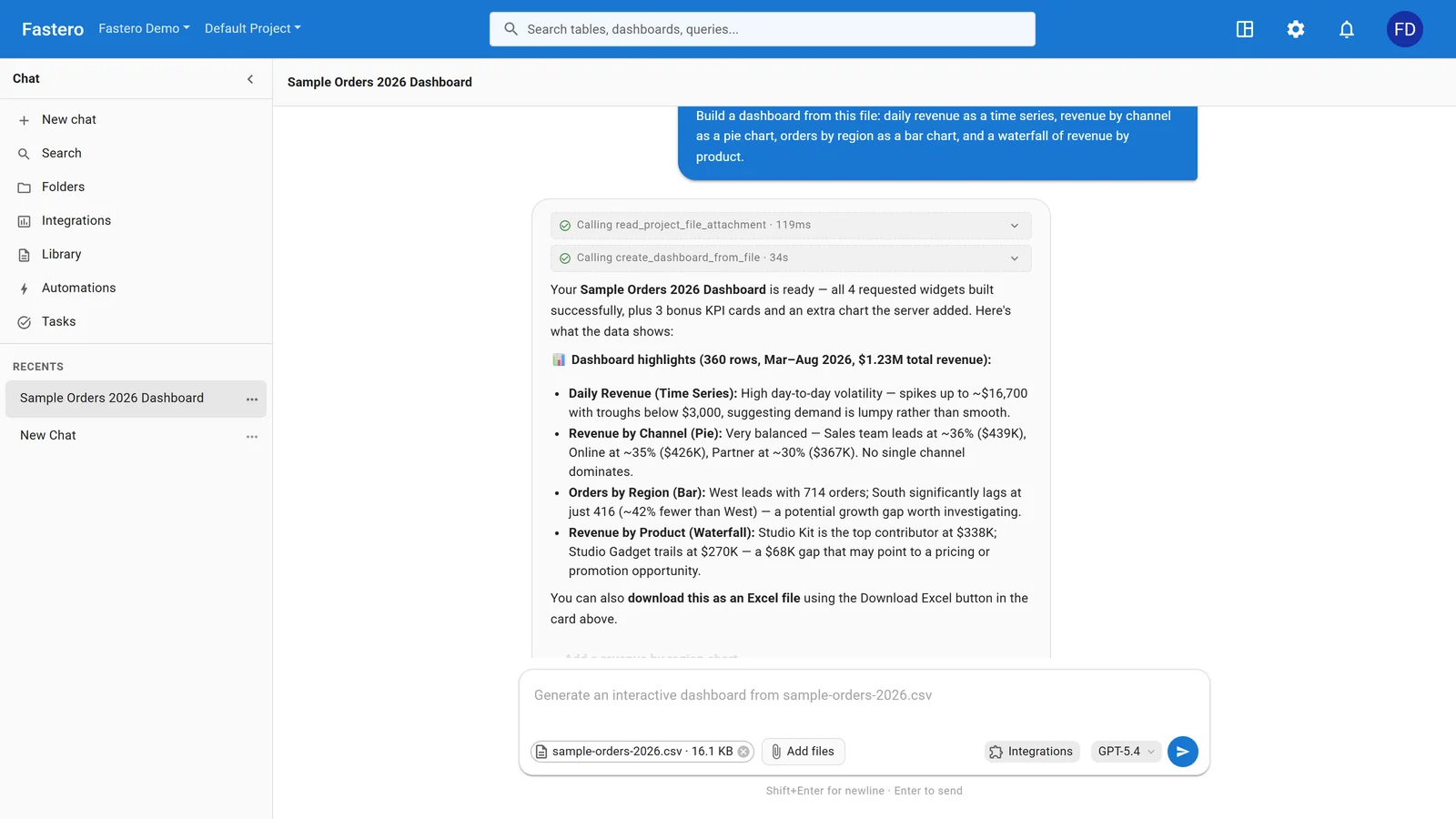
Asking for a dashboard in Fastero. Sample data.
FAQ
What is Hex Magic?
Hex Magic was the name of Hex's AI features from 2023 to 2025: generating, editing, fixing and explaining SQL and Python in Hex notebooks. Hex now calls them the Hex agent, which also powers Threads, chat with apps, and Hex in Slack.
Is Hex AI free?
Not beyond a trial. Hex's free Community plan includes 5 agent credits a month as a trial. The paid plans include 30 (Professional, $36 per editor a month) or 40 (Team, $75) credits per editor a month, and extra credits cost $25 for 50.
What is Hex Threads?
Threads is Hex's chat for business users: ask a question in plain English and the Hex agent answers from the data team's semantic models and endorsed tables, with charts. It works in Hex, in Slack, in ChatGPT and through MCP clients.
Which AI model does Hex use?
Hex runs Anthropic and OpenAI models, including Claude Opus 5.5 and the GPT-6 family, plus Kimi, which it hosts itself. "Auto" uses one model Hex chooses; users can pick another, and Enterprise customers can bring their own keys.
Does Hex train AI on my data?
Hex says its model providers don't train on customer data and keep nothing by default, apart from models that need retention, such as Fable, which an admin must allow. On self-serve plans, Hex's terms let Hex itself use AI inputs and outputs to improve its services unless you opt out.
Related reading:
- Best Hex alternatives
- Hex pricing: is it worth it?
- AI tools for data scientists
- Deepnote vs Hex vs Jupyter
Sources: Hex pricing, Hex credits, Credits and usage visibility, Hex AI overview, Notebook agent, Threads, Hex agent in Slack, Hex MCP server, Generative apps, Roles, Semantic models, Setting up for AI agents, Notebook agent best practices, Model picker, AI data privacy, Data privacy FAQ, Hex terms of service, Hex changelog, Magic public beta, Why Hex doesn't require an AI add-on, Introducing the Notebook Agent, Fall 2025 launch, Why analytics agents break differently, Deepnote pricing, Genie Code, Databricks AI/BI release notes, Colab's Data Science Agent, Colab MCP server, Snowflake Cortex Code, Snowflake CoWork, Jupyter AI releases, marimo AI, CoreWeave and marimo, ThoughtSpot Analyst Studio. Checked 22 October 2026.
Try Fastero free — put AI agents to work on your team's data, in the app or from Claude, with dashboards and notebooks your colleagues open with their own login. No credit card required.