

"AI forecasting software" is one of the muddiest categories in finance tooling, because "AI" is bolted onto everything from a $50/mo analyst to a six-figure enterprise planning suite. Before you compare logos, it helps to know what AI is actually doing under the hood — and which version you need.
What "AI for forecasting" actually means
There are three genuinely different things vendors call AI forecasting:
- Statistical projection — the AI fits a model (run-rate, regression, time-series) to your history and extends it forward. Useful, unglamorous, been around for years.
- Natural-language analysis — you ask questions in plain English ("why is Q3 tracking below plan?") and the tool writes the query, runs it, and explains the answer.
- Agentic workflows — the AI reasons, builds or adjusts the model, runs scenarios, and takes a next step (refresh, flag, summarize) with minimal input.
Most modern tools blend these. The ones worth paying for do all three well and keep the forecast current instead of leaving you to re-run it.
Three categories of buyer
The single biggest predictor of the right tool is your company stage, not the feature list:
- Full FP&A platforms — for finance teams that want one governed system for budgeting, consolidation, headcount, and scenarios. You adopt them as home base.
- Spreadsheet-native tools — for teams that refuse to leave Excel/Sheets but want structure and AI on top.
- AI analysts — for founders and lean teams who want the forecast built, refreshed, and monitored on top of the data they already have, without adopting a platform.
Fastero
Connect your database. Ask questions. Get dashboards.
Postgres, BigQuery, Snowflake, and 10+ sources — live-connected, AI-powered, no dashboard builder learning curve.
Try free →Quick comparison
| Tool | Category | AI strength | Starting point |
|---|---|---|---|
| Pigment | FP&A platform | Agentic modeling built on Claude | Sales-led (platform pricing) |
| Anaplan | FP&A platform | AI on top of enterprise planning | Enterprise, sales-led |
| Workday Adaptive | FP&A platform | AI-assisted planning at scale | Enterprise, sales-led |
| Abacum | Mid-market FP&A | Variance flagging, NL reports | Sales-led, faster deploy |
| Cube | Spreadsheet-native | AI over Excel/Sheets sync | Sales-led |
| Drivetrain | FP&A platform | Driver-based modeling + AI | Sales-led |
| Fastero | AI analyst | Agent builds + monitors forecast on your data | Free–self-serve |
Tool-by-tool
Pigment — best agentic FP&A platform
The standout AI-native platform of 2026: Modeler, Analyst, and Planner agents (built on Anthropic's Claude), fast implementation relative to legacy suites, and customers like Figma and Gong. If you're buying a platform and want the strongest agentic modeling, start here.
Watch out for: platform pricing and commitment. It's the right answer for a finance team, the wrong one for a solo founder.
Anaplan — best for large, complex enterprises
The heavyweight for connected planning across finance, sales, and supply chain. AI features sit on top of a very powerful (and very involved) modeling engine.
Watch out for: implementation time and cost. This is a multi-quarter, consultant-assisted rollout. Enormous power, enormous overhead.
Workday Adaptive Planning — best for existing Workday shops
Mature, scalable planning with AI-assisted forecasting, and a natural pick if you're already in the Workday ecosystem.
Watch out for: it shines inside Workday and feels heavy outside it. Enterprise pricing and process.
Abacum — best mid-market FP&A
Repeatedly near the top of 2026 rankings. Native Excel and Google Sheets integration, AI-powered variance flagging, NL report generation, anomaly detection. Teams report roughly halved budget cycles and far less manual data entry.
Watch out for: still a full platform aimed at a finance function, not a lightweight add-on.
Cube — best spreadsheet-native platform
"Hit your numbers without sacrificing your spreadsheets." Deep bidirectional Excel/Sheets sync with governance underneath. Great when the team lives in spreadsheets but needs structure and consolidation.
Watch out for: you're still adopting an FP&A platform. If you want an agent to maintain the forecast rather than a system to build it in, see Cube alternatives.
Drivetrain — best driver-based modeling
Popular with SaaS finance teams that want the model wired to operational drivers — pipeline, hiring, usage — with AI assistance layered on.
Watch out for: platform-scale adoption and pricing; built for finance teams.
Fastero — best AI analyst for founders and lean teams
Fastero doesn't ask you to adopt a planning platform. It reads the spreadsheet you already forecast in, connects live sources like Stripe and your warehouse, and its agent builds the projection, explains the drivers in plain English, and alerts you when actuals drift from plan — then lets non-finance operators just ask it questions.
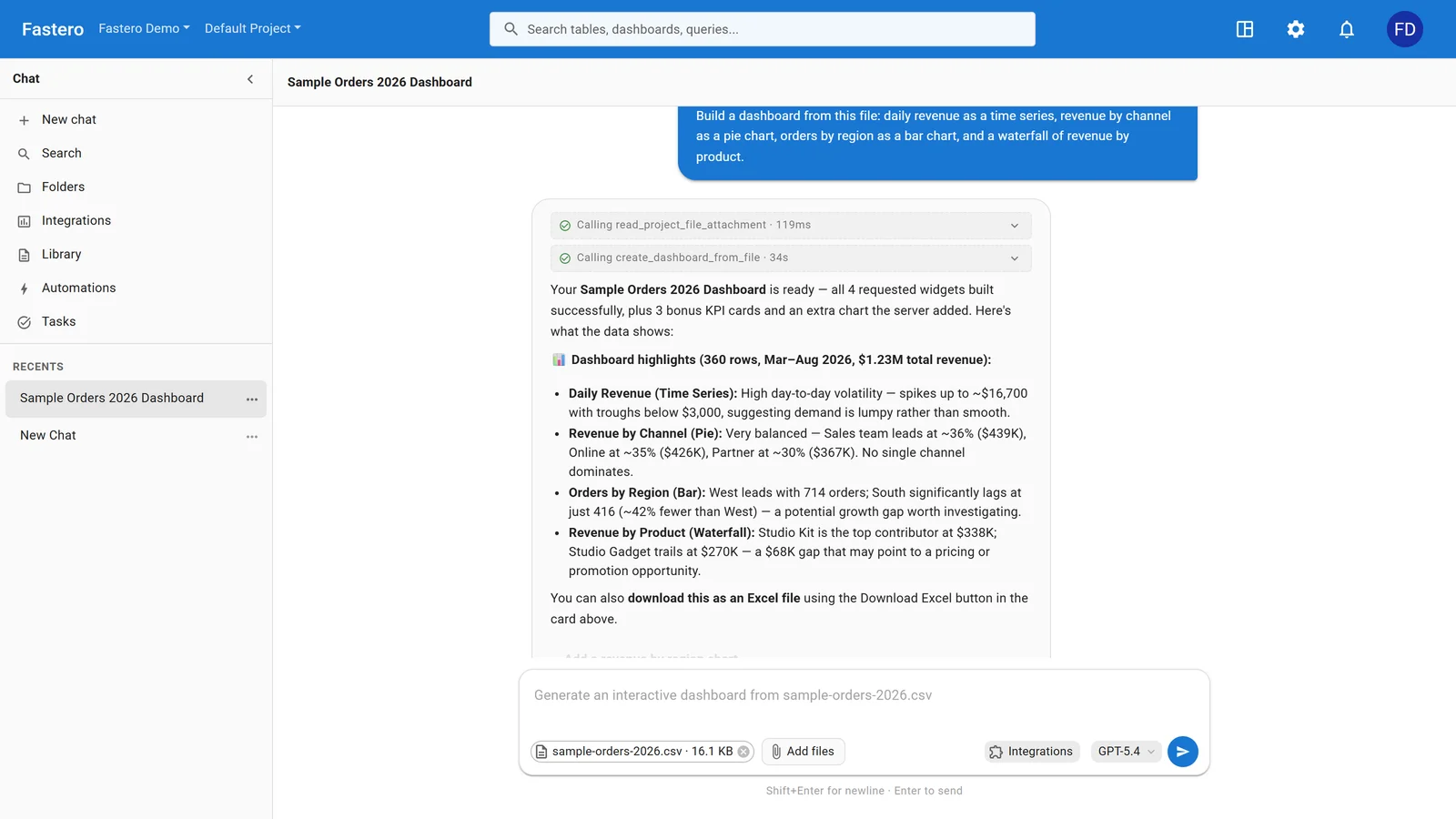
Fastero's AI analyst reading a file and building the dashboard, with a summary of what it found. Sample data.
Strengths: no migration, start from your own model and data, forecast stays current on its own, drift alerts, and a free tier to try it.
How it's different: Fastero is an AI analyst, not a planning platform — you don't adopt it as home base, you add it on top of what you already have. For your first forecast, we build it with you.
Best for: founders, operators, and lean finance teams who want an AI analyst to keep a forecast alive on top of what they already have.
A decision framework
Scenario 1: "We're a 200+ person company with a finance team and we need one planning system." → Pigment (modern, agentic), Anaplan or Workday Adaptive (enterprise scale), or Abacum/Drivetrain (high-growth mid-market). Buy the platform.
Scenario 2: "We live in spreadsheets and won't leave, but the model is chaos." → Cube or Abacum. Spreadsheet-native structure with AI on top.
Scenario 3: "I'm a founder/operator and the forecast keeps going stale because nobody maintains it." → An AI analyst like Fastero. You don't have a modeling problem — you have a maintenance-and-monitoring problem. Connect your data, let the agent build and watch the forecast.
Scenario 4: "I just need to answer 'what's our runway?' without reopening a spreadsheet every time." → Same as 3. The value is a forecast that refreshes on live data and alerts you on drift — not another dashboard.
What I'd actually pick
For an enterprise finance org, I'd shortlist Pigment for the agentic modeling and one legacy suite (Anaplan or Workday) if scale and consolidation demanded it.
For a startup or lean team — which is most people reading this — I would not buy an FP&A platform in 2026. I'd connect my spreadsheet and Stripe to an AI analyst, have it build the forecast, and turn on drift alerts. The forecast stays current, the runway question has a live answer, and I never rebuild the model by hand again.
Pick the category that matches your stage first. Then, and only then, compare the logos. For the agent-specific view of this field, see best agentic forecasting tools in 2026; for a hands-on build, see how to build a cash-flow forecast with AI.
Try Fastero free — connect your data and ask questions in plain English — get answers with full SQL visibility and set up automated monitoring in minutes. No credit card required.