Alternative page
Alternatives to Hex: notebooks your team keeps, with the dashboards and apps built in.
Hex is compelling when analysts work together in one notebook. Teams look elsewhere when the notebook has to feed dashboards and Streamlit apps the rest of the company opens, when Claude does part of the work, or when paying per editor stops making sense.
Fastero
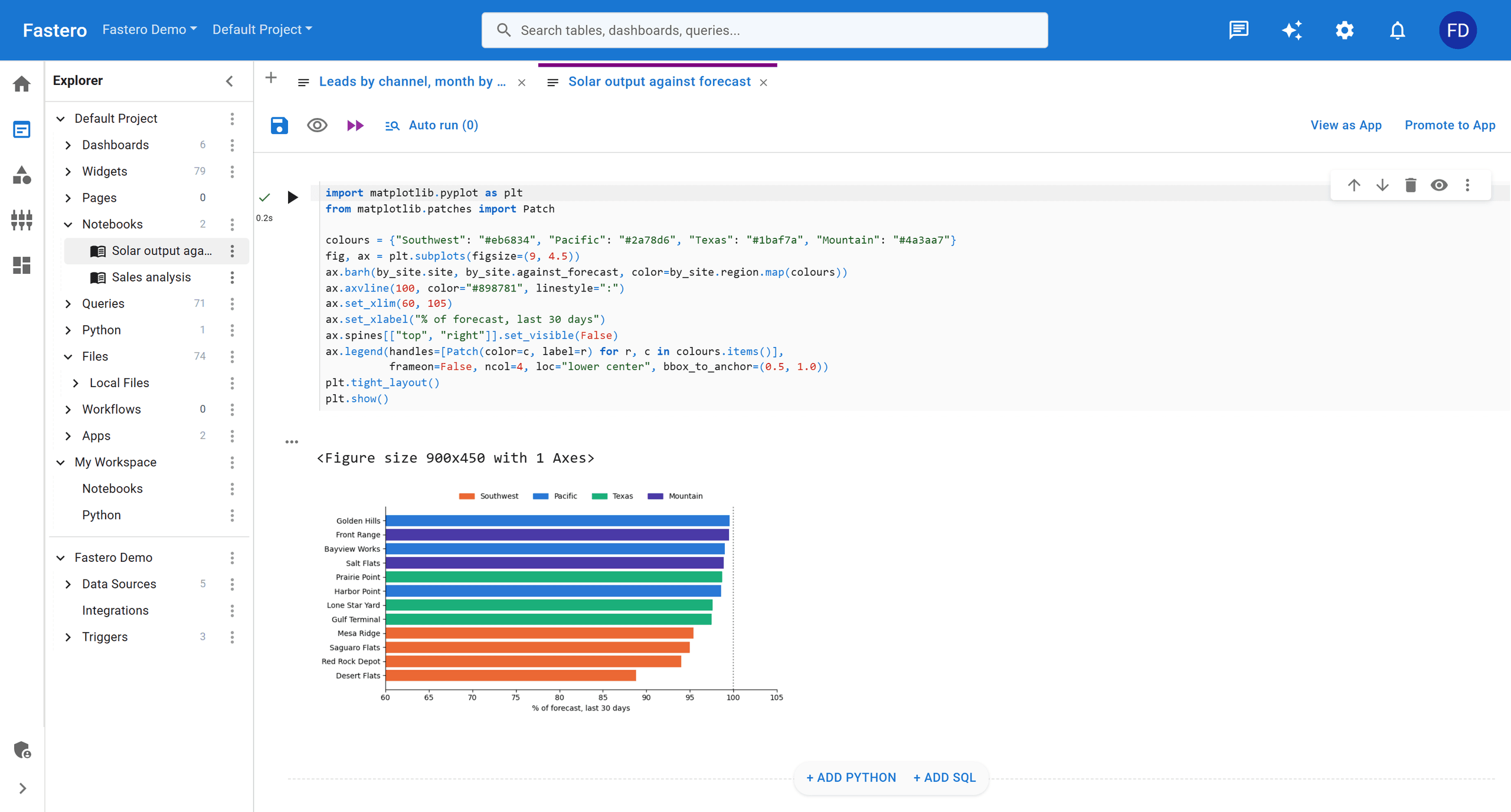
Notebooks in standard .ipynb with SQL cells, scheduled on the Free plan, with the dashboards and Streamlit apps they feed behind the same login.
Hex
Strong when several analysts work in the same notebook and publish the result as a Hex app.
What to evaluate
The right Hex alternative depends on where the work lands, who reads it and who does it.
Where the work is supposed to land
If the notebook is the deliverable, Hex fits. If it has to feed a dashboard, a Streamlit app or a scheduled report the rest of the company opens, look for a workspace that hosts all of them.
Who pays to read it
Hex charges $36–75 per editor a month. In Fastero, Pro is $20 per editor and viewers are free, so the people who only read dashboards and apps cost nothing.
Who does the work
Analysts write SQL and Python in the notebook. Colleagues ask Fastero’s AI agent in plain English, and Claude Code or claude.ai build dashboards and notebooks through Fastero’s connector.
Practical shortlist
Shortlist the options based on where your team is trying to go next.
Fastero
Best when notebooks feed dashboards and Streamlit apps your team opens, and when you work with Claude.
Streamlit
Useful when the team wants Python-first app flexibility and is comfortable owning more of the app lifecycle itself.
Deepnote
Useful when live co-editing in a managed notebook matters most; its free plan covers three editors and five projects.
Related pages
All alternatives
Browse the full list of comparison pages
Hex vs Streamlit
Notebook-first vs app-first delivery compared
Streamlit alternatives
When your Python app needs production-grade hosting
Retool alternatives
When you need more than an internal tool builder
Hosted apps
Deploy Python apps with auth, scheduling, and custom branding
Natural language to SQL
Ask questions in plain English, get SQL answers
Decision framing
Keep the notebook. Ship what it produces.
Fastero runs your notebooks as standard .ipynb on a notebook server nobody on your team has to run, with SQL cells on your connections and secrets kept out of the code. Put a notebook on a cron schedule, turn a SQL cell’s rows or a pandas DataFrame into a dashboard widget that refreshes on that schedule, or promote it to an app behind your team’s login. Colleagues sign in to read it, and viewers are free.